THE ENERGY INDUSTRY TIMES - JULY/AUGUST 2026
16
Final Word
Y
ou could be forgiven for think-
ing this was something to do
with Beyoncé and Jay-Z. In-
stead, it was part of the discussion at
this year’s Eurelectric Power Sum-
mit. A bit of ‘The Carters’ minus the
glamour, but just as interesting.
With the European Commission due
to unveil its Electrication Action
Plan on July 17th (just days after the
time of writing), the summit, held in
early June, focused on the importance
of electrication in driving decar-
bonisation and delivering energy se-
curity during these uncertain times.
Discussions were framed around
two major projects – industrial elec-
trication and articial intelligence
(AI) – launched during the event.
Opening the conference, Kristian
Ruby, Secretary General, Eurelectric,
said: “…In recent years we’ve seen
that access to electricity is literally a
matter of life and death. From the
front lines of Donbas to the smelters
of Dunkirk, from the data centres in
Dublin to the devices in our homes
and hospitals… electricity is bringing
power to life.”
With ‘Bringing Power to Life’ being
the headline theme, Ruby stressed
that the current geopolitical landscape
is putting Europe’s “way of life under
threat”, and that the bloc needs a clear
answer to foreign energy dominance.
That answer, he said, is European
electric power.
“Industrial strength is of essence in
this new world. Europe must answer
the call from its industrial base. Make
sure that it stays competitive on its
way to climate neutrality. We want
decarbonisation, not de-industriali-
sation,” he said. “As the electricity
sector, we have strong ties with our
industrial partners. But sometimes in
life, we know that even the closest of
relationships can need some new
energy.
“So, over the past year we sat down
with our industrial partners for a bit
of couple therapy… And out of these
difcult discussions… we found that
if we invest in the relation, if we in-
novate and co-create, we can turn
troubled ties around and re-emerge as
vibrant electric power couples.”
According to a new report – ‘Pow-
er Couples: Enhancing Industrial
Competitiveness Through Electri-
cation’, unveiled on the rst day of
the summit – electrication already
represents a competitive advantage
for Europe, but scaling up requires
better alignment across system levels.
The report from Eurelectric and
Accenture, which draws on more than
3500 market signals across 61 com-
panies and 30 documented projects,
identies what makes an industrial
project successful and what holds
back deployment. It concludes that
the barrier to scaling electrication
across European industry is no longer
technology – it is system execution,
the ability to turn viable projects into
investable ones quickly enough.
To identify key barriers and shape
common solutions, the European
power sector engaged with industry
players from three different segments:
low- and medium-temperature heat,
energy-intensive industries and data
centres.
The resulting report identies ve
replicable models working as ‘Power
Couples’: integrated industrial part-
nerships models that jointly optimise
demand, low-carbon supply, infra-
structure and exibility.
In a ‘Power Couples’ model, one
load anchors long-term clean power,
another shifts demand when prices
spike, a third provides fast balancing,
and all of them share infrastructure,
risk and system value. They operate
through commercial structures such
as long-term PPAs, Heat as a Service,
Energy as a service, waste-heat
offtake, exibility revenues or blend-
ed public-private nancing.
In his opening speech Ruby also
stressed the importance of AI in
speeding up the energy transition,
optimising grids, integrating clean
power sources and serving new load.
The massive increase in renewables
along with industrial electrication,
and the transition from a centralised
system to a decentralised one calls for
digitalisation and AI. Indeed, AI is
already reshaping every part of the
utilities value chain – from genera-
tion, transmission and distribution,
right through to energy trading, retail
and delivering capital projects with
lower risk.
AI represents a unique opportunity
to boost Europe’s competitiveness.
Its rapid uptake is reshaping both
electricity demand and power system
operations.
On the one hand, AI is driving sig-
nicant new demand for electricity,
with data centres expected to account
for around 28 per cent of the growth
in European electricity demand by
2030. This underlines the need to
align the expansion of AI infrastruc-
ture with the readiness of the power
system. On the other hand, AI is be-
coming a key enabler to manage the
power system’s complexity.
During the summit Miguel G. Tor-
reira, Global Utilities Strategy Lead,
Accenture, shared results of a survey
on what electricity executives think
about AI adoption. The survey found
that although the investment in AI is
real and accelerating, “uncomfortable
gaps” are starting to emerge.
Torreira noted: “Every utility in this
room is investing in AI. [But] Most
are yet to see any returns from it, and
almost none have actually asked their
employees what they think about it.”
A key nding from the survey of
C-suite executives from 3650 of the
world’s largest organisations across
20 industries including energy and
utilities, found that only 12 per cent
cite return on investment as a prima-
ry driver.
“If returns are not the main driver
for AI, what is? And how do they
make sure they are meeting that cri-
teria?” said Torreira, pointing out this
“measurement gap”. The second
concern is what he called the “deliv-
ery gap”. “Only a third of executives
report the impact of AI at scale across
enterprise, despite the investment and
boardroom commitment.”
He added: “To me it seems that AI
is the way people believe in going to
the gym. The intentions are real, but
the results sometimes are not.”
During the panel discussion follow-
ing Torreira’s presentation, Stephen
Fitzpatrick, Founder and CEO of
Kaluza, said: “I heard a joke once…
In the beginning, AI is like sex: ev-
erybody thinks everybody else is
doing it better and getting more of it.
And we are just trying our best to get
as much as possible.
“This idea that AI is the goal rather
than the tool; I think that’s where
people aren’t sure. They think, ‘the
more I do the better it will be’. But
this is clearly not the case. It’s not
some new religion; it’s the same as
every other business decision that you
make. You have to measure the results
and invest in the winners. That’s
something we have really found in
the last six months – measuring the
results of the AI that we’re using is
more and more important.”
The potential of AI for power is
huge. At the same time power demand
is being driven by data centres and
the AI workloads they host. AI data
centres have become a signicant
new customer of the electricity sector,
while the utilities powering them are
deploying the same AI models to do
real operational work. To address
these parallel issues Day 2 of the
conference saw Eurelectric announce
the launch of a new project on AI:
‘The era of electric intelligence’.
Conducted with its partner EY, the
project will explore how much
power will be needed to feed AI
(Power4AI) and how AI solutions
will augment the power sector (AI4P-
ower). The conclusions of this anal-
ysis will released in late 2026
(Power4AI) and in 2027 (AI4Power).
To seize the opportunity that AI
presents, Eurelectric is partnering
with stakeholders across both sectors
to identify practical pathways for
timely, efcient, and sustainable data
centre growth. Through the ‘Twin
Transition Commitments’ initiative,
it will assess future data centre de-
mand and exibility, evaluate how the
power system can meet this growth,
and advance secure and sustainable
solutions, including collaboration
between utilities and hyperscalers
and the use of applied AI.
But achieving data centre growth
and this digital transformation re-
quires coordinated action across
policy, markets, and industry.
“The energy and digital transitions
are fundamentally connected,” said
Georgios Stassis, Vice-President of
Eurelectric and Chairman and CEO
of PPC. “To support them, we must
accelerate grid connections and
streamline permitting processes.
Crucially, we need regulatory envi-
ronments that ensure a stable invest-
ment landscape. Doing so empowers
the electricity sector to deliver the
power infrastructure needed through
innovative business models. This will
fuel the data centre boom while
guaranteeing reliable and affordable
power for everyday consumers and
Europe’s decarbonisation goals.”
When asked what Europe needs to
move fast in order to seize the AI
opportunity, Stassis neatly rounded
off a conference session that spoke of
power couples and sex, with the an-
swer: “More love… we started with
sex and ended with love.”
Sex, love and power
couples
Junior Isles
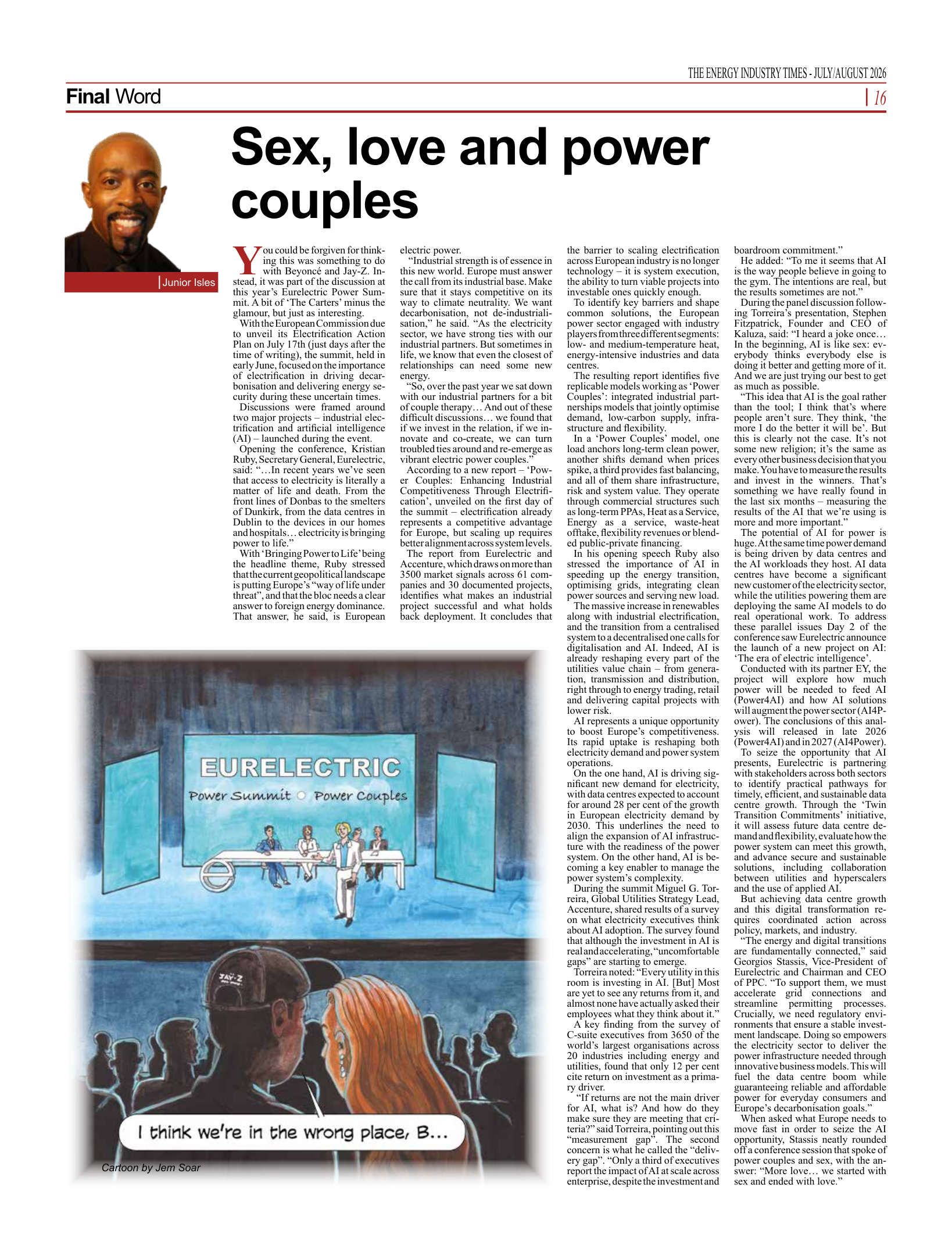
Cartoon by Jem Soar
