www.teitimes.com
July/August 2026 • Volume 19 • No 5 • Published monthly • ISSN 1757-7365
THE ENERGY INDUSTRY TIMES is published by Man in Black Media • www.mibmedia.com • Editor-in-Chief: Junior Isles • For all enquiries email: enquiries@teitimes.com
Special Supplement Corporate climate risk
Siemens Energy has brought together all of
its grid digitalisation solutions and opened
a new Grid AI Lab to help unleash the full
potential of articial intelligence. Page 11
The European summer heatwave is one of
the many signs shining a light on the scale of
losses from physical damage alone. But that
is only the visible sign. Page 14
News In Brief
ETS must drive EU
electrication, as UN calls
for increased ambition
The EU must turn its Emissions
Trading System (ETS) into Eu-
rope’s electrication engine, says
WindEurope.
Page 2
US states in court to
challenge offshore wind
cancellations
A coalition of seven states in the US
northeast states have led a lawsuit
challenging the Trump administra-
tion’s agreement with TotalEnergies
to cancel the company’s offshore
wind lease for a project off the coast
of New York.
Page 4
Strait of Hormuz crisis
reinforces need to tackle
energy vulnerabilities
Disruptions to oil and gas ows
through the Strait of Hormuz have
exposed major structural risks in
Southeast Asia’s energy sector, ac-
cording to a new International En-
ergy Agency report.
Page 5
Nuclear developer plans 14
SMR units in UK
SGE, a European Small Modular
Reactor (SMR) development and
investment platform, has an-
nounced plans to build 14 SMRs
on three sites in the UK.
Page 7
Economies ‘struggling to
adapt’ to renewables boom
The policies, nancial frameworks
and infrastructure needed to support
a renewables-based economy are
not keeping pace with the boom in
installations, according to the rst
edition of the Renewables-Based
Economy Tracker.
Page 14
Technology Review
For decades, cyber risk in the ener-
gy sector was treated as a technical
problem – something to be managed
by IT teams. Now, it’s time for en-
ergy leaders to rethink their cyber
security strategies Page 15
Advertise
advertising@teitimes.com
Subscribe
subscriptions@teitimes.com
or call +44 (0)1933 392987
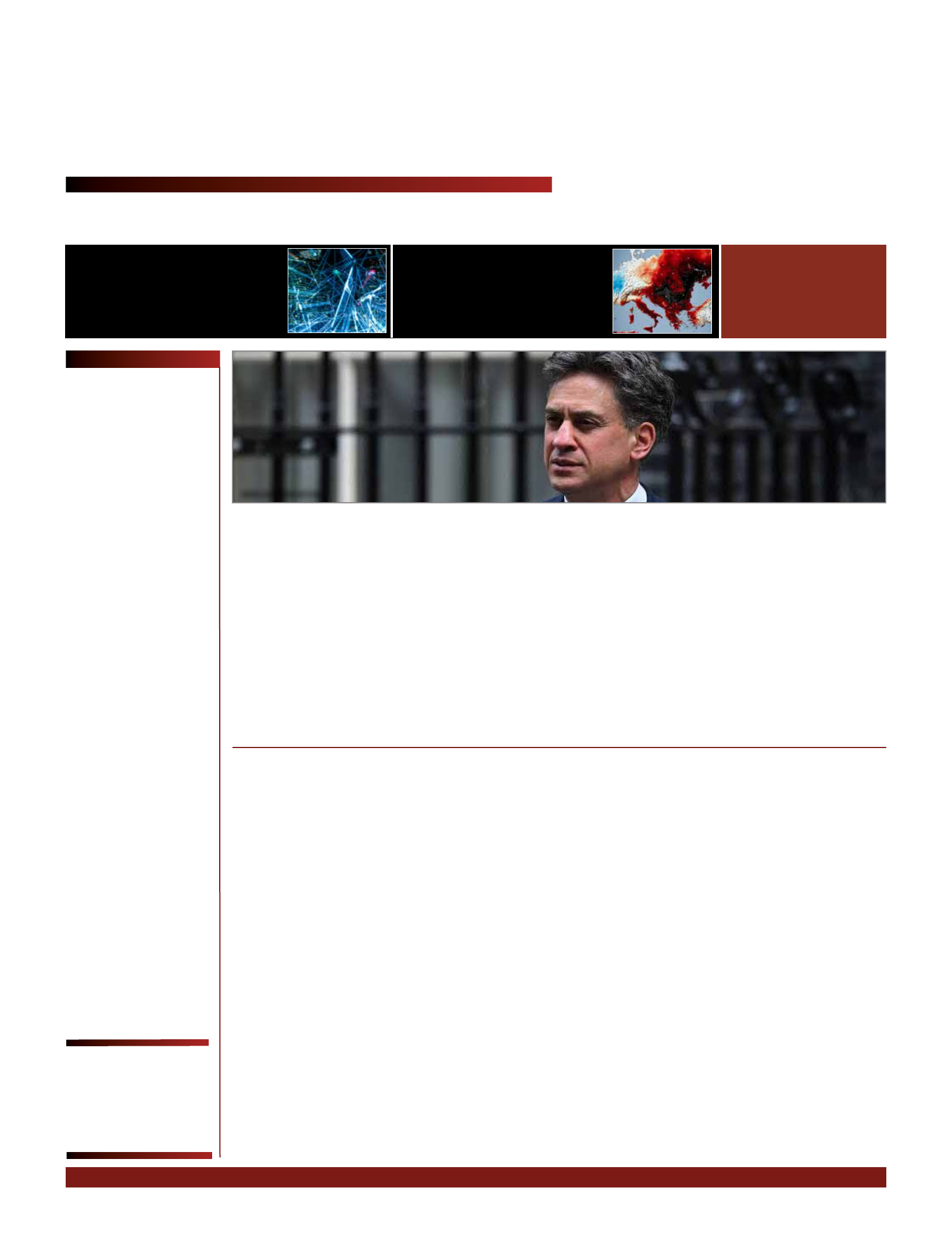
Government ministers and business leaders came together during Climate Action Week in
London, UK, in a bid to accelerate the energy transition and drive electrication, as the conict
in the Middle East continues to threaten global energy security. Junior Isles
Geopolitical risks fragments energy transition
THE ENERGY INDUSTRY
TIMES
Final Word
Time for sex, love and some
couples therapy, says
Junior Isles. Page 16
Government and business leaders
gathered in London last month to ac-
celerate the energy transition and drive
electrication, in the face of geopolit-
ical tensions that continue to threaten
energy security.
The Global Energy Transition and
Electrication Summit, held during
London Climate Action Week, saw
ministers and business leaders move
to advance practical solutions for an
accelerated energy transition away
from fossil fuel dependence.
In a sign of continued momentum on
the global shift away from coal, oil
and gas dependence, the London
summit marked a landmark moment
for international cooperation to transi-
tion away from fossil fuels, with Co-
lombia and the Netherlands formally
handing over the outcomes of the San-
ta Marta Conference on Transitioning
Awa y from Fossil Fu el s (TAFF) to the
Brazilian COP30 Presidency as input
to their global roadmap initiative.
Secretary-General of the United Na-
tions, António Guterres, said: “This
summit takes on urgent tasks, at an
urgent moment: advancing the energy
transition – at speed and scale, and
with justice; and building a new glob-
al economy for all, powered by clean,
affordable electricity.
The UK government used the June
23
rd
gathering to announce that it had
passed a signicant milestone in the
country’s effort to meet its climate
pledge.
Ed Milliband, Secretary of State for
Energy Security and Net Zero, UK,
said: “We’ve chosen today to an-
nounce we’ve passed the incredibly
signicant milestone of over £100 bil-
lion of private investment in clean
energy since our government came to
ofce less than two years ago.”
Meanwhile, a number of business
leaders demonstrated their support for
governments with the signing of the
‘Electrify Now’ initiative backing
faster electrication.
A recent survey found that 91 per
cent of global business leaders see
electrication as key to strengthening
energy security and resilience, and
that 82 per cent want their country
powered mainly by renewable elec-
tricity to help shift away from fossil
fuels.
During the recent Bonn climate talks
Türkiye’s COP31 Presidency pro-
posed, as part of its Action Agenda,
pursuing a global target of 35 per cent
Continued on Page 2
Geopolitical tensions, supply disrup-
tions and rising demand are driving
fragmentation and slowing progress
across the global energy landscape,
according to the World Economic Fo-
rum’s Energy Transition Index 2026.
The report, developed in collabora-
tion with Accenture, nds that the
global energy transition – dened as
progress toward more sustainable, eq-
uitable and secure energy systems –
has stalled despite record global in-
vestment of $3.3 trillion, including
$2.3 trillion in clean energy. The re-
search points to a growing disconnect
between capital deployment and tran-
sition readiness, which declined for
the rst time in over a decade, sug-
gesting that investment alone is no
longer enough to sustain momentum.
The disruption in the Strait of Hor-
muz has intensied existing pressures
identied in the Index, reinforcing the
degree to which energy systems re-
main exposed to geopolitical shocks,
with import-dependent emerging
economies particularly affected.
“The energy transition is not revers-
ing, but it is fracturing,” said Roberto
Bocca, Head of the Centre for Energy
and Materials, World Economic Fo-
rum. “In a more volatile geoeconomic
environment, security, affordability
and resilience are central to sustaining
progress. Closing the gap between
ambition and delivery will require
stronger foundations, including more
diversied and resilient energy sys-
tems, faster infrastructure build-out,
and capital that can reach markets
where it is needed most.”
The Energy Transition Index (ETI)
benchmarks the performance of na-
tional energy systems across three
core dimensions – security, sustain-
ability and equity – and the readiness
of the enabling environment to sup-
port the transition. Overall ETI scores
remained largely unchanged year-on-
year, reecting a slowdown in global
momentum. Declines in energy secu-
rity and transition readiness – the pol-
icy, infrastructure, investment and in-
novation conditions needed to sustain
long-term progress – offset gains else-
where amid tighter nancing condi-
tions and infrastructure constraints.
Despite growing headwinds, 60 per
cent of countries improved their over-
all scores, although balanced progress
is becoming more concentrated, with
only one in four countries improving
across all three dimensions.
“The energy transition is entering a
more disruptive and challenging
phase, making enterprise resilience
an increasingly important priority for
business leaders,” said Muqsit
Ashraf, Global Lead for Industry and
Enterprise at Accenture. “Organisa-
tions that use technology and AI
to improve adaptability, strengthen
decision-making and respond more
effectively to change will be better
positioned to navigate uncertainty
and sustain long-term growth.”
Nordic countries continued to lead
the ETI rankings, while Singapore
was among the biggest climbers, ris-
ing 10 places in the Index, driven by
new regulation and stronger political
commitment. Advanced economies
held 14 of the top 20 positions, but
progress was uneven and largely
stalled, with overall average scores
rising by just 0.2 per cent year-on-
year. Six G20 economies ranked
among the top 20: Germany (9th),
France (10th), UK (11th), China
(14th), Brazil (17th) and the US
(19th). Among major economies,
China continued to scale clean energy
investment at record levels, India re-
corded one of the strongest gains in
transition readiness, while the US
maintained strong energy security
performance despite slipping modest-
ly overall.
At the regional level, Sub-Saharan
Africa recorded the strongest gains,
while Latin America weakened amid
declining transition readiness. Brazil
remained a regional leader, support-
ed by its strong energy mix. Coun-
tries in the Middle East and North
Africa also saw a notable decline, as
weakening policy commitment and
infrastructure investment weighed
on progress, though Saudi Arabia
stood out with gains driven by signif-
icant nancial backing and renew-
able deployment.
Regional divergence is being shaped
by structural pressures. Global elec-
tricity demand grew by 3 per cent
driven by electrication, cooling, dig-
ital infrastructure and AI, and is
emerging as a dening constraint on
the transition. Emerging economies
account for around 80 per cent of de-
mand growth but continue to face
higher nancing costs and infrastruc-
ture gaps.
Meanwhile, despite record overall
investment, clean-energy capital re-
mains highly concentrated, with
around 75 per cent owing to a small
number of economies, widening the
gap between where capital is de-
ployed and where demand is rising.
The report identies three priorities
for sustaining progress: embedding
security and resilience into energy
system design from the outset rather
than as a response to crisis; unblock-
ing delivery by accelerating grid ex-
pansion and system integration ca-
pacity; and restoring investability
through stable policy frameworks and
targeted capital ows. Countries that
act on all three will be best placed to
turn today’s pressures into a durable
competitive advantage in a shifting
global landscape, said the report.
Energy crisis
Energy crisis
triggers action on
triggers action on
energy transition
energy transition
Milliband: the government
has attracted over
£100 billion of private
investment in clean energy
www.carbonbrief.org

THE ENERGY INDUSTRY TIMES - JULY/AUGUST 2026
2
Junior Isles
The EU must turn its Emissions Trad-
ing System (ETS ) into Europe’s elec-
trication engine, says WindEurope.
The call from the organisation repre-
senting Europe’s wind power sector
came as the European Commission
prepared to unveil its review of the
ETS, alongside its new Electrication
Action Plan. It said the Commission
must ensure ETS-linked funding in-
struments prioritise sectors that can be
electried using commercially avail-
able technologies. This will have the
biggest impact, displacing imported
fossil fuels and making Europe more
energy secure and competitive.
The ETS generated €43 billion in
2025. But today only about 5 per cent
of reported ETS revenues go to indus-
trial decarbonisation. It said this ETS
review is a unique chance to change
that.
WindEurope said the proposal for
the Commission’s ETS review (due
to be unveiled at the time writing)
must deliver a single objective: cut-
ting CO
2
emissions and boosting in-
dustrial competitiveness by replacing
imported fossil fuels with homegrown
electricity.
In this context, WindEurope called
on the European Commission to
strengthen the ETS architecture and
maintain a clear and predictable carbon
price signal. The Linear Reduction
Factor and free allocation rules must
be consistent with the EU’s overarch-
ing decarbonisation pathway to 2040
and beyond. Crucially, it said the Com-
mission should overhaul the use of ETS
revenues.
WindEurope CEO Tinne Van der
Straeten said: “ETS revenues need to
be channelled into electrication proj-
ects. That’s the way to strengthen
Europe’s competitiveness and sover-
eignty. Electrication immediately
replaces imported fossil fuels with
homegrown electricity and improves
our energy security. Yet so far, ETS
revenues have not been used in the
right way. Take the Innovation Fund:
the money is available, it has simply
not been spent effectively.”
Electricity covers just 4 per cent of
the heat that European industry uses in
its processes. Existing technology, like
industrial heat pumps and electric boil-
ers, could already electrify 930 TWh
of that demand – most of it for heat
below 500°C. The barrier to industrial
decarbonisation via electrication is
not technology, said WindEurope, add-
ing that instead “it is a lack of focus in
how Europe spends ETS revenue”.
While about a third of global electric-
ity generation already comes from
renewable sources, other energy-inten-
sive sectors – mainly transport, heating
and industries – have lagged behind.
Close to four-fths of global nal en-
ergy still comes from fossil fuels, as a
result.
At a recent climate summit in Bonn,
Murat Kurum, Türkiye’s Environment
Minister, who will preside over the
COP31 summit this November with
Australia, called for a target of 35 per
cent of nal energy demand to be met
from electricity by 2035, up from about
20 per cent today.
Kurum said: “By electrifying daily
life, from transport to buildings and
industry, we can protect families and
businesses from volatile energy mar-
kets. This 35 per cent by 2035 target
will be one of the dening priorities of
our COP31 presidency.”
The Australian climate change min-
ister, Chris Bowen, opening the con-
ference with Kurum and the UN cli-
mate chief, Simon Stiell, said cutting
fossil fuel dependence and investing in
clean energy and electrication were
solutions to both worsening climate-in-
duced natural disasters and what he
called “the worst energy crisis in our
history”.
of nal energy demand to be met by
electricity by 2035 – a target that
aligns with IRENA and IEA analy-
sis. The Action Agenda activation
groups are already mobilised to help
advance this priority of the COP31
Presidency through the Plans to Ac-
celerate Solutions.
While electricity currently ac-
counts for around one-fth of nal
energy demand, government and
industry leaders argued that accel-
erating electrication across trans-
port, buildings and industry is one
of the most effective ways to reduce
exposure to volatile global fossil
fuel markets while strengthening
competitiveness, energy access and
long-term resilience.
“The age of clean electrication
is here. The question is whether we
can build the grids and storage, mo-
bilise the investment, and deliver
the infrastructure at the speed and
scale required,” said Guterres at the
London summit.
Commenting on a new brieng –
‘Electrication: why clean power
delivers where coal cannot’ – pub-
lished at the summit by the Power-
ing Past Coal Alliance (PPCA) –
Benoît Faraco, Climate Ambassa-
dor, France, said: “As a leading
country on electrication, France
knows the potential it holds: this is
one of our most powerful tools to
accelerate the transitioning away
from fossil fuels, build our energy
sovereignty, meet our climate tar-
get, and bring value and jobs to our
communities. Yet, the impact of
electrication will depend on the
energy that powers it. This brief
makes clear what developing coun-
tries stand to gain by choosing clean
energy: lower long-run energy
costs, greater energy security, more
resilient grids, and far deeper emis-
sion cuts.”
The importance of energy securi-
ty was reinforced during the Inter-
national Energy Agency’s (IEA)
11th Annual Global Conference on
Energy Efciency in Montreal,
Canada, at the end of June.
Ministers and senior ofcials from
all continents said recent disrup-
tions to global energy markets fol-
lowing the war in the Middle East
had reinforced the need to acceler-
ate energy efciency as one of the
quickest and most effective ways to
lower energy costs, strengthen en-
ergy security and reduce exposure
to future market volatility.
At the conference, the COP31
Presidency announced it is commis-
sioning the IEA to produce a special
report to support the development
of an energy efciency target for
buildings for COP31, which takes
place in Antalya, Türkiye, later this
year.
“As successive energy crises have
shown, energy efciency remains
one of the most powerful tools avail-
able to governments for strengthen-
ing energy security, lowering costs
and boosting economic competi-
tiveness. Best of all, it is a resource
that every country possesses in
abundance,” said IEA Executive
Director Fatih Birol. “The commit-
ments made in Montreal demon-
strate strong international resolve to
put efciency at the heart of energy
policy and accelerate progress to-
wards a more secure, resilient and
sustainable global energy system.”
Discussions at the Global Confer-
ence drew on new IEA analysis and
tools, including an updated Energy
Efciency Policy Toolkit, recent
analysis on how to shield consumers
from price shocks and a new report
on the multiple ways energy ef-
ciency can benet businesses. The
IEA also continues to track efcien-
cy improvements through its Ener-
gy Efciency Progress Tracker.
Continued from Page 1
The world of climate change and sus-
tainability is becoming harder to nav-
igate, as pressure to relax targets con-
tinue to mount.
At the end of June the World Bank
dropped a crucial target for climate
nance following intense pressure
from the US, as the lender’s biggest
shareholder upended decades of glob-
al co-operation on tackling rising
global temperatures.
The World Bank said it would extend
its climate change action plan, but
would “retire” the target that 45 per
cent of its nancing would go to proj-
ects that offered climate “co-benets”.
The move came just months after US
President Donald Trump, who has
called climate change a hoax, pulled
the country from the UN Framework
Convention on Climate Change, the
world’s most important climate treaty.
Last year, the Financial Times report-
ed that the US was pushing the World
Bank and other multilateral develop-
ment banks to nance more fossil-fu-
el projects.
In the face of what appears to be a
waning appetite for driving environ-
mental efforts, corporations are in-
creasingly being accused of “green
hushing”, although the need to reduce
costs, cut emissions and improve ef-
ciency remains.
Asked whether there has been a
slackening off in pressure from inves-
tors to cut emissions while improving
efciencies and cutting costs, David
Pownall, Vice President, Power Sys-
tems & Safety, UK & Ireland, Schnei-
der Electric, said: “Yes, and no. It’s
impossible to ignore what’s gone on,
on the opposite side of the Atlantic.
But fundamentally, I don’t think any-
thing has changed.”
Speaking to TEI Times at an event
on the sidelines of Climate Action
Week in London last month, he added:
“If you look at western Europe and the
UK, priorities come and go… govern-
ments have complexities to juggle that
they are ill-equipped to juggle, yet.
But if you look at businesses, electri-
cation isn’t just about saving the
plant or being environmentally re-
sponsible, it’s an essential.”
With countries around the world
facing tough policy decisions in the
wake of the Middle East war, in late
June, billionaire philanthropist Mi-
chael Bloomberg pledged almost
$300 million to help renewable energy
industry associations counter a
well-nanced oil lobby.
Bloomberg, who is the UN special
envoy on climate ambition and solu-
tions, said that although “clean energy
is now cheaper than fossil fuels in
virtually every part of the world… x-
able obstacles are still slowing down
deployment”.
A recently released report by the
International Renewable Energy
Agency (IRENA) found that installed
renewables generation helped avoid
an estimated $480 billion in fossil-fu-
el costs in 2025. It conrmed renew-
ables are not only the cheapest power
source but are also a “prime geopolit-
ical shock absorber” against fos-
sil-volatile systems to enhance energy
security and economic stability in
energy crises.
The report estimates that more than
90 per cent of the utility-scale renew-
able capacity added in 2025 was
cheaper than the lowest-cost new fos-
sil alternative.
Further, it says the cost advantage of
renewables over fossil fuels continued
to widen. In 2025, Solar PV remained
at its 2024 level of $44 per megawatt
hour (MWh), while wind continued to
improve, with onshore wind falling by
4 per cent to $33/MWh and offshore
wind by 3 per cent to $78/MWh.
European Union member states have
agreed the European Council’s nego-
tiating position on the European Grids
Package, comprising a revision of the
trans-European energy infrastructure
(TEN-E) regulation and a permitting
directive.
The grids package aims to address
the urgent need to modernise and ex-
pand Europe’s energy infrastructure in
order to accelerate electrication and
decarbonisation.
The Council’s position, announced
on June 26th, focuses on improving
cross-border energy infrastructure
planning, streamlining and accelerat-
ing permit-granting, and ensuring a
more secure and resilient energy
network.
“Today’s agreement paves the way
for Europe’s electrication and to-
wards achieving climate neutrality. By
fast-tracking permitting and enhancing
interconnections – including ending
energy isolation for member states – we
are securing affordable, clean energy
and bolstering energy security for all
European citizens,” said Michael Da-
mianos, Minister for Energy, Com-
merce and Industry of the Republic of
Cyprus.
“By delivering on this important and
strategic package, the Cyprus presi-
dency has put in practice the motions
of its motto ‘An autonomous Europe,
open to the world’.”
The Council supports a common
framework for network development
planning across the electricity, hydro-
gen and gas sectors. This would in-
volve a central scenario to be devel-
oped by the European Commission
and based on input from member states
and stakeholders, in order to identify
and address long-term infrastructure
gaps and bottlenecks.
The Council’s position claries that
the central scenario will take into ac-
count national energy and climate
plans, regional specicities, and dis-
parities in energy prices. It will be ac-
companied by sensitivity analyses
conducted every two years to address
market developments and pressing
needs in energy infrastructure.
Notably, energy ministers endorsed
the need for faster and more transparent
permitting procedures, including the
creation of digital portals for simplied
applications and designating electrici-
ty and renewable energy projects as
being of overriding public interest (un-
less proven otherwise), prioritising
their approval.
The Council, under the Irish presi-
dency, will initiate negotiations with
the European Parliament, once the
latter adopts its position. The aim is
to reach a nal agreement on the leg-
islation as soon as possible in 2026.
The European Grids Package was
proposed by the European Commis-
sion in December 2025, to address the
low interconnectivity among member
states and to make the EU’s energy
network t for climate neutrality.
Headline News
European Council backs modernised energy network for decarbonisation
ETS must drive EU
ETS must drive EU
electrication, as UN calls for
electrication, as UN calls for
increased ambition
increased ambition
n EU ETS revenues need to be channelled into electrication projects
n UN calls for global target of 35 per cent electrication by 2035
Drive to reduce costs, emissions and improve efciency
under growing pressure
Photo by Photo by Rik Mar
THE ENERGY INDUSTRY TIMES - JULY/AUGUST 2026
3
As geopolitical tensions reshape global energy markets, supply chains remain vulnerable,
and energy demand surges — driven in part by rapid digitalisation and the growth of data
centres — Asia faces a defining challenge: how to secure reliable, low-carbon, and scalable
energy for the future. Nuclear energy is once again at the forefront of this conversation.
Into its 10
th
year, APNE26 in Macau will bring together government leaders, utilities, technology
innovators, financiers, and industrial energy users to explore how nuclear power — alongside
emerging technologies — can deliver energy security, resilience, and decarbonisation at
scale.
Positioned at the heart of the Greater Bay Area (GBS), APNE26 provides a unique platform to
foster dialogue, investment and collaboration across borders.
Securing Asia’s Energy Future Starts Here.
As global uncertainty reshapes energy markets, Asia faces a critical challenge:
• Ensuring reliable, scalable, and low-carbon power
• Managing rising demand from AI and data centres
• Strengthening supply chains and energy independence
Nuclear energy is back at the centre of the conversation.
Join us in Macau this November as we explore why nuclear power
must be central to every nation’s energy strategy.
For more details visit: https://stratcomsevents.com/apne26/
To register: https://stratcomsevents.com/apne26/regform.html
For enquiries, email: customerservice@stratcomsevents.com
Media Partners:
Supported by: Community Partner: Endorsed by:
Securing Asia Pacic’s Energy Future in an Age of Uncertainty: Nuclear,
Advanced Technologies, Investment & Regional Collaboration
Asia Pacic Nuclear Energy 2026
Macau | 5-6 November 2026
APNE26
EU
P
VSE
C
43rd European
Photovoltaic Solar Energ
y
Conference and Exhibition
14 18
Sep
tember
WTC
World Trade Center
Rotterdam
The Netherlands
EUPVSEC.ORG
MEET THE GLOBAL PV COMMUNITY IN ROTTERDAM
The EU PVSEC is the leading global event for photovoltaics, combining a world-
class scientifi c conference with a dynamic industry exhibition. Researchers,
manufacturers and innovators come together to shape the future of solar energy.
Why participate?
• Showcase your innovations to an international PV audience
• Connect with industry leaders and decision-makers
• Increase your brand visibility in the growing solar market
Join the EU PVSEC 2026 in Rotterdam.
Programme
available
REGISTER
NOW
1K+ ATTENDEES | 100+ EXHIBITORS | 120+ SPEAKERS | 3,5K+ 1-ON-1 MEETINGS
September 29-30, 2026
K
uala Lumpur, Malaysia
ENERGY TECH SUMMIT
A
SIA 2026
A S IA N E D IT I O N O F E U R OP E ’S # 1 EV E N T I N CL I M AT E TE C H
I N NO V A T IO N A ND I NV E S TM E NT
Among attendees:
Supported by:
20-22 October 2026
Alexandria, Egypt
Bibliotheca Alexandrina Conference Center
www.moc-egypt.com
MOC - The Official Mediterranean Platform for Offshore Energy Dialogue, Investments & Partnerships
Under the Patronage of the
Egyptian Ministry of Petroleum
and Mineral Resources
Supported by Organized by
Egypt as an Anchoring
Force for Energy Security
in the Mediterranean
Energy has become the largest busi-
ness within Rolls-Royce Power Sys-
tems, growing from around 25 per
cent of revenues in Power Systems
just four years ago to become the
biggest earner within the Power Sys-
tems division. The growth has seen
energy become a signicant part of
Rolls-Royce Group, generating
around 15 per cent of the Group’s
overall revenue.
Last year the Power Systems busi-
ness of Rolls-Royce generated nearly
£6 billion in revenues out of total
Group revenues of just over £20 bil-
lion ($27 billion).
Explaining the changing business at
its recent Power Symposium meeting
in Friedrichshafen, Germany, Tobias
Ostermaier, President Stationary Pow-
er Solutions, said: “In the past Rolls-
Royce was a car company; in the
meantime, its more perceived as an
aero company, but we are denitely on
the way to becoming an aero and en-
ergy company.”
Last year Rolls-Royce Power Sys-
tems delivered more than 10 GW of
installed power. The company says the
trend has largely been driven by data
centre demand.
“We have been able to treble our
business within four years… there is
an insane demand for power solutions
within data centres,” said Ostermaier.
According to the company, the bulk of
its data centre business is in the US.
In an interview with TEI Times on
the sidelines of the Symposium, Vit-
torio Pierangeli, Senior Vice President
Global Power Generation, Rolls-
Royce, said: “About 50 per cent is in
the US, with 20 per cent in Europe, 20
per cent in APAC and less than 10 per
cent in China.”
Most of those installations, said the
company, are for what it calls “simple
data centre solutions”, where data cen-
tres are connected to the grid, with
independent power systems used for
backup. But with grid connections
facing delays, other data centre solu-
tions are now driving the company’s
data centre business.
“What we see now, especially over
the last 12-18 months is that the market
is signicantly changing,” Ostermaier
told TEI Times. “Grid-connected data
centres with backup solutions will still
be the biggest part of the market…but
the requirements are changing towards
different technologies and solutions.
“One part of the market, especially
in the US, is looking more for off-grid
solutions. Here gas engines are play-
ing a major role, so we see this as a
major opportunity where we can in-
stall straight gas power plants, or in
combination with renewables and
batteries as a micro-grid. We love this
complexity, as we have all of the parts
needed to build micro-grids within our
offering.”
To meet the expected signicant
growth in the market, R-R has given
a market guidance that it will grow in
the range of 20 per cent going forward
and Ostermaier says R-R Power Sys-
tems will continue to invest for capac-
ity expansions beyond 2027/28.
Ostermaier also said that other
emerging trends such as “the need for
resilience, grid stability and mi-
cro-grids outside of data centres” will
drive other opportunities.
Earlier this month (July) Rolls-
Royce ofcially opened a new $24
million, 23 225 m
2
(250 000 ft
2
) Lo-
gistics Operations Centre in Manka-
to, Minnesota, USA, adjacent to its
existing mtu power generation man-
ufacturing facility. The expansion
will allow Rolls-Royce to more than
double production capacity for its mtu
Series 4000 generator sets, used to
provide backup power for large-scale
critical infrastructure across the Amer-
icas, including hospitals, airports, in-
dustrial sites and data centres.
Siemens Energy, Siemens Gamesa Re-
newable Energy and Wärtsilä Gas
Solutions will soon be operating under
new names.
Following the spin-off from Siemens
AG in 2020 and the company’s suc-
cessful development, Siemens Energy
is now beginning preparations for the
transition to an independent brand.
This move is based on the time-limited
license agreement governing the use of
the brand.
In the future, the current entities Sie-
mens Energy and Siemens Gamesa
Renewable Energy will be united under
a single name and brand umbrella:
Omterra. The rebranding process is
scheduled to begin later this calendar
year and will be implemented in stages.
“Since our spin-off, it has been clear
that the licensed Siemens Energy brand
would be available to us for a limited
period. Today, our company is well
positioned strategically, operationally
and nancially. We have earned the
trust of our customers and the capital
markets, improved our protability,
and have ambitious growth plans for
the years ahead. Against this backdrop
and given that the current brand agree-
ment is time-limited, now is the right
time to begin the transition to our own
independent brand,” says Christian
Bruch, CEO of Siemens Energy.
Meanwhile, Nord Gas Solutions has
been announced as the new name for
the former Wärtsilä Gas Solutions
business. The launch follows the re-
cent acquisition by Mutares SE & Co.
KGaA.
As a global provider of advanced gas
solutions for the marine, biogas, and
energy sectors, the company will fur-
ther strengthen its market presence
worldwide while continuing to devel-
op its capabilities in innovation and
digitalisation under new ownership.
“With this new identity, we are build-
ing on a strong foundation while posi-
tioning ourselves for future growth,”
said Kjell Ove Ulstein, CCO, Nord Gas
Solutions. “Our focus remains un-
changed: delivering high-quality sys-
tems and lifecycle solutions that sup-
port our customers in navigating the
energy transition.”
The brand will be rolled out across
all channels, including digital plat-
forms and customer communications.
The announcement followed news
that Wärtsilä has agreed to establish a
joint venture with German company
RCT Solutions GmbH for its global
Energy Storage business. The owner-
ship structure of the joint venture will
be 50 per cent RCT Solutions and 50
per cent Wärtsilä. At a later stage, new
investors may join the joint venture,
which could reduce the ownership of
the initial shareholders.
The joint venture would include
Wärtsilä’s Energy Storage business
currently reported as a separate seg-
ment. The Energy Storage business
has been the smallest segment within
Wärtsilä, with about 480 employees
globally and net sales of €694 million
with a protability of 3.3 per cent in
2025. Wärtsilä would transfer net as-
sets representing less than 5 per cent
of Wärtsilä’s total net assets into the
joint venture.
“After closing the transaction of the
joint venture, Wärtsilä will be partner-
ing with an experienced player with
strong capabilities in operating an in-
tegrated energy storage business in
challenging market conditions,” said
Håkan Agnevall, President & CEO,
Wärtsilä.
RCT Solutions GmbH is a German
engineering company, founded in
2012, with strong international exper-
tise in solar and battery energy storage
systems (BESS).
“This joint venture is a signicant
step in building a stronger, more com-
petitive global energy storage plat-
form,” said Peter Fath, CEO, RCT
Solutions GmbH.
The Volkswagen Group has entered
into an exclusive arrangement with
Bain Capital for the sale of its majori-
ty stake in Everllence – 51 per cent of
the shares are to be transferred to Bain
Capital. With this transaction, Volks-
wagen wants to signicantly strength-
en the company’s nancial position as
its transformation moves forward. In
the medium term, Volkswagen intends
to remain a major shareholder in Ev-
erllence with a 49 per cent stake.
The envisaged leveraged buy-out
transaction generates proceeds of
about €7.4 billion for Volkswagen.
Everllence, which ranks among the
world’s leading manufacturers of large
engines, turbomachinery and decar-
bonisation solutions, is to continue its
growth in the dynamic markets of glob-
al shipping, data centres and the ener-
gy sector thanks to the new ownership
structure.
Uwe Lauber, CEO of Everllence,
said: “The transaction lays the ground-
work for the sustainable continuation
and further acceleration of our success-
ful growth trajectory.
“Bain Capital’s nancial strength,
strategic expertise and global network
are expected to strengthen our position
to drive innovation, scale up cut-
ting-edge technology and tap into new
markets. At the same time, we are com-
mitted to remaining a reliable partner
for our customers – with the clear am-
bition of making key industries world-
wide more efcient, successful and
climate-friendly.”
The transaction is subject to the
completion of the information and
consultation process in France and
other customary conditions, which
include obtaining the required regu-
latory approvals.
The Science Based Targets Initiative
(SBTI) has published revised guidance
for the more than 11 000 companies in
its voluntary programmes to address
climate risk.
Under the changes, companies can
miss targets if they can demonstrate
science-based “best efforts”, disclose
obstacles and show evidence of action.
The SBTI said greater transparency
about shortfalls would help companies
manage legal and reputational risks.
The organisation does not intend to
publicly identify companies that fail to
meet their targets.
The revised standard also allows
companies to buy certicates linked to
lower-carbon products they have nei-
ther purchased nor made or used.
The revisions have drawn criticism
from campaigners. In a letter to SBTI
Chief Executive David Kennedy, a
coalition of 26 NGOs warned that
making the so-called hourly ener-
gy-matching system optional risked
rendering it “unscientic” and the
standard-setter taking a “permanent
step into irrelevancy”.
The SBTI defended the changes, say-
ing: “The level of ambition is un-
changed; what has changed is the prac-
ticality. This is a standard designed to
be implemented by companies of all
sizes, working in multiple different
sectors worldwide.”
Launched ahead of the 2015 Paris
climate agreement, the SBTI has spent
recent years grappling with how to
remain relevant as companies com-
plain about the cost of moving away
from fossil fuels while scientists sound
the alarm about climate risks as emis-
sions continue to rise.
n In June a Paris court found TotalEn-
ergies must account for its customers’
greenhouse gas emissions, ruling that
it had a legal obligation to disclose its
full climate impact.
SBTI softens approach to
corporate climate targets
New names for major power plant solutions providers
Volkswagen to
sell majority
stake in Everllence
Growth in energy market and data centres
drives Rolls-Royce transition
Data centre electricity demand has been a major driver in seeing Rolls-Royce become more of an energy company.
Junior Isles reports from Friedrichshafen, Germany.
8
THE ENERGY INDUSTRY TIMES - JULY/AUGUST 2026
Companies News
Photo by www.mbm-omega.co.uk
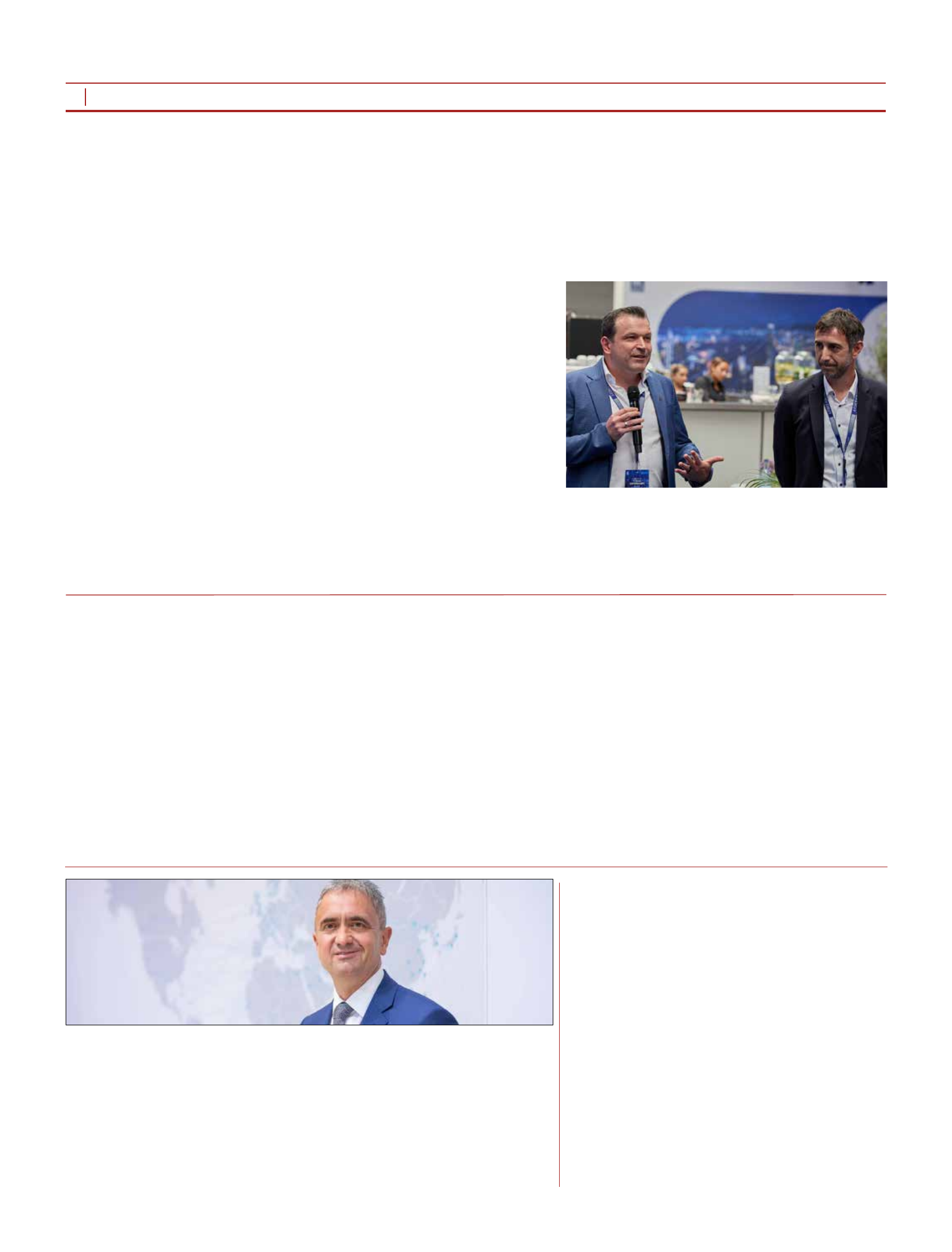
Ostermaier (left) and Pierangli (right) say revenues from data
centre business has quadrupled
its transformers, is being brought un-
der the Noedra umbrella.
Commenting on the introduction,
Chaudhry said: “It’s one third to do
with rebranding of our old products
but two thirds is completely new ar-
chitecture and framework that does
not exist in the industry.”
The Noedra ecosystem allows data
to be connected across all of Siemens
Energy’s suites. To enable a coherent,
future-ready digital grid.
Chaudhry explained: “You can now
connect monitoring data with Noedra
and use it for operation. In the past,
monitoring data was decoupled and
never used in real-time operation. If
you are creating images and videos
with cameras and drones to analyse
your assets to create digital twins of
these assets, this can also be connect-
ed with Noedra. So, all the data
needed to run the grid efciently,
safely, with good availability can be
connected. That’s why Noedra is such
a unique framework.”
The change in approach was pre-
dominantly driven by the sector it-
self. Three or four years ago, Siemens
Energy was perhaps more identied
as a producer of equipment like
generators, turbines, transformers,
switchgear, and providing solutions
to make these products smarter. To-
day it has to be much more than an
equipment supplier; it has to be a
solutions provider.
“You could buy a transformer with
sensors and a monitoring device to
make it an intelligent transformer.
You cou ld d o th e sam e wit h switc h-
gear or any other product. This is
what we have been doing in the past,”
said Chaudhry. “But the grid is run-
ning at its limit, and with the boom in
electrication, data centres and ev-
erything else, grids are a bottleneck.
Customers are now saying it’s no
longer enough to look at siloed prod-
ucts like transformers or switchgear.
needs to change, he says.
“In the future, if there is a crisis
situation or if there are contingencies
where you have to act fast using a
system that is highly automated, you
don’t have the freedom like in the
past where you have a dispatch plan
for tomorrow, can do the stability
studies ofine, and then evaluate
what’s possible,” said Chaudhry.
“Basically, for the grid of the fu-
ture, where the network is highly
loaded and volatile because of re-
newables and other changes, it is no
longer possible to run power system
studies and power system evalua-
tions ofine. Ofine meaning run-
ning those studies in a separate de-
partment with separate data sets,
while running the grid and control
centre with completely different data
sets. This data has to be combined
because in the future you will need to
act much faster.”
Operators therefore require a frame-
work that enables them to connect
live operational data from the grid
with simulation model data in order to
maintain power system stability.
Chaudhry added: “For example,
there must be a framework that allows
you to gure out, in real-time, if you
can overload your transformers with-
out risking their availability or integ-
rity. Operators need the capability of
knowing in real-time when they can
use the capacity from their assets
instead of using a paper-based evalu-
ation that is just based on static limits.
This is what was done in the past.”
As more intelligence is built into the
grid, data must be connected, he said.
“The energy industry is waiting for its
TCP/IP or internet moment where
everything became connected.”
Siemens Energy has worked on
digital solutions for the last decade
but to meet the new and future chal-
lenges, everything, including existing
digital brands such as Sensformer for
E
lectricity grids are key to the
energy transition. Yet the chal-
lenge facing grid operators in
terms of delivering grids capable of
handling a future generating mix that
will look quite different to the base-
load centralised systems for which
grids were designed, is a challenge.
Digitalisation of the grid has a key
role to play in meeting the challenge.
Recognising the importance of digi-
talisation, Siemens Energy has long
been investing in technologies that
not only make grids smarter but also
help operators to plan, design, and
operate them.
The company recently took a
completely new approach to grid
digitalisation with the introduction
of its Noedra digital ecosystem – the
Mind of the Grid – inspired by the
ancient Greek word ‘Noesis’.
Adnan Chaudhry, Senior Vice
President of Digital Grid at Siemens
Energy, explained: “It’s a learning,
evolving system with the capability
of putting complex information in
the right context and presenting it so
people can understand it.”
The system brings together intelli-
gent solutions – from sensing and
control systems, to software and advi-
sory – into one connected ecosystem.
By transforming data from across the
grid into clear, coordinated, and con-
dent action, Noedra helps operators
work smarter and faster in an increas-
ingly complex energy landscape.
Using experiences from the utility
sector, Noedra adopts what Chaudhry
says is “a completely new approach”.
He explained: “I spent eight years in
the utility industry as a power system
planner, using data sets for simula-
tion models; then I went to substation
operations, which had completely
different data sets. I then moved to
the operations control centre, where
you run and control the entire grid,
and again we worked with a different
set of data.
“All of the data in the grid – whether
generation or consumption – are in
silos, not connected to each other.
And there are 20 different ways of
modelling a transformer, depending
on how it is needed, but sometimes
the data between the models is not
consistent… you don’t need all the
information for every model but
the data consistency between the
different information sets is crucial.”
He noted that for the grid of the fu-
ture, an operator will need, for exam-
ple, predictive maintenance, optimis-
ation of the usage of the asset, and be
able to automate running of the grid.
The existing way of doing simulation
ofine and operating the grid and
control centre using different data sets
Special Technology Supplement
THE ENERGY INDUSTRY TIMES - JULY/AUGUST 2026
Digitalisation of the grid is key in meeting many of the challenges facing the electricity sector. Siemens Energy
has introduced the Noedra ecosystem in a move to bring together all of its grid digitalisation solutions. It has also
opened a new Grid AI Lab to help its customers utilise the full potential of articial intelligence. Junior Isles speaks
to Siemens Energy’s Adnan Chaudhry.
11
A new approach to
spreading intelligence
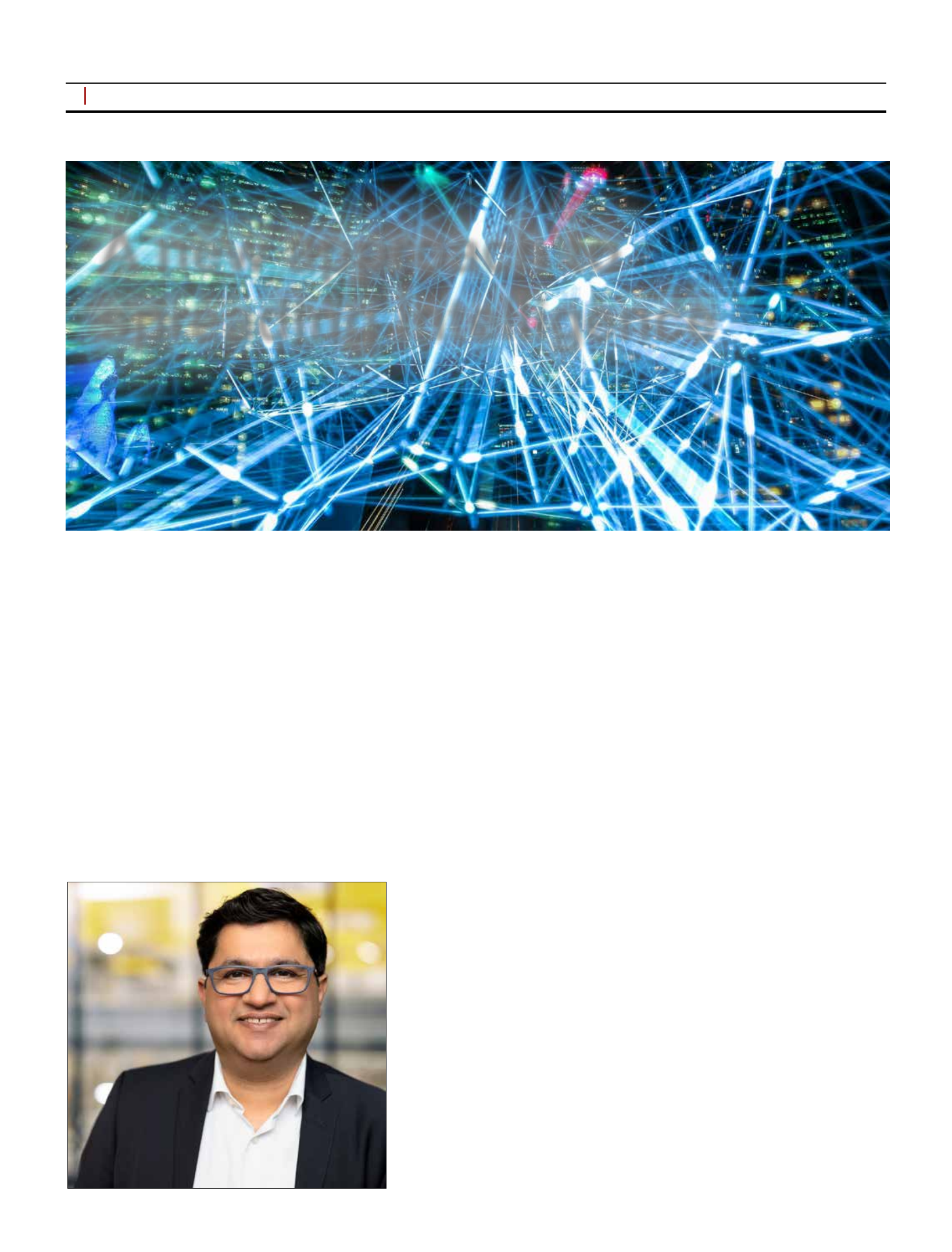
Chaudhry: “It’s a learning,
evolving system with the
capability of putting complex
information in the right
context and presenting it so
people can understand it.”

the potential efciency gains, it has
to look at the system from end-to-to-
end.
“We saw that there was no frame-
work that allowed our customers to do
this, because all the data was siloed,”
said Chaudhry. “This is what led to the
Noedra concept. It also meant repur-
posing our products, which meant
completely changing the data archi-
tecture of the previous transformer –
something we have been doing for
two decades.”
Siemens Energy therefore had to
build a data architecture so data can
be exchanged between transformer
switchgear to allow an entire substa-
tion to be monitored. To provide
solutions for overhead lines, in early
June Siemens Energy acquired
Camlin Group, a Northern Ire-
land-based specialist in grid moni-
toring, analytics and asset digitalisa-
tion technologies.
Commenting on the acquisition,
Chaudhry said: “We bought a sensor
company for overhead line sensors to
allow dynamic line rating. So even for
equipment we don’t produce, in order
to give the customer value, we added
portfolio elements into our Noedra
application so we can digitalise en-
tirely from end-to-end.”
Notably, information systems from
other vendors can also be integrated
into the Noedra ecosystem. So, the
entire system can be viewed using
one framework.
“This means all the information is in
one location so all information can be
handled in the same way,” noted
Chaudhry. He explained why this is
important. “In a critical situation you
don’t want to have go to a different
screen where the menu is different, or
have to nd different functionalities
at different menu points.”
Noedra works like an app-based
system, similar to an iPhone, where
the look and feel can be customised
and certain apps can be integrated
with everything being available to run
from a central Noedra system.
While this is traditionally opera-
tional data, another layer has been
added to complement live informa-
tion gathered from sensors. But,
particularly in extreme weather sce-
narios, this is insufcient for the grid
of the future.
Noedra therefore also uses data
from cameras, weather satellites and
weather information systems. “We
even worked with weather scientists
to work out how we can embed these
information systems for grid opera-
tion,” said Chaudhry. “For example,
if there is a camera on your overhead
line, we can combine visual informa-
tion with temperature sensor informa-
tion so that if there is sagging, because
it’s a hot day and there is no wind for
cooling, we can reduce the loading of
the line so it does not come into con-
tact with trees under the line and
thereby reduce the risk of wildres.”
Noedra currently comprises four
suites – Noedra Flow (Nf), Noedra
Node (Nn), Noedra Shield (Ns) and
Noedra Atlas (Na). Each of these
represents a different application
within the grid: protecting, sensing,
structuring, and guiding the grid.
“We started with four suites, but we
can add; it’s an evolving learning
system, Chaudhry noted. “We are
already working on a fth suit, which
we will hopefully launch in a year or
two at the latest. And we will also
grow the [existing] suites.”
The suites are basically the rst
identication layer of Siemens Ener-
gy customers and operators, chosen to
allow them to more simply identify
the area of application.
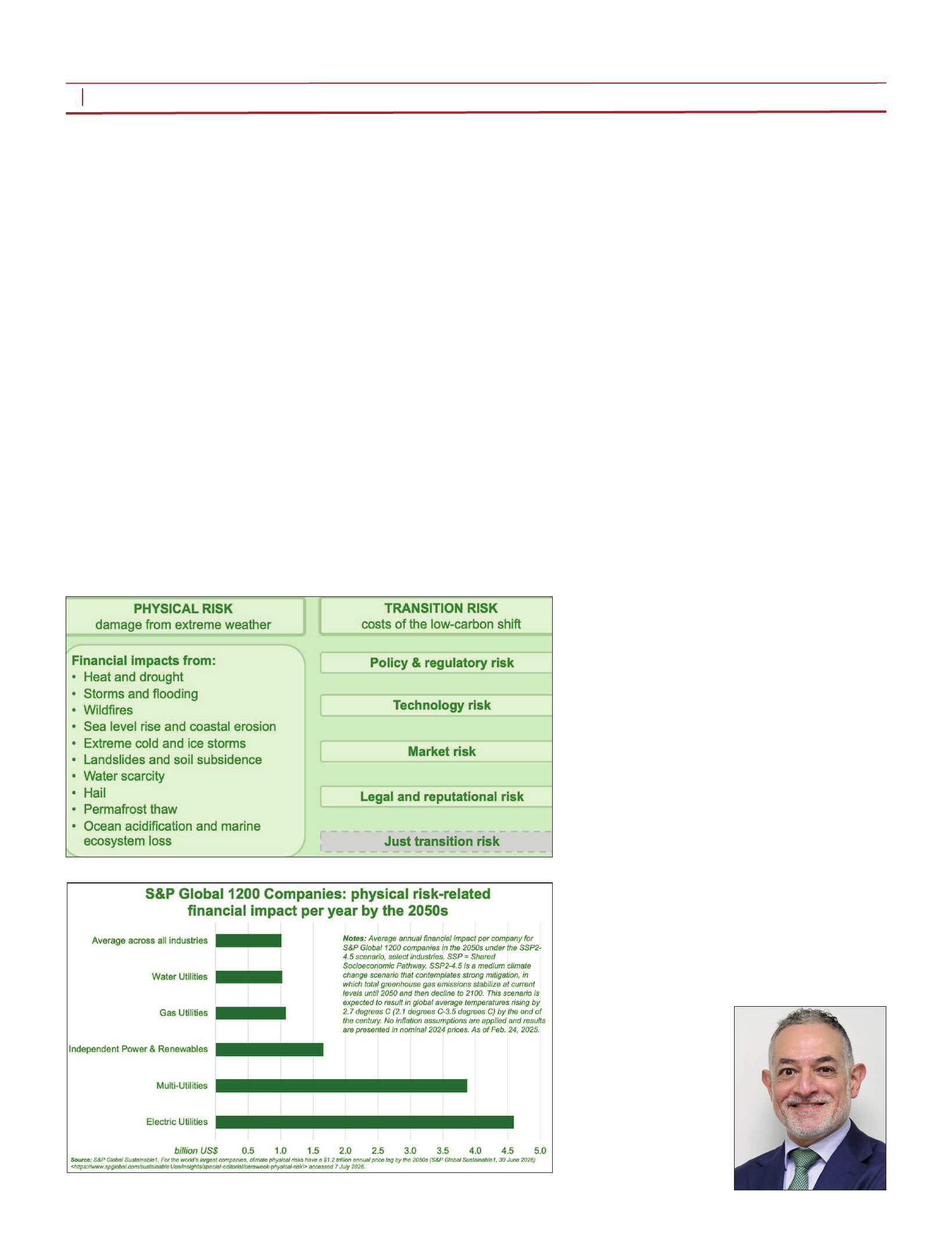
Nn is focused on the substation,
designed to boost grid reliability
through substation digitalisation
solutions. The substation is essential-
ly a node in a network, so everything
in the substation that an operator
might need to monitor, manage, and
optimise can be found in the Nn suite.
“Whether it is a camera or vi-
sion-based system, a monitoring sys-
tem, SCADA (supervisory control
and data acquisition) or HMI (human
machine interface) system or control
and protection system, you will nd
under Noedra node,” said Chaudhry.
“Any digital products for the trans-
former, switchgear and even un-
manned robots that move around the
substation will be under Nn.”
Noedra Node integrates sensing,
inspection, predictive analytics, pro-
tection, and automation into a single,
coordinated layer of intelligence. It
transforms substations from isolated
technical assets into self-aware, intel-
ligently supervised systems (digital
substations), able to monitor their
own condition, anticipate risks, and
support faster, more condent opera-
tional decisions.
Network nodes are connected by
lines. Items related to the lines fall
under the Noedra Flow (Nf) suite.
Line monitoring, diagnostics and
inspection, for example, are all under
the Nf suite. “We call it Noedra Flow
because it relates to anything that en-
sures power is owing around the line
and through the line itself,” said
Chaudhry.
The third suite, Na, is designed
around grid planning. “The grid
consists of thousands of lines and
nodes, and this provides a map for
operators to handle everything around
power system planning as well as
the analytics,” Chaudhry noted.
The Atlas suite delivers energy ad-
visory services with the strategic
clarity, technical assessment, and the
planning expertise needed to design
resilient, efcient, and future-ready
energy systems.
The fourth suite, Ns, covers all the
protection solutions related to the grid
for ‘cyber-physical’, i.e. both physical
and cyber resilience.
“Typically, in the past, the industry
was mainly talking about cyber secu-
rity – patch management and ensuring
cyber-secure grids, etc. But with No-
edra Shield, since we are working
with camera-based systems for sub-
stations and lines, etc., we also added
physical security. We can use these
cameras to detect if someone is trying
to target the grid. And since the infor-
mation systems and data sets are all
combined, the robot that is doing op-
eration inspection, could also be in-
structed to investigate through a
physical inspection.”
The use of articial intelligence
(AI) was central to building Noedra
and is key to its operation. Building
the framework required a rethink of
how Siemens Energy structures and
uses its data.
Chaudhry explained: “We worked
with Nvidia and two other compa-
nies to implement a completely new
data architecture, with new data ag-
gregation and data handling possibil-
ities that did not exist in the energy
industry. Since we were doing it, we
also made it AI-enabled.” This
means that many of the applications
within the Noedra suites can also
utilise AI because all the data is
suitably structured.
Siemens Energy says it is already
They are asking: ‘what happens if I
have a capacity limitation and need to
get more from the assets? I can put
sensors on a product, but what does it
tell me and how does it help me if I
just look at one individual product?’”
When transferring power from one
point to another, there is a substation
at point A and point B, and all their
associated equipment, with a trans-
mission line in between. If a utility
wants to digitalise in order to realise
Special Technology Supplement
THE ENERGY INDUSTRY TIMES - JULY/AUGUST 2026
12
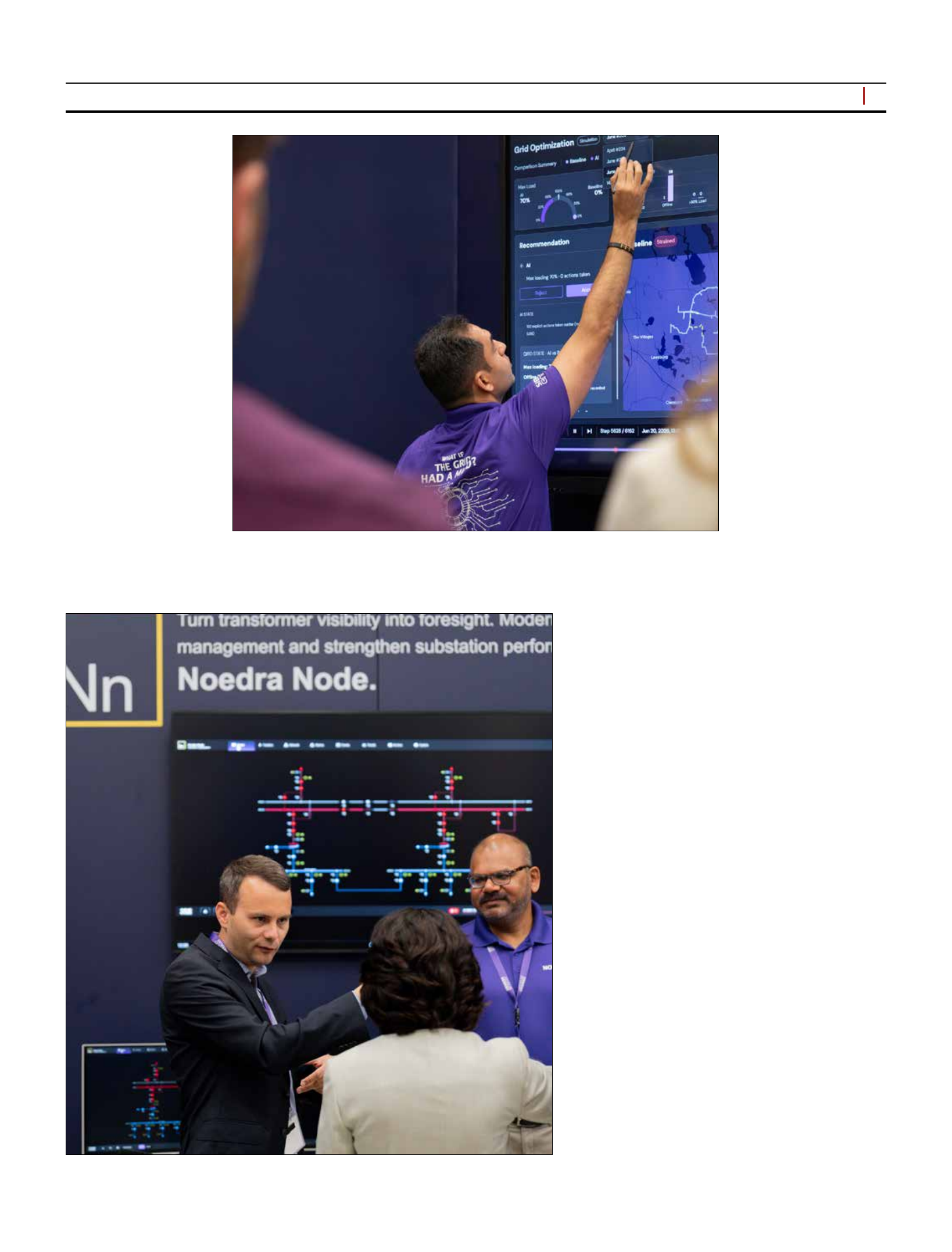
Siemens Energy’s Grid AI lab in Orlando opened earlier this year
Siemens Energy had to build
a data architecture so data
can be exchanged between
transformer switchgear,
allowing an entire substation
to be monitored
Siemens Energy Board
Member Tim Holt (centre) and
Adnan Chaudhry welcome the
Camlin Group Management,
Peter and Michael
Cunningham to the team
suites and layers within Noedra.
“We are working on a kind of ‘Mi-
crosoft co-pilot’ for the grid, said
Chaudhry. “If you look at Noedra
Node, for example, everything you
need to run the grid and the assets is
connected. If you want to know
whether there are any issues, alarms,
or even when to perform the next
maintenance on a specic transform-
er in a particular substation, you
don’t have to look at many structures.
You could simply open the AI Noe-
dra Assistant, or Knowledge Base as
we call it, and ask it simple unstruc-
tured questions like ‘when do I have
to service transformer ‘x’?’ And
based on the data, it will give you the
information.”
AI has also been used extensively
to create digital twins, with Siemens
Energy working with Nvidia for ve
years in total on this technology. It
has spent three of these years build-
ing the right language models for
creating digital twins of transform-
ers. In overhead lines, AI is proving
to be invaluable. AI-based models
have been trained to analyse infor-
mation gathered from drone inspec-
tions to detect faults.
Chaudhry said: “The more AI-mod-
els are trained, they can detect many
things far faster than humans. Even a
simple 1 cm crack in a [cable] insula-
tor, which no human eye could see at
a few metres from a helicopter, can be
detected much faster with the camera
and analytics.”
Earlier this year Siemens Energy
opened a new facility for using AI to
improve electric grids. Located next
to the company’s Innovation Centre
Orlando, the new Grid AI Lab inte-
grates Nvidia AI infrastructure with
Siemens Energy grid expertise to
train AI models that will enable
utilities to better manage their grids
in real-time, optimising operation
and grid maintenance.
Siemens Energy is building contin-
uously evolving digital twins of
physical infrastructure with Nvidia
Omniverse and Metropolis libraries.
These digital twins allow engineering
teams to visualise, simulate and col-
laborate in a shared digital environ-
ment, analyse asset conditions, visu-
alise asset behaviour and simulate
future operating conditions. The AI
applications, alongside work in aca-
demic and applied research, will open
up entirely new opportunities to use
the data from the power grid to ad-
dress some of the challenges in the
changing energy landscape.
Projects in the AI Lab are already
seeing Siemens Energy collaborate
with customers and universities, the
two main universities being the Uni-
versity of Central Florida and Georgia
Institute of Technology. It is also in
discussions with national labs and
research institutes such as the Electric
Power Research Institute (EPRI).
“Using articial intelligence, we
will be able to analyse the electrical
grid in new and powerful ways and
help to make it safer, more reliable
and more efcient,” said Chaudhry.
“We built this lab to provide a collab-
oration environment where custom-
ers, partners, universities and indus-
try leaders will come together to
co-create, experiment and accelerate
the application of AI to real-world
grid challenges.”
Siemens Energy will work with
customers to deploy and integrate
advanced sensing technologies across
the electrical grid, combining data
from grid-connected assets with aeri-
al and geospatial data acquisition
technologies. This multi-source data
will be analysed at the new Grid AI
Lab to develop and validate AI driven
insights that support grid planning,
operations, and resilience – helping
utilities operate the grid more ef-
ciently and strengthen preparedness,
response, and recovery for extreme
weather events.
There are a number of projects al-
ready being carried out at the lab,
one of the most interesting being an
AI-based intelligent solution called
Grid Assist. In critical grid situations
it allows instantaneous, automatic,
re-dispatch or change of loads to
avoid an outage.
Chaudhry explained: “Following an
outage, you might discover that the
parameters for protection, for exam-
ple, are outdated and not based on the
latest changes in the grid. This can be
one of the causes of some blackouts.
Grid Assist looks at the current data it
has, not solely the parameter settings,
and will override the parameter set-
tings if necessary.”
Such futuristic technology will take
some time to be implemented in the
energy sector, but Siemens Energy
has a plan for developing them in the
new AI lab.
“The AI lab has what I would call
three buckets: one is for futuristic
ideas we develop; one for projects
that can be implemented in a 2-3-year
timeframe, such as Grid Assist; and
another for using AI and data analyt-
ics to meet today’s needs. The initial
plan was to split the time and resourc-
es equally between the three areas but
current drivers such as the data centre
boom in the US, means most of the
activities in the lab are currently fo-
cused on our customers’ immediate
needs,” said Chaudhry.
Much of the ongoing work is in
creating digital twins, building the
learning models, and training the AI
knowledge-base with the data sets.
He gave an example: “When you y
a drone or helicopter over a grid, you
generate 100s of terabytes of data.
This is then analysed in the lab and
used to create training models for the
AI.”
Chaudhry sees imaging and inspec-
tion as the rst area that the AI lab will
benet the power industry. This will
provide utilities with much needed
visibility of their grids. With 80-90
per cent of grid outages caused by
incidents such as short-circuits or
ashovers from an overhead line to a
tree, introducing digitalisation and
intelligence in this area can be a big
benet to grid operators.
As grids become more complex,
managing that complexity will be-
come an increasing challenge. Sie-
mens Energy sees the work at its AI
lab and the Noedra ecosystem as the
rst step in meeting this challenge.
As Chaudhry put it: “We are bring-
ing vision to reality step-by-step.”
using AI in different applications,
where all the connected modules
have enhanced capability. AI is used
in data collection, creating digital
models and allowing information and
analytics to be shared across all the
Noedra Node integrates sensing, inspection, predictive analytics, protection, and automation into
a single, coordinated layer of intelligence
THE ENERGY INDUSTRY TIMES - JULY/AUGUST 2026
Special Technology Supplement
13
The new Grid AI Lab
integrates Nvidia AI
infrastructure with Siemens
Energy grid expertise to train
AI models that will enable
utilities to better manage
their grids in real-time,
optimising operation and grid
maintenance
Carbon pricing raises costs for most
companies, and new rules are forcing
rms to rethink how they generate
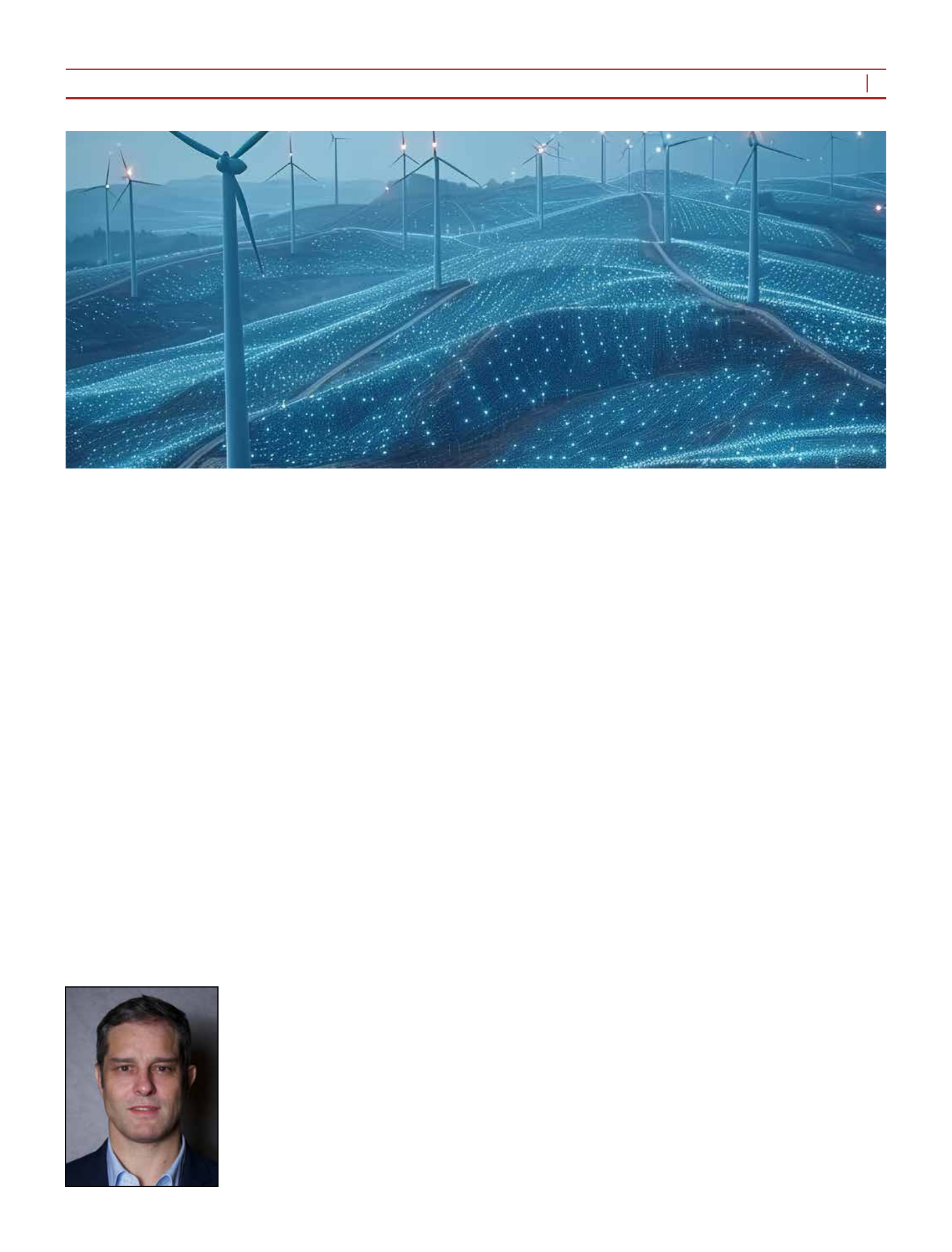
revenue. Technology risk is the sec-
ond most impactful category. Clean
energy technology, along with AI
both managing the grid and adding
new demand on it, is displacing lega-
cy infrastructure. Market risk comes
third by impact. Fossil fuel demand
declines and renewables grow, shift-
ing the supply and demand picture
that rms have long relied on. Legal
and reputational risk is fourth, smaller
in dollars today but growing quickly
through litigation and stakeholder
pressure.
The dashed box at the bottom is
“just transition’ risk. It refers to the
human cost of shifting to a green
economy, especially the impact on the
workforces and communities that rely
on fossil fuels. It is still emerging as a
category, but worth tracking. The
chart highlights that physical damage
is only the visible half of the bill. The
S
ince late May, western Europe
has been hit by one heatwave
after another. The sweltering
heat has been causing human losses
and economic havoc, including higher
electric power prices and train trans-
port disruptions.
Insurance rm Allianz warned that
repeating the ve hottest years from
2014 to 2024 across 2026 to 2030
would drive cumulative GDP losses
to as much as 7 per cent in France,
Germany, Italy and Spain, a recent
Financial Times article emphasised.
The same article noted that nancial
rm MSCI found that of 11 215 listed
companies, 99.8 per cent face a ma-
terial nancial risk from extreme
heat, yet ‘the world is not pricing
climate risk,’ said MSCI’s CEO.
More broadly, between 1995 and
2024, more than 9700 extreme
weather events caused around $4.5
trillion in direct losses worldwide,
adjusted for ination, according to
Germanwatch’s Climate Risk Index
2026. Storms alone accounted for
$2.64 trillion of that.
The scale of losses from physical
and transition risk is a true economic
reckoning for energy rms. Climate
risk for energy and other companies
splits into two broad types.
Physical risk is the direct damage
caused by extreme weather. The chart
Navigating Climate Risk shows some
of the main triggers, from heat and
drought to storms and ooding,
wildres and rising seas, through to
slower-moving issues like permafrost
thaw and ocean acidication. Nature
loss belongs here too: as ecosystems
degrade, so does the economic value
that depends on them.
Transition risk is the cost of shifting
to a low-carbon economy. It typically
commands fewer headlines as it is
much less visible. The chart breaks it
into four sub-categories, ranked by
how heavily they may impact energy
companies today. Policy and regula-
tory risk has the greatest impact.
other half, transition, is where rms
are least prepared, not because they
are unaware but because it sits low on
the priority list, even as banks, insur-
ers and regulators increasingly de-
mand answers.
The costs of climate change are al-
ready vast and mounting. Physical
risk alone will cost the world’s largest
listed companies roughly $1.2 trillion
a year by the 2050s, according to S&P
Global Sustainable1, with electric
utilities set to take the hardest hit,
about $4.6 billion per annum (see
chart).
At the global level, the numbers are
larger still. Moody’s puts the econom-
ic hit from physical climate risk at up
to $41.4 trillion by 2050, or a 14.5 per
cent loss in global GDP, with two-
thirds coming from chronic pressures
such as sea level rise and productivity
decline rather than headline disasters.
A Potsdam Institute study in Nature
reaches a similar order of magnitude,
estimating the world economy is al-
ready locked into around $38 trillion
in annual damages by 2050, even
with sharp emissions cuts from today.
Transition costs are signicant too.
Unlike climate change costs, transi-
tion costs can be partially or wholly
mitigated through targeted invest-
ments. The International Energy
Agency (IEA) estimated in late 2023
that clean energy investment needs to
reach roughly $4.5 trillion a year by
the early 2030s, up from $1.8 trillion
in 2023, to keep 1.5°C in reach, a
target most now consider unachiev-
able. McKinsey in 2022 projected
that the wider transition bill would
reach around $9.2 trillion a year in
physical asset spending through
2050.
The many examples of physical and
transition risk reshaping corporate
strategy grow by the month. Two re-
cent cases illustrate these risks: Ger-
man multinational energy utility
RWE in Europe, where the courts are
redrawing the boundaries of corporate
liability, and Japanese energy giant
JERA in Asia, where the economics
of the transition are quietly repricing
fossil-fuel assets.
In May 2025, the Hamm Higher
Regional Court in Germany dismissed
a decade-long lawsuit brought by
Peruvian farmer Saúl Luciano Lliuya
against RWE, the country’s largest
power producer. Lliuya had argued
that RWE’s historical emissions con-
tributed to glacial melt above his
hometown of Huaraz, raising the risk
of a catastrophic ood. He sought
around $20 000, a proportional share
of the cost of protective ood works,
based on RWE’s roughly 0.5 per cent
share of global industrial emissions
since the industrial revolution.
The case was dismissed on the facts,
the court nding insufcient ood
risk to his specic property, but the
ruling was a landmark. For the rst
time, a German court accepted the
principle that major emitters can be
held liable for climate-related damage
abroad, in proportion to their contri-
bution to global emissions. Legal ob-
servers described it as lighting the
fuse for a wave of similar claims.
Over 3000 climate cases have now
been led globally by end 2025, per
THE ENERGY INDUSTRY TIMES - JULY/AUGUST 2026
Decarbonisation Series
14
The other half of corporate climate risk
The other half of corporate climate risk
Navigating Climate Risk
Columbia University’s Sabin Centre,
with over 60 “polluter pays” suits
against fossil fuel and utility rms.
RWE accepted the ruling. The prece-
dent, however, applies across juris-
dictions with similar legal frame-
works, including the UK, the
Netherlands and Japan.
JERA, a 50/50 joint venture be-
tween TEPCO and Chubu Electric, is
Japan’s largest power generator, sup-
plying roughly 30 per cent of the
country’s electricity from around 67
GW of capacity. As of nancial year
2023, 97 per cent of that capacity is
fossil fuel -based and just 0.2 per cent
of its domestic generation is renew-
able. Rather than pivot, JERA is
doubling down. In 2025 alone it
signed 5.5 million tonnes per year of
new long-term US LNG contracts
and continues to promote ammonia
and hydrogen co-ring to extend the
life of its coal plants, technologies
that remain unproven at commercial
scale.
The strategy is exposed on two
fronts. A November 2025 study in
Energy Strategy Reviews estimates
that Southeast Asia’s coal red plants
could face $85 to $123 billion in
stranded-asset losses by 2060, with
early strandings beginning around
2042. Separately, IMF modelling
published in January 2026 nds that
a quarter of Asia-Pacic coal capital
stock could become stranded if the
transition accelerates. Global LNG
supply is entering its largest-ever
growth phase, expected to squeeze
trader margins. JERA’s model banks
on economics and technologies
moving in its favour. Neither is
guaranteed.
These are only two illustrations
among thousands of examples. Ener-
gy rms may take two pathways:
execute a clear transition strategy or
remain passive and only take action
once it is too late. Given the scale of
nancial exposure, waiting is the
more expensive option.
Prepared for The Energy Industry
Times by Joseph Jacobelli of actE, a
climate business and nance insights
platform (asiacleantechenergy.com).
Joseph Jacobelli runs Bourne Impact
Capital and has spent more than 35
years in energy markets. He also
works to advance sustainable nance,
hosting the Asia Climate Finance
Podcast and writing two books, most
recently ‘Powering the Unstoppable
Green Shift’.
Physical risk financial impact
S&P Global 1200 Companies: physical risk-related nancial impact per year by the 2050s
Navigating climate risk: an energy sector strategic framework
Energy and other corporations are becoming increasingly aware of the climate-related risks they face. The European
summer heatwaves and a new analysis are only two of the many signs shining a light on the scale of losses from
physical damage alone. But that is only the visible half. The costs rms tend to underprice or overlook are still to come.
Joseph Jacobelli explains.
A
s generation, transmission and
grid operations become
more digitised and intercon-
nected, cyber risk increasingly man-
ifests itself as an operational threat
with real-world consequences – out-
ages, safety incidents, delayed re-
covery and arguably, most import-
ant, loss of public trust.
For energy companies and asset
owners today, selecting the right cy-
ber security approach is critical –
business critical. Beyond traditional
threat detection, organisations need
to balance deployment exibility,
risk mitigation and visibility, while
an increasingly stringent regulatory
environment also means compli-
ance at the very highest level.
Disruptions across global energy
systems – often aimed at renew-
ables – have shown that attacks do
not necessarily need to take down
the grid to be effective.
Take the co-ordinated cyber attack
on Poland’s energy infrastructure
late last year when 30 renewable
energy facilities – wind, solar PV
farms and several renewable energy
generators among them – were tar-
geted. The perpetrators, reportedly a
Russian military-linked hacking
group, deployed wiper malware that
destroyed data on computer sys-
tems, corrupted rmware on opera-
tional technology (OT) devices, and
damaged remote terminal units
(RTUs).
While the timing wasn’t optimal,
given the risk of the grid going
down during a bitter winter, the at-
tack failed to cause major outages
with systems continuing to produce
power. There was, however, still a
serious consequences with disrupt-
ed communication between facili-
ties and operators unable to remote-
ly monitor or control assets.
So, while total grid failure was
avoided, it highlighted the opera-
tional risks of an attack.
This high prole case was seen
widely as one of the rst co-ordinat-
ed attacks on renewable energy
plants. CISA, the US cyber defence
agency, published an alert, high-
lighting OT/ICS lessons from the
CERT Polska report published in
January, while the UK’s National
Cyber Security Centre issued its
own warning.
It is concerning that the CERT Pol-
ska report concluded that the attack-
er’s activities, “indicate a strong in-
terest in the energy sector and
capabilities to attack industrial de-
vices”. For energy operators it’s a
chilling reminder of the threats they
face. It shows that cyber criminals
are wising up to the potential im-
pact of targeting critical energy in-
frastructure – particularly distribut-
ed assets – where operational
resilience is critical. Once consid-
ered small fry, wind and solar
farms, battery storage, heat and
power plants, even electric vehicle
charging infrastructure, are now in
the ring line.
This shift is signicant as renew-
able energy infrastructure scales.
Renewable generation, storage and
grid automation all promise ef-
ciency and sustainability, but they
also introduce new attack surfaces
in the form of digital control tech-
nologies and points.
Digitalisation is the foundation to
managing wind farms, solar and
battery storage sites, for example.
They now rely on interconnected
control systems like SCADA and
broader OT to monitor perfor-
mance, remotely control assets and
maximise uptime.
We are already seeing threats
emerging in the form of a new class
of malware developed to exploit in-
dustrial environments. IOCON-
TROL is just one example; a modu-
lar cyber weapon observed in
targeted attacks against critical in-
frastructure.
Designed to inltrate and control
everything from industrial routers
to human-machine interfaces and
programmable logic controllers, it
operates with stealth and precision.
By leveraging legitimate protocols
like MQTT – commonly used for
machine-to-machine communica-
tion – it blends in with normal traf-
c, evading traditional detection
methods. Its modular design also
means it can adapt to different envi-
ronments with little or no effort,
making it highly portable across
different energy assets.
Energy operators often share com-
mon SCADA architectures across
systems, which, while operationally
efcient, becomes a liability when
malware is used to exploit these ar-
chitectures. Then factor in third-par-
ty suppliers and supply chain at-
tacks, and the risks start to multiply.
There is too much trust in vendor
connectivity – and not just in the
energy sector – and limited insight
into internal OT communications.
Failure is not always obvious on
day one; it accumulates and eventu-
ally becomes a major operational
disaster.
Attackers that gain a foothold via
one vulnerable device or connec-
tion, can then move across, escalate
privileges and take control of criti-
cal systems. In some cases, the
command infrastructure can even be
buried within the OT network, long-
term without raising alarms.
For operators and asset owners, the
consequences are all too clear and
the risks far too great. Even ‘limited’
compromises, such as control system
interference, can slow down efforts
to restore systems, and amplify the
impact of system failures.
Operational downtime and disrup-
tion to services from an attack are
often the tip of the iceberg for ener-
gy operators. Sadly, the conse-
quences go much deeper if you fac-
tor in nancial loss.
Unplanned operational downtime
can cost upwards of $125 000 per
hour, according to IBM’s Cost of a
Data Breach report with the indus-
trial sector in third place for breach
costs among the 17 industries stud-
ied. On average, data breaches cost
industrial organisations 13 per cent
more than the $4.88 million global
average.
When you start to add it all up, you
begin to understand the real-world
nancial consequences. When you
consider that a 98 MW wind turbine
site could lose $1.9 million from just
a week of downtime, it starts to hit
home.
Compliance is another operational
consideration, but it’s becoming
more and more complex. In bank-
ing, cyber security is seen as core
operational risk and Boards are
personally responsible. This respon-
sibility drives budgets, robust cyber
resilience and continuous oversight.
Energy has not fully reached this
point where cyber security is treated
as a core operational risk. We are
building highly decentralised, digi-
talised energy systems that we de-
pend on, but in many cases, it’s still
treated as an IT issue rather than a
leadership responsibility.
Yet, times are changing. The UK
has just changed the rules for ener-
gy cyber security, and it is good
news for operators and asset own-
ers. Cyber security will become a
board and CEO problem, not IT.
This means that cyber risk in the
sector will now sit on the same line
as safety and nancial risk.
The government’s new Energy
Sector Cyber Security Strategy
(2026–2030), jointly issued by
DESNZ, NCSC, Ofgem and NESO,
moves the goalposts. If you own or
operate renewable generation, stor-
age, or grid-connected assets, this
lands on your desk. The strategy ex-
plicitly extends baseline cyber resil-
ience to operators not currently un-
der NIS, with proposals for all
Ofgem licensees by end of 2027.
Operators will need to accelerate
protection of their most critical
assets.
The bottom line is that this is
shifting from “are we required to?”
to “can we prove it in nancial and
compliance terms?” That’s the con-
versation energy operators – and the
sector as a whole – should be hav-
ing now, ahead of the deadline rath-
er than chasing it. Cyber security
can no longer be an afterthought.
Protecting global energy infra-
structure requires a proactive and
holistic approach to cyber security,
which acknowledges the risks of
digital transformation and the con-
sequences of failure. By prioritising
cyber security at every level, the
sector can ensure resilient, reliable,
and secure energy systems that sup-
port a stable and sustainable future.
Rafael Narezzi is the Co-Founder
of Centrii (formerly known as Cy-
ber Energia) and an OT cyber secu-
rity expert.
For decades, cyber risk in the energy sector was treated as a technical problem – something to be managed by IT
teams, addressed through compliance checklists, or discussed only after a major incident. Centrii’s Rafael Narezzi
argues that this framing no longer holds and that energy leaders need to rethink their cyber security strategies.
When cyber risk becomes
When cyber risk becomes
an operational risk
an operational risk
THE ENERGY INDUSTRY TIMES - JULY/AUGUST 2026
15
Technology Review
Narezzi: Protecting global
energy infrastructure requires
a proactive and holistic
approach to cyber security
THE ENERGY INDUSTRY TIMES - JULY/AUGUST 2026
16
Final Word
Y
ou could be forgiven for think-
ing this was something to do
with Beyoncé and Jay-Z. In-
stead, it was part of the discussion at
this year’s Eurelectric Power Sum-
mit. A bit of ‘The Carters’ minus the
glamour, but just as interesting.
With the European Commission due
to unveil its Electrication Action
Plan on July 17th (just days after the
time of writing), the summit, held in
early June, focused on the importance
of electrication in driving decar-
bonisation and delivering energy se-
curity during these uncertain times.
Discussions were framed around
two major projects – industrial elec-
trication and articial intelligence
(AI) – launched during the event.
Opening the conference, Kristian
Ruby, Secretary General, Eurelectric,
said: “…In recent years we’ve seen
that access to electricity is literally a
matter of life and death. From the
front lines of Donbas to the smelters
of Dunkirk, from the data centres in
Dublin to the devices in our homes
and hospitals… electricity is bringing
power to life.”
With ‘Bringing Power to Life’ being
the headline theme, Ruby stressed
that the current geopolitical landscape
is putting Europe’s “way of life under
threat”, and that the bloc needs a clear
answer to foreign energy dominance.
That answer, he said, is European
electric power.
“Industrial strength is of essence in
this new world. Europe must answer
the call from its industrial base. Make
sure that it stays competitive on its
way to climate neutrality. We want
decarbonisation, not de-industriali-
sation,” he said. “As the electricity
sector, we have strong ties with our
industrial partners. But sometimes in
life, we know that even the closest of
relationships can need some new
energy.
“So, over the past year we sat down
with our industrial partners for a bit
of couple therapy… And out of these
difcult discussions… we found that
if we invest in the relation, if we in-
novate and co-create, we can turn
troubled ties around and re-emerge as
vibrant electric power couples.”
According to a new report – ‘Pow-
er Couples: Enhancing Industrial
Competitiveness Through Electri-
cation’, unveiled on the rst day of
the summit – electrication already
represents a competitive advantage
for Europe, but scaling up requires
better alignment across system levels.
The report from Eurelectric and
Accenture, which draws on more than
3500 market signals across 61 com-
panies and 30 documented projects,
identies what makes an industrial
project successful and what holds
back deployment. It concludes that
the barrier to scaling electrication
across European industry is no longer
technology – it is system execution,
the ability to turn viable projects into
investable ones quickly enough.
To identify key barriers and shape
common solutions, the European
power sector engaged with industry
players from three different segments:
low- and medium-temperature heat,
energy-intensive industries and data
centres.
The resulting report identies ve
replicable models working as ‘Power
Couples’: integrated industrial part-
nerships models that jointly optimise
demand, low-carbon supply, infra-
structure and exibility.
In a ‘Power Couples’ model, one
load anchors long-term clean power,
another shifts demand when prices
spike, a third provides fast balancing,
and all of them share infrastructure,
risk and system value. They operate
through commercial structures such
as long-term PPAs, Heat as a Service,
Energy as a service, waste-heat
offtake, exibility revenues or blend-
ed public-private nancing.
In his opening speech Ruby also
stressed the importance of AI in
speeding up the energy transition,
optimising grids, integrating clean
power sources and serving new load.
The massive increase in renewables
along with industrial electrication,
and the transition from a centralised
system to a decentralised one calls for
digitalisation and AI. Indeed, AI is
already reshaping every part of the
utilities value chain – from genera-
tion, transmission and distribution,
right through to energy trading, retail
and delivering capital projects with
lower risk.
AI represents a unique opportunity
to boost Europe’s competitiveness.
Its rapid uptake is reshaping both
electricity demand and power system
operations.
On the one hand, AI is driving sig-
nicant new demand for electricity,
with data centres expected to account
for around 28 per cent of the growth
in European electricity demand by
2030. This underlines the need to
align the expansion of AI infrastruc-
ture with the readiness of the power
system. On the other hand, AI is be-
coming a key enabler to manage the
power system’s complexity.
During the summit Miguel G. Tor-
reira, Global Utilities Strategy Lead,
Accenture, shared results of a survey
on what electricity executives think
about AI adoption. The survey found
that although the investment in AI is
real and accelerating, “uncomfortable
gaps” are starting to emerge.
Torreira noted: “Every utility in this
room is investing in AI. [But] Most
are yet to see any returns from it, and
almost none have actually asked their
employees what they think about it.”
A key nding from the survey of
C-suite executives from 3650 of the
world’s largest organisations across
20 industries including energy and
utilities, found that only 12 per cent
cite return on investment as a prima-
ry driver.
“If returns are not the main driver
for AI, what is? And how do they
make sure they are meeting that cri-
teria?” said Torreira, pointing out this
“measurement gap”. The second
concern is what he called the “deliv-
ery gap”. “Only a third of executives
report the impact of AI at scale across
enterprise, despite the investment and
boardroom commitment.”
He added: “To me it seems that AI
is the way people believe in going to
the gym. The intentions are real, but
the results sometimes are not.”
During the panel discussion follow-
ing Torreira’s presentation, Stephen
Fitzpatrick, Founder and CEO of
Kaluza, said: “I heard a joke once…
In the beginning, AI is like sex: ev-
erybody thinks everybody else is
doing it better and getting more of it.
And we are just trying our best to get
as much as possible.
“This idea that AI is the goal rather
than the tool; I think that’s where
people aren’t sure. They think, ‘the
more I do the better it will be’. But
this is clearly not the case. It’s not
some new religion; it’s the same as
every other business decision that you
make. You have to measure the results
and invest in the winners. That’s
something we have really found in
the last six months – measuring the
results of the AI that we’re using is
more and more important.”
The potential of AI for power is
huge. At the same time power demand
is being driven by data centres and
the AI workloads they host. AI data
centres have become a signicant
new customer of the electricity sector,
while the utilities powering them are
deploying the same AI models to do
real operational work. To address
these parallel issues Day 2 of the
conference saw Eurelectric announce
the launch of a new project on AI:
‘The era of electric intelligence’.
Conducted with its partner EY, the
project will explore how much
power will be needed to feed AI
(Power4AI) and how AI solutions
will augment the power sector (AI4P-
ower). The conclusions of this anal-
ysis will released in late 2026
(Power4AI) and in 2027 (AI4Power).
To seize the opportunity that AI
presents, Eurelectric is partnering
with stakeholders across both sectors
to identify practical pathways for
timely, efcient, and sustainable data
centre growth. Through the ‘Twin
Transition Commitments’ initiative,
it will assess future data centre de-
mand and exibility, evaluate how the
power system can meet this growth,
and advance secure and sustainable
solutions, including collaboration
between utilities and hyperscalers
and the use of applied AI.
But achieving data centre growth
and this digital transformation re-
quires coordinated action across
policy, markets, and industry.
“The energy and digital transitions
are fundamentally connected,” said
Georgios Stassis, Vice-President of
Eurelectric and Chairman and CEO
of PPC. “To support them, we must
accelerate grid connections and
streamline permitting processes.
Crucially, we need regulatory envi-
ronments that ensure a stable invest-
ment landscape. Doing so empowers
the electricity sector to deliver the
power infrastructure needed through
innovative business models. This will
fuel the data centre boom while
guaranteeing reliable and affordable
power for everyday consumers and
Europe’s decarbonisation goals.”
When asked what Europe needs to
move fast in order to seize the AI
opportunity, Stassis neatly rounded
off a conference session that spoke of
power couples and sex, with the an-
swer: “More love… we started with
sex and ended with love.”
Sex, love and power
couples
Junior Isles
Cartoon by Jem Soar
