synchronous compensators] and even
hybrid solutions that use STATCOMs
or Enhanced-STATCOMs coupled
with some other grid supporting re-
sources such as battery storage, su-
percapacitors, or synchronous con-
densers, to mitigate any issues caused
by a lack of inertia in the grid. This is
where technology helps to have a
stable grid – even if you change the
generation mix compared to what you
had in the past.”
He added: “We believe that in
principle every country can manage
a grid that has around 60-65 per cent
of [intermittent] renewables, i.e.
wind and solar, if it invests in the
right technologies.”
Several projects demonstrate the
capabilities of these technologies. In
April 2024, Hitachi Energy secured
an order from SP Energy Networks to
design and deliver a rst-of-its-kind
power quality solution to stabilise the
grid and boost the ow of renewable
energy from Scotland to England.
The project, located at SP Energy
Networks’ substation at Eccles, con-
sists of two sets of an SVC Light
®
STATCOM and a synchronous con-
denser controlled centrally by the
MACH™ control system, connected
at a common electrical node. Each
STATCOM installation uses Hitachi
Energy’s advanced power electronics
and MACH control and protection
solution to provide system strength,
instantaneous voltage control, and
enable maximum power ow.
According to Hitachi Energy, the
combination of technologies will
maximise the future power system’s
potential while also providing in-
creased system stability and security,
thus supporting the increasing inte-
gration of renewables into the grid.
The integration of renewables, often
through the use of HVDC links, is an
important application for power
electronics, and Persson provided
several examples.
The 1200 MW Caithness Moray –
Shetland project in Scotland is a good
example of how power electronics is
have the same system inertia as one
that has rotating turbines, and can
therefore be harder to control. The
importance of network control was
highlighted in the blackout across the
Iberian Peninsula in April last year,
with some citing the higher reliance
on renewables as one of the causes.
As the generation mix moves to
more variable generation from wind
and solar, there is clearly a need to
control networks more reliably. While
some argue that variable renewables
could cause a more unstable network,
Persson notes that this no longer
needs to be the case. “That could be
true if you used the outdated tech-
nologies you had in the past. Tradi-
tional solutions alone cannot manage
increasing grid complexity,” he said.
In traditional power systems, me-
chanical inertia is used to provide grid
stability. In conventional power
plants the inertia typically comes
from the rotating mass of spinning
turbines. Wind and solar plants,
however, are connected to the grid via
inverters. These electronic devices
act as current sources, synchronising
their output to follow the grid’s exist-
ing voltage and frequency. They use
Phase-Locked Loops (PLLs) to track
the grid’s waveform and inject or ab-
sorb power, but they cannot start a
grid during a blackout or stabilise it
during a major disturbance, as they
rely on a stable external voltage/fre-
quency reference.
Persson commented: “In the past,
inverter-based solutions were grid-
following, which means that if you go
outside frequency and voltage ranges
you have to close the plant down.
This, in turn, can cause cascading ef-
fects and then blackouts. But with
newer power electronics you can
have grid-forming. With digitalisa-
tion and grid-forming capabilities the
grid can be formed to be stable in
terms of frequency and voltage, for
both AC and DC applications.
“Now we have HVDC systems us-
ing converters that are based on
power electronics, STATCOMs [static
T
he energy transition faced some
headwinds in 2025. With a slow-
down triggered by unfavourable
policies in the US and China’s shift
from xed tariffs to auctions impacting
project economics, the International
Energy Agency has lowered its growth
forecasts for renewables.
In spite of challenging times, how-
ever, growth is expected to remain
strong in the medium/long-term. Ac-
cording to the Paris-based agency, the
amount of installed renewable power
capacity is forecast to more than
double by 2030. Meanwhile DNV’s
most recent ‘Energy Transition Out-
look’ notes that the US slowdown will
have only a marginal effect on the
global energy transition as momen-
tum continues to build elsewhere, and
predicts an almost even split between
fossil and non-fossil fuels in 2050.
Still, the renewables sector will
have to navigate headwinds as it
grapples with supply chain issues,
grid infrastructure modernisation and
nancing. Certainly, the grid for re-
newable integration is widely recog-
nised as possibly the biggest challenge
to the energy transition. As is often
noted, there can be no transition
without transmission.
Commenting on the challenges fac-
ing the transition, Niklas Persson,
Managing Director of Business Unit
Grid Integration at Hitachi Energy,
said: “Over the last year and a half, we
have seen a few issues – in the US
some projects have been cancelled.
We have also seen some auctions in
Europe that have not been successful
and are delaying projects. However,
the whole sentiment is here to stay.
It’s coming from the electrication of
industry, the whole transportation
sector, and, of course, data centres.”
According to Persson, the transition
is essentially being driven from two
sides: from the consumer side, or
what he calls the edge of the grid – i.e.
the electrication of transportation
and industry, as well as data centre
demand – and from the generation
side, where the likes of Europe, China,
India, and the Middle East are leading
the shift to solar and wind. “This
[shift] calls for a different means of
transmitting that generation to the
edge where the consumption will be,”
said Persson.
He added: “Now it’s also more
about energy security due to a global
geopolitical situation where there is
an increasing desire to manage your
own generation, which is also driving
a different generation mix. This is all
creating a super-cycle demand that
will last for the next 10-20 years.”
One of the biggest challenges is
moving this new generation, much of
which will be renewable, to the point
of consumption. This will require
strengthening existing grids and
building new grid capacity at the rate
needed to keep pace with generation.
Much of the technological devel-
opments in the transmission sector
are, therefore, being driven by the
expected generation mix of the fu-
ture. Subsequently, there has been
signicant focus on maintaining grid
stability as the amount of renewables
increases.
A grid based on renewables does not
Special Interview
THE ENERGY INDUSTRY TIMES - JANUARY-FEBRUARY 2026
The energy transition is seen by many as one of the biggest economic opportunities of the 21st century. But there
can be no transition without transmission. Hitachi Energy’s Niklas Persson discusses why companies building
transmission systems will need to focus on deploying pioneering technologies, such as power electronics, while
putting in place the skills, supply chains, partnerships and collaboration agreements to make it happen.
Junior Isles
11
Persson: Traditional solutions
alone cannot manage
increasing grid complexity
Transition through
transmission
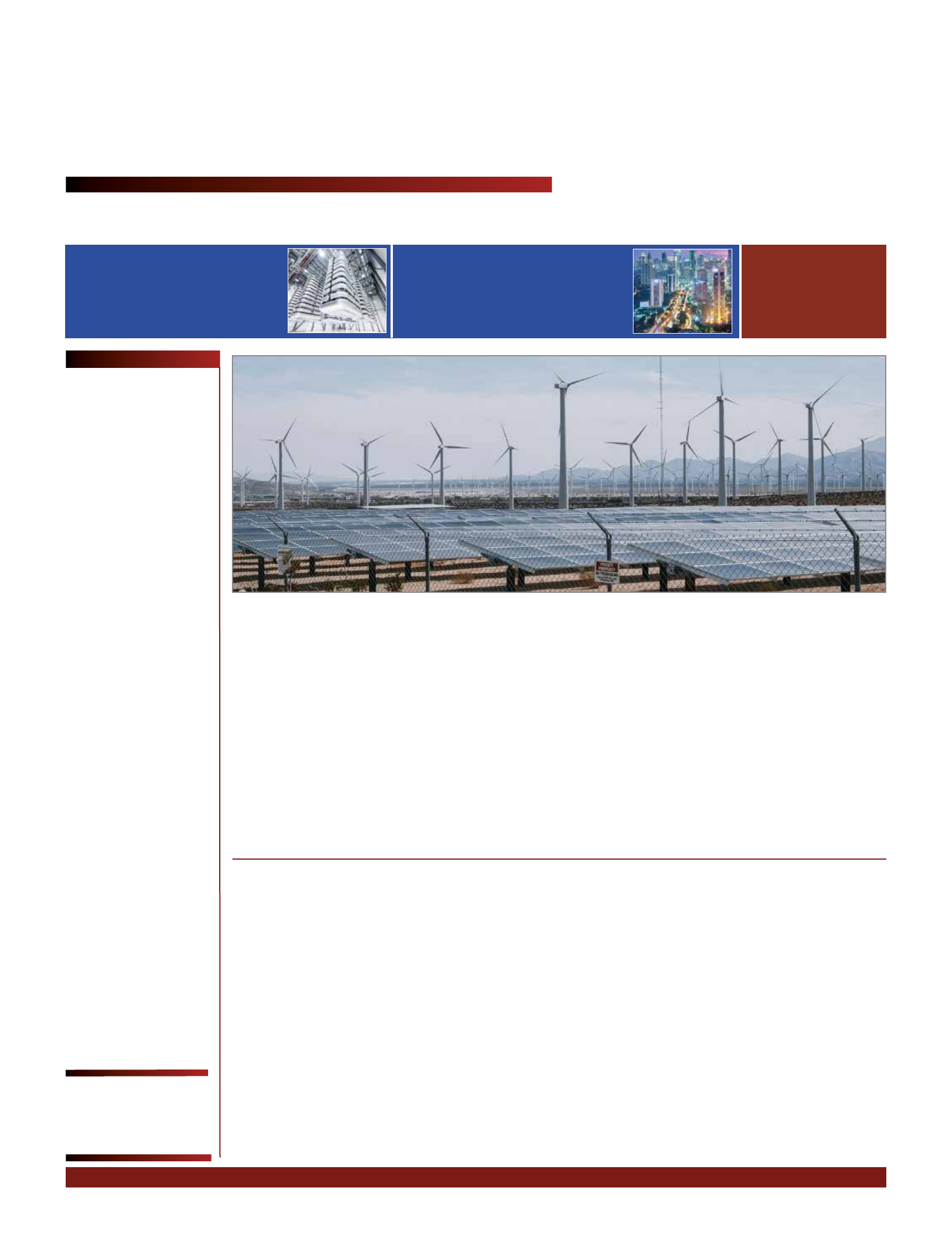
Yichu, Taiwan. Wind and solar
plants can now be connected
to the grid using newer power
electronics that enable grid
stability
these cities, it’s often difcult to get
the right-of-way to build overhead AC
lines. Just laying one HVDC cable
allows you to get 1 GW into the city.”
But the application of power elec-
tronics solutions goes beyond the in-
tegration of renewables and HVDC
connectors.
According to Persson, it is being
increasingly used in data centre proj-
ects where there can be wide uctua-
tions in load very quickly.
“Loads can ramp up very quickly for
AI calculations, and then ramp down
very quickly. This disturbs grid stabil-
ity. We foresee power electronics as
one of the solutions for managing this
instability. It is a growing market, and
we are seeing strong demand in Eu-
rope, in places like the UK and the
Nordics. There is very strong demand
in the US, thanks to the growing data
centres; so, there is a lot of STACOMs
on the AC side. We also see a growing
demand in India and across Asia.”
Power electronics are also important
for electrifying oil and gas platforms.
Hitachi Energy has carried out several
projects and is currently working on
the electrication of a . W project
in Abu Dhabi. “This is largely being
driven by [emission] reduction targets
to run oil and gas elds,” said Persson.
The huge demand in these various
sectors is good news for equipment
suppliers and solutions providers, but
it comes with challenges.
There has been massive investment
in the transmission sector globally –
not only in Europe, but also in the
Middle East and throughout Asia as
well as in countries like India and the
USA. But it is not enough.
According to the IEA’s ‘World En-
ergy Outlook 2025’, investments in
electricity generation have increased
by almost 70 per cent since 2015 to
reach $1 trillion per year, but annual
grid spending has risen at less than
half the pace to $400 billion. This, it
said, increases congestion and delays
the connection of new sources of
electricity generation and demand.
Persson noted: “On the consump-
tion side, it is very easy to do things
quickly. For example, projects for in-
dustry or data centres seldom take
more than two years to construct,
commission and generate revenues.
But the time to connect to the grid –
the time to receive permits and get a
connection to the grid – is very often
more than two years. And this is one
of the big challenges that this industry
is facing right now – the time it takes
to connect consumers to the grid.
“At the same time, the demand is
much higher than 5-6 years ago.
While we anticipated the increase, it
came much faster and more massively
than expected. The investment levels
needed for transmission in 2030-2035
is 5-6 times higher than what we saw
prior to 2020.”
Hitachi Energy is taking a strategic
approach to meet the demands of the
power transmission sector.
Since 2020, the company has an-
nounced that it will invest $9 billion
through 2027, one of the largest in the
industry, to address the need for skills;
stronger, more efcient supply
chains; greater manufacturing capac-
ity and R&D; and developing the
technologies that will be needed go-
ing forward. A signicant part of this
will be to ease bottlenecks in the
transformer market.
According to the IEA, a rise in
transmission spending is putting the
spotlight on bottlenecks in supply
chains. Although permitting is the
primary cause of delays in transmis-
sion projects, particularly in advanced
economies, supply of cables, trans-
formers, materials and other compo-
nents is also becoming a limiting
factor.
“There’s a huge demand for trans-
formers, also from utilities just to
strengthen the transmission grid. You
can say transformers are the key bot-
tleneck to manage from an OEM
perspective. And that’s partly why we
have this investment strategy through
2027,” noted Persson.
Looking at how project times have
changed with the transmission equip-
ment demand, Persson used offshore
wind as an example. “The fastest
offshore wind project we have done is
the 1.2 GW Dogger Bank project in
the UK. That took 38 months but
around four years was the usual. Now,
with the demand, projects take be-
tween 5-7 years, partly driven by the
bottlenecks in components such as
transformers. But what we have suc-
cessfully done, through planning with
customers, is change the business
model.”
Hitachi Energy and its partners have
moved from taking a “project-by-
project approach” to a more collab-
orative setup, enabling, for example,
secure procurement of components
early based on known volumes.
“If you don’t go with a project-by-
project approach – where you can be
faced with long delivery time because
the OEM supply chain is full – and
instead start to plan together with
customers, you can achieve reason-
able delivery times. It will be a little
bit north of four years but still not
excessively long.”
He added that although there are no
problems securing wind turbines, the
other three main areas of an offshore
wind project – HVDC converter
equipment, cable manufacturing and
platform manufacturing – can be
bottlenecks. “If you come, opportu-
nistically, and say: ‘I want to buy an
HVDC today’, of course you face
longer delivery times. But through
planning, and the new business model
entailing framework agreements and
capacity reservation agreements,
with most customers we have been
able to mitigate the longest delivery
times and meet customer demands.”
The framework and capacity reser-
vation agreements it signed with
German energy company RWE to
develop three major HVDC projects
are a good example. It allows Hitachi
Energy and its partner, Aibel, to man-
age resources such as supply chain,
workforce hiring, allocating engi-
neering and manufacturing capacity,
and ordering materials ahead of time.
In another example, the Dutch-
German Transmission System Opera-
tor, TenneT, signed a multi-year
Framework Agreement with Hitachi
Energy as part of TenneT’s 2 GW
HVDC offshore wind programme.
The agreement will see the company
supply onshore converter stations to
accelerate the integration of bulk re-
newable energy sources into European
power grids.
Bringing such visibility into the
project pipeline and planning collab-
oratively is particularly benecial for
the supply chain.
“We are also supporting our supply
chain in developing their capacity and
competence. This has worked well so
far,” said Persson. Importantly, he
added: “Hitachi Energy is very verti-
cally integrated. We are the only
company that manufactures its own
power semiconductors. We don’t
have to compete with, say, the car in-
dustry or other suppliers. So, we are
able to control the supply chain for
these key components ourselves.
For transformers, there is a lot of
integration of these key power elec-
tronic components; the same applies
to switchgear. Of course, there are a
lot of external suppliers for these key
components, but we have a very
bringing new possibilities. Hailed as
Europe’s rst multi-terminal C
VSC (voltage source converter) sys-
tem, it connects the electricity grids
on both sides of the Moray Firth and
Shetland. The project is designed as a
ve terminal system to allow for fu-
ture HVDC extensions and the trans-
fer of more power, more efciently. In
addition to providing exibility to
transfer power in multiple directions
based on supply and demand, the
project enhances grid performance
and resilience through voltage and
frequency control.
Integrating offshore wind is cer-
tainly a key HVDC market. With the
transmission distances typically ex-
ceeding 100 km from offshore wind-
farms to onshore, HVDC is usually
the only technically feasible option.
This distance element is crucial for
underwater interconnectors between
countries as well as for transmitting
power over very long distances on
land, for example in countries like
India, China and North America.
“Here it is very effective to use DC
instead of AC due to lower losses –
in the region of one per cent instead
of 10 per cent in an AC system,” said
Persson.
Commenting on the HVDC market
and the use of power electronics,
Persson said: “There are many appli-
cations. It’s driven either by energy
security, where regions or countries
are connected. For example, if Spain
had been well interconnected it could
have been supported by other grids
and avoided the blackout. HVDC
links are connected using power
electronics; so grids don’t have to be
synchronised, unlike with AC grids.”
He also cites delivering electricity
into urban cities like Mumbai, India,
as another important market. “In
Special Interview
THE ENERGY INDUSTRY TIMES - JAN-FEB 2026
12
The electrication of transport
is a signicant driver of the
energy transition
ready there to expand the [production]
capacity as well as the engineering
capacity. There, we also have the
competence to develop the people that
we onboard.”
In addition, expansion is also under-
way in the US, India, Asia, and Latin
America. We are expanding in every
region in order to support the local
markets,” Persson noted. “It’s a global
programme, where we mostly expand
on our existing footprint.”
At the same time, the company re-
alises that innovation is crucial to
delivering an energy transition that is
affordable. DC grids or meshed grids
are important for harvesting the full
potential wind in the North Sea, for
example. This would allow operators
to drastically reduce the number of
converter systems needed, if multi-
terminal meshed grids are used.
Persson said: “We are investing in
innovation to be prepared for when
the DC grid is needed. I am not con-
cerned about the [readiness of the]
technology. We already have a multi-
terminal system in the UK and have
already developed and tested an
HVDC circuit breaker. So, from a
technology perspective, we are ready
to apply it as soon as the countries and
transmission system operators need
them. We foresee that a DC grid, or
meshed grid, or hybrid connector,
will come some time between 2030
and 2040.”
This timing largely depends on
countries having the grid codes in
place for operating an interconnected
DC grid, covering areas such as
multi-vendor interoperability and
standards. It is also dependent on
having a regulatory framework that
addresses concerns such as revenue-
sharing, who will have access to the
wind generation when the wind is
blowing.
Currently, the UK and Germany
are at the forefront of technology
development. Meanwhile, at the Eu-
ropean level, initiatives such as
PROMOTioN and InterOPERA are
looking to ensure compatibility and
coordination.
PROMOTioN is a precursor project
(Progress on Meshed HVDC Off-
shore Transmission Networks) that
laid the groundwork for offshore en-
ergy grids by researching technical,
nancial, and regulatory reuirements
for a meshed European offshore net-
work. In preparation for the technol-
ogy, in 2023, the EU launched Phase
1 of the project ‘Enabling interopera-
bility of multi-vendor HVDC grids’
(InterOPERA), funded by Horizon
Europe. InterOPERA unites 21 Euro-
pean partners, with the main objective
of making future HVDC systems
mutually compatible and interopera-
ble by design. This will improve the
grid forming capabilities of offshore
and onshore converters and pave the
way for the rst C multi-termi-
nal, multi-vendor, multi-purpose real-
life projects in Europe.
“The Shetland multi-terminal proj-
ect is a very strong demonstrator of
how multi-terminal technology al-
ready works. And if you add a DC
breaker, you can connect more termi-
nals and therefore reduce the number
of terminals while still transmitting
the power to the consumption points,”
noted Persson.
With such projects involving coop-
eration between different vendors and
countries, there could be concerns
over intellectual property (IP) being
an obstacle to an affordable future
energy system. But Persson does not
see this as a problem.
“Looking at DC grids, if you con-
nect the various systems on the right
level, we don’t believe there is a huge
need for protecting IP. We have been
able to connect at the system level in
the past already. But we don’t see IP
being a barrier,” he said.
Looking forward, Hitachi Energy is
condent that countries can cooperate
to achieve an affordable transition.
“Many countries across Europe
have realised the global demand for
energy solutions and power products,
and our collaboration with many
customers is excellent. This means
we can plan, invest and build the ca-
pacity needed.
He added: “We will continue to in-
vest in digitalisation to support grid
operators. Digitalisation in applica-
tions and processes is key in our
strategy to support the energy transi-
tion. Also, the way we use digitalisa-
tion in the future to improve projects
and make them more affordable is
very interesting. If you look at AI and
other tools, we can use them to im-
prove our performance in every area.
“Like many companies, we are only
at the beginning of understanding
exactly where and how we can imple-
ment it. We already apply AI in areas
where we can improve safety and
quality, and gain cost reduction and
efciency.” These areas, he said, in-
clude engineering and operations to
help identify and diagnose system is-
sues and enhance productivity while
facilitating access to information.
This, as part of the broader strategy,
will help Hitachi Energy achieve its
main goal: to apply a holistic ap-
proach to plan, build and operate the
future grid, keeping up commitments
to customers and stakeholders and
delivering projects to inspire the next
era of sustainable energy.
Persson concluded: “This market is
a lot about lead-time; it’s a lot about
growth. But what is important for us,
is to deliver. You can book a lot of
orders and have a huge backlog, but
the key is to deliver projects. It’s
about keeping customer promises –
delivering projects on time and on
quality. This is where Hitachi Energy
can contribute to the energy transition
– keeping the promises we make to
customers and society.”
vertical value chain within Hitachi
Energy for these systems. This is
helping us to ensure we have a ro-
bust supply chain. So far, it’s work-
ing well.”
To meet its project delivery goals
Hitachi Energy plans to employ 15
000 people between 2023 and 2027
and is currently “in the middle” of
that hiring cycle.
“We have been extremely success-
ful in nding good people. oing into
the energy transition, the industry is
attractive for both young and experi-
enced people. The technology is quite
complex, and the projects are interest-
ing. o, we have been able to nd key
competence,” said Persson.
“If someone had asked me three or
four years ago: ‘what is your most
critical issue in managing this?’ I
would have said the ability to hire
skilled people. But we have been ex-
tremely successful in positioning the
attractiveness of this industry. So, we
are nding people globally.”
Hiring, people, however, is only
part of the story. The most interesting
part, says Persson, is to ‘onboard’
people and develop them, so they
understand the industry. He added:
ere we have specic programmes
like putting people back into school to
train on our technology; we have
buddy and mentorship programmes
to ensure we have the right skills at
the right time.”
At the same time, the company’s
manufacturing capabilities are being
expanded. As a European-centric
company – with its headquarters in
Switzerland, Europe will be one of
main areas of expansion.
Persson explained: “The fastest
way for us to invest is to expand our
browneld factories because the
management and competence are al-
An DC valve hall. The
integration of renewables
often through the use of
HVDC links is an important
application for power
electronics
anufacturing its own semiconductors helps itachi Energy control the supply chain
THE ENERGY INDUSTRY TIMES - JAN-FEB 2026
Special Interview
13
itachi Energy has been very
successful in ‘onboarding’
and developing people, so
they understand the industry
