THE ENERGY INDUSTRY TIMES - JUNE 2026
16
Final Word
A
merican educator and author
Stephen Covey once said
“trust is the glue of life…”. It
is a quote not wasted on Fatih Birol,
Executive Director of the Internation-
al Energy Agency (IEA). At the end of
May the IEA launched its 11th ‘World
Energy Investment’ report, one which
Birol called “perhaps the most import-
ant up to now” due to the Middle East
crisis.
According to Birol, the crisis, which
has resulted in the effective closure of
the Strait of Hormuz, is “the largest
energy security threat in history –
bigger than the oil crises of 1973 and
1979, and the 2022 natural gas crisis
in Europe and beyond, put together”.
While ‘what if the Strait of Hormuz
is closed?’ has long been a theoretical
question, the issue is now real. The
closure of this critical transit route –
where as much as 20 per cent of the
world’s oil and gas shipments pass
through – has had, and will continue
to have, wide-ranging impacts for the
energy sector.
Energy security is now priority
number one, two and three for many
countries and industry players, driving
governments to reshape their invest-
ment decisions. The WEI report pro-
vides numbers on expected spend for
the sector this year at this critical time,
as well as knowledge and information
on how budgets compare with the last
ten years.
According to the IEA, global energy
investment will reach $3.4 trillion in
2026, a slight increase year-on-year.
While this top line number is import-
ant, the breakdown is of more signi-
cance. Around $2.2 trillion is expected
to go to grids, storage, low-emissions
fuels, nuclear, renewables, efciency
and electrication in 2026, while
around $1.2 trillion is set to be invest-
ed in oil, natural gas and coal.
“The breakdown provides vital in-
formation for governments and indus-
try players who have to re-shape their
energy investment decisions and
strategies based on the right data and
information,” said Birol.
The IEA chief shared four key areas
that will frame the debate triggered by
the US-Israeli war against Iran.
The rst is energy diversication.
Birol called it his “number one golden
rule”. Avoiding over-reliance on a
single country, trade route or technol-
ogy makes perfect sense and many
countries – both consumers and ex-
porters – have logically taken steps in
this direction.
“The UAE for example, is fast-track-
ing a pipeline to bring energy, not
through Hormuz, but through Fujairah
on the other side of the country,” said
Birol. “For the consuming countries,
a recent example is an agreement
signed by India to store UAE stocks.”
He said the second trend will see
countries shifting to domestic energy
sources where possible. This is partic-
ularly important in Asia, which imports
80-90 per cent of its Middle East oil
and gas through the Strait of Hormuz.
This, says Birol, will strengthen mo-
mentum for renewables, not only in
Asia but globally. Notably, the report
also shows that solar deployments
continues at pace, with global solar
investments hitting $1 billion/day.
The Strait’s closure will also increase
the call for nuclear and in some
countries, coal. Birol noted that it is
too early to say what the net effect will
be on emissions because of the Middle
East crisis.
The IE report nds reduced spend-
ing on coal across all scenarios but
warns this conclusion may also require
careful review in light of today’s crisis.
As coal is the most carbon-intensive
of all the fuels, there are pressing en-
vironmental reasons to reduce its use.
But as it is also relatively abundant in
many Asian countries that are being
hit hard by the current disruption, it
might also be considered an energy
security asset. According to the IEA,
coal investments this year may be the
highest for the last 15 years, driven by
Asia.
While energy resources vary from
country, Birol noted that the “one re-
source that all countries have, is ener-
gy efciency” and urged countries to
make the most of this potential. “We
believe energy efciency measures
will be deployed in many countries in
order to make energy more secure and
affordable,” he said.
urther electrication is the third
strategy the IEA predicts governments
will adopt going forward. “Electricity
will make even stronger inroads into
the energy mix in response to this
crisis. The IEA has already highlight-
ed that the ‘Age of Electricity’ is
coming,” said Birol.
This was evidenced by the an-
nouncement of a major electrication
strategy for France. French President
Emmanuel Macron said last month
that thousands of companies would be
involved in the country’s effort to
double the share of domestically
produced electricity in its energy mix
to 60 per cent by 2030.
ust 0 years ago, in the rst EI
report, the share of electricity in
global energy investment was less than
40 per cent. According to the IEA, that
share is now more than 60 per cent.
This has been driven by electric mo-
bility and more recently by data centre
growth, especially in countries like the
U, where gas and coal red plant
investment is set to overtake China for
the rst time in decades as the country
reacts to data centre demand.
IEA Chief Energy Economist, Tim
Gould, who led the report, added:
“Electricity has always been a big part
of the energy investment picture… but
since 2015, spending on electricity has
been growing faster than other parts
of the global economy… fast forward
to our expectations for 2026, the share
of electricity investment [in the energy
mix] rises to around 70 per cent. In
China, it’s 75 per cent.
In terms of spend on coal and gas
red plant, he said: “hile China has
traditionally been out in front, largely
because of investments in coal, there
has been a sharp increase in the US,
primarily for gas red plants.”
He also noted that global spending
on grids is expected to reach $500
billion in 2026 – up nearly 20 per cent
year-on-year. Spending on battery
storage projects for the power sector
is forecast to be “well above” $100
billion/year.
The fourth trend the IEA predicts is
that in terms of investment, there will
be greater focus on energy security. In
some cases, it says, this will mean
substantial additional investment and
additional cost. With high energy
prices driving ination and conse-
uently interest rates, nancing proj-
ects will become more challenging it
says.
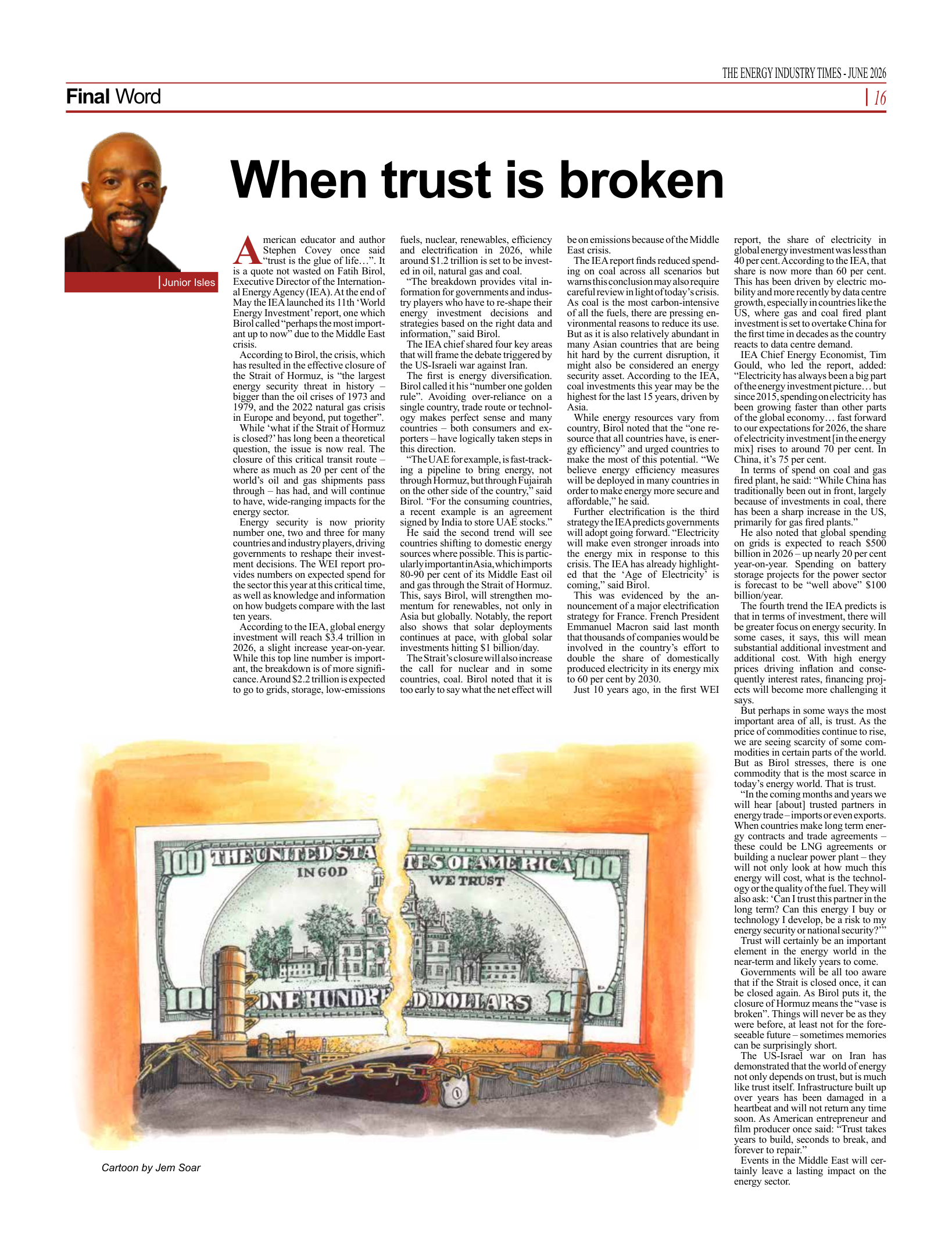
But perhaps in some ways the most
important area of all, is trust. As the
price of commodities continue to rise,
we are seeing scarcity of some com-
modities in certain parts of the world.
But as Birol stresses, there is one
commodity that is the most scarce in
today’s energy world. That is trust.
“In the coming months and years we
will hear [about] trusted partners in
energy trade – imports or even exports.
When countries make long term ener-
gy contracts and trade agreements –
these could be LNG agreements or
building a nuclear power plant – they
will not only look at how much this
energy will cost, what is the technol-
ogy or the quality of the fuel. They will
also ask: ‘Can I trust this partner in the
long term? Can this energy I buy or
technology I develop, be a risk to my
energy security or national security?’”
Trust will certainly be an important
element in the energy world in the
near-term and likely years to come.
Governments will be all too aware
that if the Strait is closed once, it can
be closed again. As Birol puts it, the
closure of Hormuz means the “vase is
broken”. Things will never be as they
were before, at least not for the fore-
seeable future – sometimes memories
can be surprisingly short.
The US-Israel war on Iran has
demonstrated that the world of energy
not only depends on trust, but is much
like trust itself. Infrastructure built up
over years has been damaged in a
heartbeat and will not return any time
soon. As American entrepreneur and
lm producer once said: “Trust takes
years to build, seconds to break, and
forever to repair.”
Events in the Middle East will cer-
tainly leave a lasting impact on the
energy sector.
When trust is broken
Junior Isles
Cartoon by Jem Soar
