
www.teitimes.com
June 2026 • Volume 19 • No 4 • Published monthly • ISSN 1757-7365
THE ENERGY INDUSTRY TIMES is published by Man in Black Media • www.mibmedia.com • Editor-in-Chief: Junior Isles • For all enquiries email: enquiries@teitimes.com
Sponsored Editorial From Hamburg to Madrid
With the addition of its PowerPods, AVK now
provides the entire power chain for a
data centre. Page 12
Following WindEurope in Madrid, TEI Times
spoke to Hitachi Energy’s Alfredo Parres
to hear the challenges facing offshore wind,
and the real progress that is being made.
Page 13
News In Brief
Fossil fuelled power
generation in structural
decline
Every OECD country in 2025 was
below its fossil-fuelled power gen-
eration peak for the rst time, indi-
cating a turning point in the transi-
tion away from fossil fuels.
Page 2
Trump anti-renewables
crusade takes effect
The Trump administration escalated
its crusade against renewable ener-
gy by stalling approvals for about
165 onshore wind projects waiting
for sign-off from the Department of
Defense.
Page 4
Chinese solar exports
double amid energy crisis
Data analysed by global energy
think-tank Ember shows that Chi-
na’s solar exports reached a record
6 in arch, double the previ-
ous month, amid high energy prices
due to the U-Israel war with Iran.
Page 5
UK smooths the way to new
green energy target for 2040
The UK government has accepted
the recommendation of its indepen-
dent Climate Change Committee to
set a legally binding goal of cutting
carbon emissions per cent by
200.
Page 7
Battery storage grows ‘at
blistering pace’
Installations of batteries that store
energy for later use surged by 48
per cent in 202 from the previous
year, according to new data from
BloombergNE.
Page 8
Energy Transition
Investment Series
TEI Times analyses ietnam’s cli-
mate pledges, electricity mi and
investment environment.
Page 14
Technology Review
Long duration energy storage is fast
emerging as the key solution to re-
duce wind curtailment, stabilise
grids, and ensure that clean energy
delivers its full value. Page 15
Advertise
advertising@teitimes.com
Subscribe
subscriptions@teitimes.com
or call +44 (0)1933 392987
The EU and the UK are cracking down on the use of Chinese components in its energy
sector, as the region looks to grow its use of renewables without jeopardising national security
by increasing dependence on foreign players. Junior Isles
Europe’s offshore wind expansion running into structural supply constraint
THE ENERGY INDUSTRY
TIMES
Final Word
When trust is broken things are
torn apart, says Junior Isles.
Page 16
The import of China-made energy in-
frastructure euipment to Europe is
coming under scrutiny, with the EU and
UK recently taking steps to block the
use of solar and wind power euipment
in projects due to security concerns.
Early last month, the European
Commission said imported inverters
used to control solar panel installa-
tions and other energy technology rep-
resented one of “the most pressing
threats” to the EU’s critical infrastruc-
ture and that any funding would be
stopped from November .
European Commission spokesper-
son Siobhan McGarry told reporters
the EU Executive has decided to take
“concrete action right now” against
the “risk of disruption of the EU’s crit-
ical infrastructure by foreign actors,”
including by “developing guidance on
restricting the use of EU funds for
projects involving inverters from
high-risk suppliers.”
uppliers from China, ussia, North
Korea and Iran are affected by the ban,
an unnamed EU ofcial told Politico,
but noted that Chinese suppliers hold
0 per cent of the global market share
of solar inverters. uawei is a market
leader in the technology.
igh-risk vendors already involved
in EU-funded projects can ask for an
eception, the EU ofcial said, and
the Commission will decide by No-
vember , whether to allow the proj-
ects to continue without restrictions
on which suppliers they can use.
ccording to carry, risks posed
by foreign interference in clean ener-
gy networks include manipulation of
“electricity production parameters”,
disruption of electricity generation
and unauthorised access to operation-
al data. This could mean a “remote
shutdown… leading to countrywide
blackouts”, she said.
Europe has taken an increasingly
restrictive approach to Chinese tech-
nology imports that it judges to be a
security risk or likely to undermine
key industrial sectors such as the car
industry.
The Commission has recently out-
lined its Industrial ccelerator ct,
which will eclude China from public
funding for other clean technologies
such as electric vehicles. eanwhile,
its cyber security act will exclude Chi-
nese companies such as uawei from
telecommunications networks and so-
lar energy systems.
In a statement, uawei said the
Continued on Page 2
Europe’s offshore wind expansion is
running into a structural supply con-
straint where the turbine market is
becoming increasingly concentrated,
says ystad Energy.
ccording to the Denmark-based
global independent research and ener-
gy intelligence company, E erno-
va, iemens amesa and estas have
historically anchored western off-
shore turbine supply, but with E
Ve rn o va h a vi n g p a us e d n ew o ff s ho r e
wind orders following a series of tech-
nical and operational setbacks, ie-
mens amesa and estas now ac-
count for virtually all turbines
available to European developers.
ystad Energy’s analysis of the off-
shore wind market outlines a sharp
increase in per-megawatt () costs,
with turbine selling prices rising by
between 40 per cent and 45 per cent
since 2020, outpacing manufacturing
cost increases of 20-25 per cent over
the same period.
“Europe’s offshore ambitions are
real, and the pipeline reects genuine
political commitment. But the mar-
ket has moved into structurally tight
territory: high demand, limited sup-
plier diversity and rising turbine
compleity. That combination gives
original euipment manufacturers
(OE) real pricing power and the
ability to be selective about which
projects get built,” said ander Baks-
joberget, Offshore ind esearch at
ystad Energy. “If Europe doesn’t
meaningfully epand estern manu-
facturing capacity or rethink how sup-
ply constraints are addressed in its
auction frameworks, it won’t deliver
its post-2030 targets at the pace or
cost the energy transition reuires, es-
pecially in the current climate that has
so much uncertainty as a result of the
iddle East conict.”
ricing pressure is most acute in the
turbine’s most comple components,
says ystad Energy. The nacelle,
which houses the generator, gearbo
and power electronics that convert
wind into electricity, sits at the centre
of current supply constraints, while
similar pressures are emerging in
blade manufacturing, driven by in-
creasing turbine sizes, longer produc-
tion cycles and the logistical demands
of transporting and installing
net-generation components.
The supply constraint is not evenly
distributed across the turbine value
chain. It is most pronounced in na-
celles and blades, where supplier con-
centration is high and substitution is
limited, while towers remain compar-
atively more eible, with a broader
supplier base and lower barriers to
entry.
ccording to ystad, the mi of tur-
bines being delivered between 2020
and 202 shows how uickly the mar-
ket has changed. Earlier years were
dominated by smaller -0 tur-
bines, while more recent deliveries
are shifting toward the larger 14-15
class. iemens amesa was rst
to move into bigger turbines, signing
contracts for its model ahead
of estas before moving into the
class, while estas’ 236-
grew in popularity from 202
onward. iemens amesa still holds
the larger overall share of deliveries,
cementing its position as the market
leader. This shift in turbine size is im-
portant context for understanding
price increases: the turbines being
built and installed today are signi-
cantly larger and more comple than
those from ve years ago, and that
compleity is reected in what OEs
can charge.
The 40-45 per cent rise in turbine
selling prices since 2020 cannot be
eplained by rising costs alone. In
2020-202, turbines were sold under
contracts that assumed relatively sta-
ble input costs, and when ination hit
hard through 202-2023, manufactur-
ers were locked into those agreements
and absorbed the losses themselves.
hen those contracts epired from
2023 onward, prices reset sharply and
the burden shifted to developers, who
now face higher turbine prices and
tighter contract terms. anufacturers
are recovering their margins on newer
deals, though protability across off-
shore divisions remains sueezed by
the costs of ramping up and scaling a
new generation of larger, more com-
ple turbines.
The key shift in the offshore turbine
market is not just the level of cost in-
ation, but how those costs are dis-
tributed across the value chain. ys-
tad Energy’s analysis models a
scenario where a 30 per cent increase
in selected input categories would
raise total manufacturing costs by
roughly per cent, reecting how
different components are eposed to
different cost drivers.
EU takes hardline against
EU takes hardline against
Chinese technology imports,
Chinese technology imports,
citing security concerns
citing security concerns
McGarry: the Commission is taking “concrete action right now”
audiovisual.ec.europa.eu

THE ENERGY INDUSTRY TIMES - JUNE 2026
2
OECD nations have reached a deni-
tive turning point, transitioning from a
historical peak in fossil fuel generation
to a sustained and structural decline,
according to recent report from UK-
based energy think-tank Ember.
Ember’s ‘Global Electricity Re-
view’ showed that record solar growth
meant clean power sources grew fast
enough to meet all new electricity
demand in 2025, thereby preventing
an increase in fossil generation, which
saw a small fall of 0.2 per cent. This
was the rst year since 2020 without
an increase in electricity generation
from fossil fuels and only the fth year
without a rise this century.
The analysis further shows OECD
fossil generation in 2025 was 19 per
cent below its peak. Since peaking in
2007, fossil fuel generation in OECD
has dropped 19 per cent (-1313 TWh),
lowering its share in the mix from 63
per cent to 48 per cent by 2025. This
shift resulted in a 28 per cent reduction
(-1477 MtCO2e) in OECD power
sector emissions. The rise in solar and
wind generation in this period (+2138
TWh) met both the fall in fossil gen-
eration (+1313 TWh) and also the rise
in electricity demand (+630 TWh) in
their entirety.
Every OECD country in 2025 was
below its fossil generation peak for
the rst time. Nearly all, 36 out of the
38, OECD countries saw fossil gen-
eration peak in 2019 or before. Tür-
kiye peaked in 2021, and Colombia
peaked in 2024. Two member states
– Iceland and Costa Rica – now oper-
ate zero-emission power systems, a
further seven maintain fossil share
below 10 per cent, while a group of
six nations remains heavily reliant on
fossil fuels for over 60 per cent of their
electricity generation.
Non-OECD fossil generation fell in
2025 as China peaks and India avoids
coal reliance.
Beyond the OECD, 2025 also
marked the rst year this century, out-
side the COVID affected 2020, in
which non-OECD fossil generation
fell, as China (-0.9 per cent) and India
(-3.3 per cent) both fell. China’s fossil
output declined as solar expanded
rapidly. India, meanwhile, is moving
towards clean energy without repli-
cating the coal heavy trajectory of
earlier industrialising economies.
The report said ambitious coal
phase-out targets, combined with rap-
id wind and solar deployment, have
allowed OECD nations to increasing-
ly decouple their electricity sectors
from fossil fuels in favour of a clean-
er power mix.
“For governments, this shift rep-
resents a strategic pivot toward ener-
gy sovereignty; by prioritising do-
mestically generated renewables,
countries are insulating themselves
from the price volatility and geopolit-
ical risks that accompany dependence
on global fossil fuel markets,” the
report stated.
The ndings came as the Interna-
tional Renewable Energy Agency
(IRENA) published a report showing
that the economics of solar and wind
energy paired with battery storage in
prime solar and wind regions deliver
round-the-clock power at lower costs
than fossil fuels.
Firm levelised costs of electricity
(‘rm costs’) for solar plus storage
range from $54-82/MWh in high-
quality resource regions, compared
with $70-85/MWh for new coal in
China and more than $100/MWh for
new gas globally.
Commenting on the report, IRENA
Director-General Francesco La Cam-
era said: “24/7 renewable power is
now cost-competitive with fossil fu-
els. The long-standing argument that
renewables lack reliability no longer
holds. Today, renewables can deliver
reliable, round-the-clock power. As
oil and gas markets remain exposed
to geopolitical shocks, including on-
going disruptions in the Strait of Hor-
muz, we must insulate our economies
with resilient renewable systems.”
Commission failed to provide “any
specic facts or technical evidence”
to back its decision.
“This restriction lacks an objective
and transparent basis, constitutes
origin-based discrimination, and
violates the principle of fair and
non-discriminatory treatment in
international trade... All suppliers
should be held to the same standards
of technical transparency and cyber
security,” Huawei said.
A report issued in late April by
Loom, a non-prot organisation
focused on economic, environmen-
tal and national security issues, said
dependence on Chinese green tech-
nology was making European coun-
tries vulnerable to cyber attacks,
trade restrictions and espionage.
The report co-authored by Mi-
chael Collins, a former deputy head
of national security strategy in the
UK Cabinet Ofce, said European
governments were failing to fully
account for such risks as they roll
out Chinese green tech in a bid to
secure energy supplies and address
climate change.
Collins told the Financial Times
that countries risked “sleepwalking
into a scenario where you’re sud-
denly confronted with a big nation-
al security problem”.
The report, co-authored by Mi-
chal Meidan, Director of the China
Energy Programme at the Oxford
Institute for Energy Studies and
based on interviews with energy
and national security experts, iden-
tied eight separate risks linked to
an over-reliance on Chinese green
technology.
Among the greatest was supply
chain disruption, according to the
authors, who argued that China was
likely to restrict supply of low-car-
bon technology and components.
Asked about the report, the foreign
ministry in Beijing said the essence
of China-EU trade relations was
“mutual benet and win-win out-
comes” and should not be “politi-
cised or subjected to an overly broad
security framing”.
Chinese ofcials dismissed con-
cerns about dependence on their
country’s green technology, say-
ing that Beijing has no intention
of using it for political advantage
and that cheap turbines, solar pan-
els and other renewable energy
products reduce the much greater
risk stemming from high carbon
emissions.
Loom’s Executive Director, Joss
Garman, said the recent fossil fuel
price shocks “should accelerate Eu-
rope’s energy transition but new
dangers arise because the cheapest
route runs so overwhelmingly
through China”.
Meanwhile, in late April, Chinese
wind turbine maker Ming Yang
Smart Energy accused the UK of
“politicisation” after the UK gov-
ernment ruled in March that Ming
Yan g cou ld no t dep lo y i ts p roduct s
in offshore projects in the country,
and rejected plans to invest £1.5
billion in manufacturing turbine
blades and other parts in the Scottish
Highlands.
Ming Yang’s Chair, Zhang Chuan-
wei, said in an interview with the
FT that the UK’s “politicisation” of
the investment would not only harm
Ming Yang but also “greatly under-
mine the sense of security Chinese
companies feel when entering the
British market”.
He said that he and other Ming
Yan g executi ves had spo ke n to th e
UK’s energy ministry, but the gov-
ernment declined to explain what
made its products a national securi-
ty threat.
Continued from Page 1
New research led by the University of
Oxford and University College Lon-
don (UCL), UK, has revealed that pol-
lution from coal red power plants is
signicantly reducing the energy out-
put of solar photovoltaic (solar PV)
installations, particularly where these
are expanding side-by-side.
The ndings, published in Nature
Sustainability, map and assess more
than 140 000 solar PV installations
worldwide using satellite data. By
combining this with atmospheric data
on air pollution, the researchers cal-
culated how much sunlight is lost and
how this reduces electricity genera-
tion. They found that aerosols – tiny
particles suspended in the air – re-
duced global solar electricity output
by 5.8 per cent in 2023. This is equiv-
alent to 111 TWh of lost energy – the
amount generated by 18 medium-
sized coal red power plants.
Crucially, these losses represent a
signicant and often overlooked
constraint on the clean energy transi-
tion. Between 2017 and 2023, new PV
installations added an average of
246.6 TWh of electricity each year,
while aerosol-related losses from ex-
isting systems reached 74.0 TWh an-
nually – equivalent to nearly one-third
of the gains from new capacity. This
highlights a previously unrecognised
interaction between fossil fuel use and
renewable energy, where emissions
from one system directly reduce the
performance of the other.
Lead author Dr Rui Song (Depart-
ment of Physics, University of Ox-
ford, and Mullard Space Science Lab-
oratory, UCL) said: “We are seeing
rapid global expansion of renewable
energy, but the effectiveness of that
transition is lower than often assumed.
As coal and solar expand in parallel,
emissions alter the radiation environ-
ment, directly undermining the per-
formance of solar generation.”
To identify the sources of these
aerosol-related losses, researchers
traced their origins and found coal
red power generation to be a major
contributor. This effect is particularly
evident in China, where solar and coal
capacity have expanded in parallel and
are often co-located. Regions with
high coal capacity aligned closely
with areas experiencing the greatest
solar PV losses.
China is the world’s largest solar
producer, and generated 793.5 TWh
of solar PV electricity in 2023 (41.5
per cent of the global total). But it also
experienced the largest losses from
aerosols, with total output reduced by
7.7 per cent. The researchers estimate
that around 29 per cent of aerosol-re-
lated solar PV losses in China come
specically from coal red power
plants. Coal plants emit ne pollution
particles that scatter and absorb sun-
light, reducing the amount that reach-
es nearby solar panels. As a result, the
panels generate less electricity than
they otherwise could.
Interestingly, China was also found
to be the only major region showing
a sustained improvement. Aerosol-re-
lated solar PV losses declined by an
average of 0.96 TWh per year (-1.4
per cent annually) between 2013 and
2023. This is likely due to stricter
emission standards and widespread
adoption of ultra-low-emission tech-
nologies within coal red power
plants, rather than a reduction in coal
capacity itself.
Co-author Dr Chenchen Huang
(University of Bath) said: “Our nd-
ings send a clear warning to the Sus-
tainable Development Goals: over-
looking pollution-induced solar
energy losses can lead to a systematic
overestimation of renewable energy
output by governments, businesses
and the broader community. To stay
on track, policies must account for this
hidden drag and shift fossil-fuel sub-
sidies away from coal.”
The Global Renewables Alliance
(GRA) has announced its 2026 corpo-
rate partners, bringing together leading
companies from across the renewable
energy value chain at a critical moment
for the global energy transition. As
countries and businesses face contin-
ued energy insecurity, price volatility
and growing pressure on competitive-
ness, the partnership underlines the
urgent need to accelerate the deploy-
ment of renewable power, grids and
storage.
This year’s partners include Fortes-
cue, Iberdrola, Arup, EDP, Hitachi,
Octopus Energy Generation, Ørsted,
SSE, SUNOTEC, and Vestas.
Together, these companies represent
a broad cross-section of the global
energy ecosystem, including develop-
ers, utilities, technology providers,
manufacturers, investors, advisors,
and major energy buyers. By partner-
ing with GRA, they contribute indus-
try expertise and strengthen the pri-
vate sector voice in support of tripling
global renewable energy capacity by
2030.
“Energy has become a dening issue
for economic stability and competi-
tiveness,” said Bruce Douglas, CEO
of the Global Renewables Alliance.
“The companies partnering with GRA
this year are demonstrating that re-
newables, combined with grids, stor-
age and electrication, are not only
the fastest and cheapest route to de-
carbonisation, but the foundation of a
secure and resilient energy system.
Turning ambition into implementa-
tion is now the priority.”
Across industries, partners high-
lighted the growing role of renew-
ables in addressing today’s energy
challenges.
Andrew Forrest, Executive Chair-
man and Founder at Fortescue, said:
“Volatile fossil fuel prices are a hand-
brake on global growth. Nations and
industries cannot build prosperity on
fuels that swing wildly in cost and
security. The only real pathway for-
ward is clear – replace fossil fuels with
abundant, predictable renewable en-
ergy. Fortescue is proving that heavy
industry can be decarbonised now, not
decades from now.”
Gonzalo Sáenz de Miera, Director
of Climate Change and Alliances at
Iberdrola, said: “Electrication is at
the heart of the response to today’s
security and competitiveness chal-
lenges, stemming from the continued
dependence of our energy model on
fossil fuels… Through our partner-
ship with the Global Renewables Al-
liance, we are joining forces with key
partners to accelerate electrication
worldwide and deliver meaningful
benets across society.”
Through their partnership with
GRA, the companies will share prac-
tical business experience and demon-
strate how renewable energy is al-
ready delivering tangible benets for
businesses and economies.
Headline News
Corporations join Global Renewables Alliance to strengthen energy security
Fossil fuelled power generation
Fossil fuelled power generation
in structural decline
in structural decline
Every OECD country in 2025 was below its fossil fuelled power generation peak for the rst
time, indicating a turning point in the transition away from fossil fuels. Junior Isles
Coal pollution reduces solar power output, study nds
Photo by www.pexels.com
THE ENERGY INDUSTRY TIMES - JUNE 2026
3
MESSE MÜNCHEN, GERMANY
—
The International Exhibition
for Energy Management and
Integrated Energy Solutions
n Ready for a 24/7 renewable energy supply: infrastructure for modern grids
n Efficiency through digitalization: intelligent grid monitoring and
management
n Balanced grids: unlocking and leveraging flexibility potential
n Industry meeting point: 100,000+ energy experts and
around 2,800 exhibitors at four parallel exhibitions
www.EM-Power.eu
SCAN FOR
ALL INFO
EU
P
VSE
C
43rd European
Photovoltaic Solar Energ
y
Conference and Exhibition
14 18
Sep
tember
WTC
World Trade Center
Rotterdam
The Netherlands
EUPVSEC.ORG
MEET THE GLOBAL PV COMMUNITY IN ROTTERDAM
The EU PVSEC is the leading global event for photovoltaics, combining a world-
class scientic conference with a dynamic industry exhibition. Researchers,
manufacturers and innovators come together to shape the future of solar energy.
Why participate?
• Showcase your innovations to an international PV audience
• Connect with industry leaders and decision-makers
• Increase your brand visibility in the growing solar market
Join the EU PVSEC 2026 in Rotterdam.
17, 18 & 19 November 2026
Köln Messe, Cologne, Germany
100% focused Exhibition on
Next Generation Power Transmission
and Distribution Technologies
• FREE ADMISSION to Qualified Visitors only – TSOs,
DSOs and Utilities – No Public Admission
www.powertranstech.com
4
TECHNOLOGY
PRESENTATION
STAGES
3
INTENSIVE
DAYS
220+
EXHIBITORS
2000+
VISITORS
THE ENERGY INDUSTRY TIMES - JUNE 2026
7
Europe News
Janet Wood
A Swiss parliamentary commission
has narrowly backed allowing the con-
struction of new nuclear power plants
in the country, endorsing an amend-
ment to the nuclear energy law by 13
votes to 12. It rejected proposals to
mandate state funding.
The Council of States has already
voted to lift the current ban. The Na-
tional Council will decide next,
though the nal word is likely to rest
with voters.
Opponents had sought additional
conditions, including a detailed
waste-disposal strategy, stronger pri-
oritisation of renewables and a revised
electricity supply plan. A proposal to
limit approval to fourth-generation
reactors also failed. A majority of the
commission argued that energy policy
should remain technologically neutral
and keep all options open. Some ar-
gued that lifting the ban would under-
mine planning certainty for renew-
ables and expose the public sector to
substantial nancial risks.
A separate proposal, the Stop Black-
out initiative, also seeks to lift the
current ban on nuclear new-build.
Since it published its 2017 Energy
Strategy, Switzerland has prohibited
new nuclear plants, while allowing
existing ones to operate as long as they
are safe. Swiss-based utility Axpo es-
timates that existing Swiss nuclear
plants, Gösgen and Leibstadt, can con-
tinue operating for another 80 years,
but under current plans Gösgen will be
disconnected from the grid by 2029
unless a new decision is made.
The discussion comes as Thomas
Sieber, Chair of Axpo, called for three
to four gas red power plants to be
added to Switzerland’s mix of hydro-
power and other renewables alongside
nuclear. e said gas red power plants
have major advantages because they
can be built relatively quickly and
bring eibility to the system.
“This gives us time to expand other
capacities and, from an economic per-
spective, is also the most cost-effec-
tive option for winter electricity in the
next few years or even decades,” said
Sieber.
Sieber also spoke out in favour of
focusing funding more on winter pow-
er and promoting the expansion of wind
power. Switzerland must act now to be
able to guarantee sufcient winter elec-
tricity and security of supply by 2050.
Electricity prices are likely to decline
in the medium term. More and more
renewable energies are coming into the
system worldwide, which have a
price-dampening effect, said Sieber,
who will relinquish his role as Axpo
Chair at the end of May.
eanwhile, po has ofcially
opened its largest solar PV array in
northwestern Spain. The Vilecha facil-
ity comprises four photovoltaic plants
with a combined capacity of 200 MW.
Germany has announced plans to join
a new Important Project of Common
European Interest (IPCEI) on innova-
tive nuclear technologies, making
fusion energy a strategic priority
alongside EU partners, while the gov-
ernment has pledged over €2 billion
for research and pilot projects to 2029.
The new IPCEI aims to bring togeth-
er research institutions, start-ups and
industry across Europe, with project
launches targeted for 2027.
Fusion is being supported despite still
being in the experimental stage. Euro-
pean fusion companies and industry
groups recently called for greater pub-
lic support of private sector projects
and a dedicated regulatory framework
distinct from that governing nuclear
ssion, in an open letter to the EU warn-
ing that Europe must “seize the
opportunity” or risk falling behind
countries such as the US, China, Japan
and Canada.
The US attracted more than 70 per
cent of global private fusion funding
last year, with deals worth $2.6 billion,
while Europe accounted for about $600
million in venture capital investment
during the same period. Europe lacks
large government-backed pro-
grammes, with the exceptions of the
UK and Germany.
Mark Cupta, a fusion investor at ven-
ture capital rm relude entures, said
that as start-ups moved from laborato-
ry experiments towards commer-
cial-scale devices, companies would
require “at least an order of magnitude
more capital”.
HSCALE, the hyperscale data centre
rm backed by Bain Capital, has an-
nounced the nancial closure of its
second large-scale data centre campus
in Settimo, Milan, Italy. The transac-
tion brings HSCALE’s total commit-
ted power capacity in the Milan met-
ropolitan area to 250 MW, with
ready-for-service dates in 2028.
The combined Milan investment rep-
resents more than €2 billion of capital
deployment in the region, where
pre-construction and procurement ac-
tivities are already underway. The
company said all major hyperscalers
are already present and growing in this
area, making it a primary deployment
zone for cloud infrastructure in South-
ern Europe.
Oliver Schiebel, HSCALE Chief
Executive, said: “Milan is one of the
strongest hyperscale markets in Eu-
rope and we are committing around
€2 billion to this region because we
understand what the market needs,
and are serious about its growth po-
tential. Our team closed the second
site, secured the power and is already
progressing through pre-construc-
tion, ensuring we deliver real capaci-
ty, as fast as possible.”
HSCALE’s energy strategy in Milan
is designed around a diversied supply
mix, with nearly 50 per cent of power
sourced from renewable generation
including solar, wind and hydroelec-
tric. It has a ‘structural partnership’
with Aquila Clean Energy, which it
says provides integrated access to
clean energy supplies rather than rely-
ing solely on standard power purchase
agreements.
Ocean Winds (OW) has started elec-
tricity production at its 30 MW Éoli-
ennes Flottantes du Golfe du Lion
(EL) oating offshore wind farm.
The pilot wind farm, 16 km off the
coast, aims to demonstrate the viabil-
ity of oating offshore wind develop-
ment and construction
Marc Hirt, Country Manager for
France at Ocean Winds, said: ”The
start of electricity production for
EFGL is an important milestone for
France’s energy sovereignty and for
oating wind more broadly.”
Meanwhile Nexans, RTE and Su-
perGrid Institute have announced the
launch of RHODÉ (Raccordement
HVDC Offshore Distant Électrique),
a collaborative project to develop
oating DC electrical connections
for large-scale offshore wind farms
installed in deep waters, far from the
coast.
The group said large-scale deploy-
ment of offshore wind is potentially
leading to the development of sites
located at depths greater than 100 m
and several tens of kilometres from
the coastline. Under these conditions,
traditional solutions with ed bot-
tom substations may reach their tech-
nical and economic limits. It said
RHODÉ forms the missing link be-
tween research projects already un-
derway and the industrial realisation
phase of the rst 320 k or 2 k
oating DC connections, envis-
aged from 2040 onwards.
Janet Wood
The UK government has accepted the
recommendation of its independent
Climate Change Committee to set a
legally binding goal of cutting carbon
emissions 87 per cent by 2040.
The decision comes as the govern-
ment announced reforms that will give
Parliament the authority to approve
critical energy schemes and protect
infrastructure projects from judicial
review.
The proposal would allow Parlia-
ment to designate and approve the
most important clean energy projects
as being of ‘Critical National Impor-
tance’ (CNI), reducing the exposure
from judicial review on all but human
rights grounds.
or all other nationally signicant
infrastructure – including transport and
water projects – the government will
introduce a ed legal challenge win-
dow, at the end of which the planning
consent could be updated to address
any legitimate issues. Courts would
refuse permission for a judicial review
on any issues not brought up during the
consenting period or in the challenge
window. The government is also ex-
pected to allow promoters of smaller
energy projects to apply directly to the
Planning Inspectorate, to support fast-
er decision-making on generation and
transmission.
A Treasury spokesperson said: “For
too long, vital infrastructure delivery
has been delayed by judicial reviews
of projects the country needs. The
Chancellor won’t stand for it any lon-
ger and is bringing forward bold
changes to support delivery.”
The government has also recently
made changes that would help offshore
wind developers. Until now, develop-
ers faced strict limits on the types of
environmental compensation they
could offer. The new rules open up a
wider range of options.
Marine Minister Emma Hardy said:
“Offshore wind power is a key driver
of our mission to make Britain energy
secure and tackle the climate crisis.
As we build the clean energy infra-
structure our country needs, these
reforms mean that we can also deliver
real, lasting benets for nature, from
restoring native oyster beds to pro-
tecting seabird colonies for future
generations.”
Meanwhile Schroders Greencoat and
Carlton Power have reached Final In-
vestment Decision (FID) on the 30
MW Barrow Green Hydrogen Project
in Cumbria.
The project, which is being delivered
by Green Hydrogen Energy Company
(GHECO) saw the signing of a Low
Carbon Hydrogen Agreement with the
UK government in June 2025, follow-
ing the government’s rst ydrogen
Allocation Round. GHECO is target-
ing a 200 MW portfolio of green hy-
drogen projects in the UK by 2030.
Kristian Høeg Madsen, Co-Head of
Hydrogen Investments at Schroders
reencoat, said: “e have signicant
ambitions to grow the GHECO plat-
form – reaching Final Investment De-
cision on Barrow is therefore a key
milestone for Schroders Greencoat, as
well as the UK’s emerging hydrogen
economy.”
UK smooths the way
UK smooths the way
to new green energy
to new green energy
target for 2040
target for 2040
Two more data centres totalling
250 MW planned for Milan area
Germany backs fusion as industry calls for EC support
Floating wind plant starts generation
n Permitting and nature protection rules reformed
n Final investment decision on green hydrogen plant
Switzerland moves closer to new
nuclear build
n Commission joins voices in favour n Axpo chief calls for gas plants in addition
Photo by Pexels.com

Ve st a s h a s w o n a 1 86 M W t u rb i ne
order from EDF Power Solutions
North America for the Forêt Domani-
ale Wind Project. The order includes
28 EnVentus V162-6.2 MW wind tur-
bines and 2 EnVentus V162-6.0 MW
along with a 10-year service agree-
ment. Turbine delivery is expected in
Q2 2027, with commissioning expect-
ed in Q4 2027. This is the third project
that EDF has secured through Hy-
dro-Québec’s call for tenders.
In addition, Equinor, through its
subsidiary Rio Energy, acquired the
Esquina do Vento wind project from
Ve st a s. T h e 2 30 M W pr o je c t i s l oc a t-
ed in the state of Rio Grande do
Norte in northeast Brazil. Addition-
ally, Equinor entered into a wind tur-
bine supply agreement with Vestas
for the same project. As per the sup-
ply agreement, Vestas will supply 51
V163-4.5 MW turbines, with instal-
lation scheduled to commence in
March 2027.
Wärtsilä will supply an off-grid pow-
er solution for a new data centre facil-
ity under construction in Texas, USA.
The 790 MW power plant will operate
with 42 Wärtsilä 50SG engines run-
ning on natural gas.
The Wärtsilä equipment is sched-
uled for delivery in 2028, and the
plant is expected to become fully op-
erational in late 2029. This is Wärt-
sil’s fth data centre related order in
the U and its rst in Teas. lto-
gether, Wärtsilä has thus far sold
over 2.4 GW of power capacity for
US data centres.
AtkinsRéalis has announced that it has
signed a Strategic Alliance Agreement
with First American Nuclear (FNCO)
to be the engineering, procurement,
and construction management
(EPCM) provider for EAGL-1 SMR
projects in North America. The agree-
ment contemplates services worth up
to 20 million over the rst ve years.
Under the rst task orders, tkins
Réalis will prepare procedures and
policies required to do design work,
such as a quality programme and
engineering procedures. It will also
undertake the conceptual design for
the balance of plant and review the
design of the nuclear steam supply
system.
EAGL-1 is the only US nuclear re-
actor design cooled by lead-bismuth,
a liquid metal alloy that has been
used in successful nuclear systems
abroad for decades. The unique
properties of lead-bismuth enable a
simpler, more compact reactor de-
sign with fewer components and re-
duced complexity.
Electroguayas, Ecuador’s state power
generator, has awarded a $20 million
contract to upgrade the 90 MW Santa
Elena II thermal plant to HH Interna-
tional of South Korea. HH Internation-
al will increase the capacity of the
plant to 108 MW.
The plant came online in 2011 and
comprises 53 9H21/32 model en-
gines which use diesel for startup
and then operate on fuel oil.
Electroguayas said that Santa Ele-
na’s expansion will reduce depen-
dence on eastern basin reservoirs and
electricity imports during droughts
and El Niño events as well as
strengthen grid stability and voltage
quality, while fast-start internal com-
bustion engines will help meet peak
demand and offset sudden supply
disruptions.
Wärtsilä has signed two equipment
supply contracts with Origem Energia
to develop new balancing power proj-
ects in Brazil. The contracts are for the
supply of two batches of 18 Wärtsilä
34SG balancing engines.
The projects are the Pilar and Pilar
Nova power projects, scheduled to
start operations in October 2028, and
the Manguaba I-V projects, sched-
uled to start operations in August 2.
South Korea’s Hanwha Power has
signed an MOU with Canadian infra-
structure company Pembina Pipeline
to collaborate on green power gener-
ation projects.
Under the terms of the agreement,
Hanwha Power will explore apply-
ing waste heat recovery power gen-
eration systems to Pembina’s pipe-
line compressor stations and gas
infrastructure facilities. Hanwha
Power’s waste heat recovery power
generation system is a next-genera-
tion technology that uses carbon di-
oxide in a supercritical state.
Indonesian state utility PLN has
awarded a 45 MW hydropower project
contract valued at $116 million to
Kencana Energi Lestari (KEEN). The
hydropower plant will be developed
in Pakkat district, Humbang Hasun-
dutan Regency, North Sumatra.
Giat Widjaja, Finance Director of
KEEN, said: “The Pakkat 2 hydro-
power plant is estimated to require
an investment of around $116 mil-
lion, with a construction target of ap-
proximately four years. We are cur-
rently awaiting the signing process
for the Power Purchase Agreement
with PLN before entering the con-
struction phase.”
Indonesia has been accelerating re-
newable-energy development as part
of its broader strategy to reduce de-
pendence on fossil fuels and meet
long-term climate commitments.
DeepOcean has secured a contract for
the installation and support of in-
ter-array cables at the TPC offshore
wind farm phase 2 (TPC-II) offshore
Taiwan. The scope of the contract
covers installation of inter-array ca-
bles, as well as engineering and proj-
ect management services.
The 295 MW project, located 6.5-
20 km off Lukang in Changhua
County, will feature 31 Vestas 9.5
MW turbines installed on jacket
foundations. The turbines will be
connected via three 66 kV inter-ar-
ray cable loops to an offshore sub-
station, with power exported to shore
through three export cables.
The offshore work will be carried
out with Dong Fang Offshore using
the chartered subsea vessel Orient
Adventurer. The work will com-
mence immediately and be complet-
ed during 2026.
South Korea’s Ministry of Climate,
Energy, and Environment has an-
nounced plans to build ten GW-scale
solar power complexes in and near the
greater Seoul area as part of a push to
expand renewable energy capacity and
lower electricity generation costs. This
is part of the ministry’s plan to achieve
100 GW of renewable energy capacity
by 2030.
The government said it will identi-
fy ten agship solar power projects
by 2030, including sites in the Si-
hwa and Hwaong districts. Other
potential locations include Pyeong-
taek Port and Lake Pyeongtaek, for-
mer coal red power plant sites in
the Chungcheong region, and border
areas spanning northern Gyeonggi
Province and Gangwon Province.
Each project will have capacities
ranging from 1 GW to 1.4 GW.
The Asian Development Bank (ADB)
has signed a 6 million nancing
package with ACWA to develop a 300
MW wind power plant in Uzbekistan’s
Bukhara region.
The new facility, Bash 2, extends
the Bash ind ower roject co--
nanced in 2023. Bash 2 will feature
39 turbines, each up to 8 MW, a
35/500 kV substation, and transmis-
sion lines connecting to the national
grid.
The nancing includes 0 million
from ADB’s ordinary capital resourc-
es, $41 million from commercial
lenders with ADB as the lead arrang-
er, as $25 million from the Leading
Asia’s Private Infrastructure Fund 2
(LEAP 2).
RenewRome, a special purpose vehi-
cle owned by Kanadevia Inova, Acea,
Suez, Vianini Lavori and RMB, has
been selected to build and operate a
new waste-to-energy (WtE) plant for
the Municipality of Rome. Kanadevia
Inova will act as the EPC contractor
and will be responsible for plant main-
tenance for 30 years.
The new WtE facility is located in
Santa Palomba, 25 km southwest of
Rome. The new plant will treat
around 600 000 tonnes of non-recy-
clable waste annually and generate
around 6 . The ue gas treat-
ment (FGT) system consists of a
semi-dry unit, a wet scrubber, and a
selective catalytic reduction system
for nitrogen oxide reduction.
Construction work began last
month, and the rst waste delivery is
scheduled for autumn 2029.
Nordex has won orders from West-
fälisch-Niedersächsische Energie
(WNE) for the supply and installation
of 12 N175/6.X wind turbines. The
turbines will be installed across three
projects in the district of Höxter in
North Rhine-Westphalia. The total ca-
pacity of the orders amounts to 82 MW.
The contracts also include a service
agreement for the turbines for 20 years.
Seven turbines will be deployed at
the Dringenberg project, three tur-
bines at the Gehrden Ost project, and
two turbines at the Gehrden Fölsen
extension project. Construction work
is scheduled to start in mid-2027.
Mott MacDonald is providing lend-
er’s technical and environmental sup-
port to the West Wales Hydrogen
project, a production facility that will
deliver 2000 t of low-carbon hydro-
gen annually.
Developed by MorGen Energy, a
large-scale green hydrogen ecosys-
tems developer, West Wales Hydro-
gen is claimed to be the rst proj-
ect-nanced green hydrogen project
in the UK and Europe.
Located at the former oil renery
site in Milford Haven within the
Celtic Freeport of Wales, the project
will feature a 20 MW electrolyser
system supplied by hefeld-based
ITM Power that will be used to pro-
duce the green hydrogen.
Mott MacDonald provided techni-
cal due diligence on the project’s de-
sign, contracting structure, construc-
tion and operational plans, cost and
schedule assumptions, as well as key
risks.
The company is now advising the
lenders on bankability and ongoing
monitoring requirements.
The Ukraine government has an-
nounced that it will hold a competition
to award 322 of new eible
generation in the most energy-decient
regions. Prime Minister Yulia Svy-
rydenko said that these include the
Kyiv and Cherkasy regions (250 MW),
the Sumy, Kharkiv, and Poltava regions
(872 MW), Dnipropetrovsk (100
MW), and Odesa regions (100 MW).
An incentive mechanism will be
provided for participants. The maxi-
mum term for commissioning new
capacities is 20 months.
GE Vernova has won an order from
Middle Delta Electricity Production
Company (DEC), an afliate of
Egyptian Electricity Holding Compa-
ny (EEHC), for projects at MDEPC’s
Bahna and Nubaria power plants in
Egypt. The scope includes two Ad-
vanced Gas Path (AGP) upgrades for
the two GE Vernova 9F gas turbines at
the Bahna power plant, along with
multi-year services agreements for
Bahna and Nubaria with terms of 15
and eight years, respectively.
The upgrades are expected to in-
crease plant output while improving
efciency by about 2 per cent.
Genesis Energy and Saft, a subsidiary
of TotalEnergies, have signed a con-
tract for a 200 MWh extension for the
Huntly battery energy storage system
(BESS). The expansion builds on the
original 100 MW / 200 MWh BESS at
Huntly Power Station on New Zea-
land’s North Island.
With this expansion, Huntly is set
to become one of the largest BESS
sites in the country, reaching a poten-
tial output of 400 MWh, co-located
with a .2 gas and coal red
power station.
Eurus Energy Holding’s Aeolus SAS
(Aeolus) has completed two 50 MW
solar power plants in Tunisia, repre
-
senting Eurus’s rst renewable energy
projects in Tunisia.
The 50 MW solar power plants are
located in Sidi Bouzid Governorate
and Tozeur Governorate and will
supply electricity to approximately
120 000 households in Tunisia.
Operations will be carried out by
operating companies jointly owned
by Aeolus (49 per cent stake) and
Scatec ASA, a Norwegian renewable
energy solutions provider (51 per
cent stake).
Americas
Asia-Pacic
Vestas wins 186 MW
Québec turbine order
AtkinsRéalis wins SMR
EPCM contract
PLN awards $116 million
hydropower contract
DeepOcean wins Taiwan
offshore wind contract
South Korea to build ten
large-scale solar complexes
ADB and ACWA support
Uzbekistan wind power
Waste-to-energy plant to
be built in Rome
Nordex wins 82 MW
German turbine orders
Support for West Wales
Hydrogen project
Ukraine seeks 1.3 GW of
eile eneration
GE Vernova wins upgrade
contracts in Egypt
Next phase of New
Zealand’s Huntly BESS
Aeolus supplies solar
plants to Tunisia
Wärtsilä wins Brazil grid
balancing contracts
Off-grid energy for data
centre in Texas
International
Europe
10
THE ENERGY INDUSTRY TIMES - JUNE 2026
Tenders, Bids & Contracts
Hanwha Power MOU for
Canada green energy
HH International to
upgrade Santa Elena II

Sponsored Editorial
THE ENERGY INDUSTRY TIMES - JUNE 2026
12
D
ata centre construction has always been a
balancing act between speed, scale and resil-
ience. That balance is being tested as never
before. AI workloads are pushing power densities
into territory the industry was not initially prepared
to handle, and operators are being asked to deliver
capacity at a pace that traditional build models strug-
gle to support. The constraint is no longer just land
or chips. It is power, and more specically, the abil-
ity to get power into the building, congured cor-
rectly, and operational on schedule.
This is where the modular electrical switchroom
has quietly become one of the most important
components in the data centre stack. As of recently,
AV K h a v e p o s i t i o n e d t h e m s e l v e s a s a n e x p e r t p r o -
vider of this technology, completing their full
power chain offering.
A gap in the power chain
For all the talk of end-to-end energy partners, the
reality has been that data centre operators have
rarely been able to source their full power infra-
structure from a single provider. Generators have
come from one supplier, switchgear from another,
UPS from a third, and the integration risk has sat
squarely on the operator or main contractor. Mod-
ular electrical switchrooms, the containerised units
that house the critical electrical infrastructure re-
sponsible for safely distributing power throughout
the facility, have typically been a separate procure-
ment exercise altogether.
AV K h a s s p e n t m o r e t h a n 3 6 y e a r s b u i l d i n g e x p e r -
tise in uninterruptible power supplies, standby
power, prime power and control systems. The
component that now completes the picture, the
modular switchroom, was the missing piece. With
the launch of AVK PowerPods, that gap has closed.
PowerPods are fully integrated, pre-engineered,
transportable units that consolidate transformers,
switchgear, UPS, batteries, circuit breakers, cooling
integration, control panels, re suppression, and
distribution boards into a single containerised
solution. Each unit arrives ready to connect and
deploy. With this addition, AVK now provides the
entire power chain for a data centre, covering every
part of the energy lifecycle from generation through
distribution to ongoing maintenance.
AI as the forcing function
The timing of this launch is no accident. Hyperscale
operators and AI infrastructure providers are placing
demands on power delivery that did not exist even
three years ago. Training clusters require contiguous
blocks of power measured in tens or hundreds of
megawatts. Inference workloads need facilities op-
erational quickly enough to keep pace with model
deployment cycles. And the projected growth in AI
compute means that capacity planning is now a con-
tinuous activity rather than a periodic one.
Traditional build models are struggling to keep up.
Stick-built electrical rooms, constructed on site
alongside the rest of the facility, are exposed to
weather, labour availability, supply chain disruption
and the sequential dependencies of site programmes.
Lead times for individual components such as
transformers and switchgear have stretched in re-
cent years, and operators have absorbed both the
cost and the schedule risk.
The modular approach reorders this equation. By
moving construction off-site into a controlled facto-
ry environment, integration testing can be complet-
ed in advance, quality is more consistent, and the
unit arrives at the data centre as a tested system
rather than a collection of parts waiting to be assem-
bled. Construction time on site is reduced, and the
operator gains condence that the euipment has
been validated as an integrated whole.
Built for scale at Haydock
AV K h a s i n v e s t e d i n a 1 4 0 0 0 0 f t
2
facility in Haydock,
northwest England, designed specically to support
the volume that hyperscale and AI infrastructure
projects require. The facility has the capacity to house
22 to 25 PowerPods at any one time, depending on
size, with most units up to 18 m in length and 4.2 m
wide. Multiple access routes allow for fast delivery
to project sites across the UK and into Europe.
The scale of the facility matters because it reects
the scale of the underlying demand. PowerPods are
not a bespoke engineering project repeated occa-
sionally. They are a productionised offering de-
signed for mass deployment, and the factory has
been built around that operational reality. At the
same time, the facility supports full customisation
within each unit, so operators retain the ability to
specify the technology conguration that suits their
requirements.
Technology agnostic by design
One of the structural problems with traditional pow-
er infrastructure procurement is that operators often
end up locked into a single manufacturer’s ecosys-
tem. The choice of UPS dictates the switchgear, the
switchgear dictates the controls, and the architecture
becomes rigid before the facility is even built.
AV K ’ s a p p r o a c h i s d e l i b e r a t e l y d i f f e r e n t . P o w e r -
Pods are designed to be technology-agnostic,
meaning the operator chooses the best component
for each function rather than accepting a bundled
solution. AVK acts as an energy partner, consulting
on the optimal conguration for the project at hand
and sourcing equipment accordingly. The result is
genuine eibility, better lead times due to a broad-
er supply base, and an outcome tailored to the facil-
ity’s specic operational prole.
This matters more in the AI context than in con-
ventional cloud workloads. AI infrastructure has
different thermal proles, different load patterns,
and different redundancy requirements, and the
right technology stack for one operator will not be
the right stack for another. The supplier agnostic
model accommodates that variation in a way that
single-vendor solutions cannot.
A complete proposition
The strategic shift represented by PowerPods is that
AV K i s n o w i n t h e b u s i n e s s o f d e l i v e r i n g h o l i s t i c
and complete power solutions. Generators, UPS,
switchrooms, controls and service all come from the
same partner, which means a single point of account-
ability across the power chain and a single design
philosophy guiding the integration.
Ben Pritchard, CEO at AVK, sees this as the cul-
mination of a long-term direction of travel. “The
launch of AVK PowerPods reinforces our position
as one of the few businesses capable of designing,
delivering and supporting the entire data centre
power ecosystem, at scale, with true eibility and
with the engineering depth that critical infrastruc-
ture demands. PowerPods complete our proposition
to the market. With our ready-to-deploy model, we
are perfectly positioned to support the next wave of
hyperscale data centres and AI infrastructure.”
What this means for the industry
For data centre operators planning their next wave
of capacity, a credible single-source provider for the
full power chain changes the procurement conver-
sation. Integration risk moves to the supplier, sched-
ule certainty improves, and the operator can focus
on the workload-facing decisions that actually dif-
ferentiate their service. The cost of complexity in
multi-vendor power procurement has always been
hidden in programme overruns and commissioning
delays, and removing it has tangible value.
The wider industry implication is that modular,
factory-built power infrastructure is becoming a
necessity rather than a nice-to-have for projects
above a certain scale.
AI has accelerated this transition because the al-
ternative, slower stick-built construction, is no lon-
ger viable at the pace operators need. PowerPods
are AVK’s answer to that shift, grounded in 36 years
of critical power expertise and now positioned at the
centre of how hyperscale facilities will be powered
for the foreseeable future.
AVK has spent more than 36 years building expertise in uninterruptible power supplies,
standby power, prime power and control systems. With the addition of PowerPods, it now
provides the entire power chain for a data centre, covering every part of the energy lifecycle
from generation through distribution to ongoing maintenance.
AVK’s CEO, Ben Pritchard:
PowerPods complete our
proposition to the market
Solving the power bottleneck
holding back AI data centres
I
t was not long after the start of
Russia’s war against Ukraine
that gas and subsequently elec-
tricity prices, began to spiral across
much of the EU. The crisis brought
the realisation that in order to meet
its decarbonisation goals, while en-
suring energy security, Europe must
double-down on efforts to deploy
home-grown renewables such as
offshore wind. The war in Iran pro-
vided another stark reminder as to
why this is paramount.
At the North Sea Summit in Ham-
burg in January this year, European
leaders committed to an accelerated
and more consistent expansion of
offshore wind. And in April at the
WindEurope Annual event in Ma-
drid, just three months after the
Hamburg summit, the industry took
stock of the current situation and
what needs to be done.
In a statement, WindEurope said:
“Europe needs to move from crisis
to condence The war in Iran re-
minded Europe, again, that it needs
to replace imported fossil fuels with
homegrown, secure electricity. Off-
shore wind delivers the energy Eu-
rope needs. It is homegrown, scal-
able and cost-effective. Offshore
wind helps lower electricity costs
for households and businesses. And
it shields Europe from geopolitics
and fuel price swings.”
The North Sea Summit 2026 saw
the governments of Belgium, Den-
mark, France, Germany, Ireland,
Luxembourg, the Netherlands, Nor-
way and the United Kingdom, to-
gether with wind industry players,
and Transmission System Operators
(TSOs) of the electricity and hydro-
gen networks agree the ‘Joint Off-
shore Wind Investment Pact’ for the
North Seas.
All signatories of the Hamburg
Declaration committed to “working
together towards a shared ambition:
to scale offshore wind energy to the
levels required for Europe’s decar-
bonisation, to enable hydrogen as a
complementary energy carrier to
offshore renewable electricity
(where cost-efcient), to ensure af-
fordable and secure energy for citi-
zens and businesses, and to
strengthen Europe’s industrial base
and technological leadership”.
The Hamburg Declaration provid-
ed the political signal Europe’s off-
shore wind supply chain needed.
Governments agreed to contribute to
the build-out of 15 GW of offshore
wind annually from 2031-2040.
CfDs offer visibility on future rev-
enues and help de-risk new wind
energy investments. The volume
commitments offer visibility for
manufacturers and supply chain to
invest in factories, ports and
services.
WindEurope also highlighted the
huge role that industry has to play.
“As its contribution to the Hamburg
Declaration, the European wind in-
dustry committed to cut the costs of
offshore wind by 30 per cent by
2040, compared 2025 levels. This
will come through lower nancing
costs, de-risked projects and faster
industrialisation,” said Tinne van
der Straeten, WindEurope CEO.
“The industry is already delivering.
We are investing in projects, manu-
facturing capacity and skills. And
stepping up on security.”
Yet delivering on the goals re-
mains a tall order. One major obsta-
cle is grid buildout. Commenting on
the threat, Alfredo Parres, Hitachi
Energy’s Global Head of Renew-
ables, and Wind Europe Executive
Committee member, said: “It’s real;
we already see it. If you look
around the world, hundreds of giga-
watts are waiting in connection
queues. But the good thing about
the situation is that the problem is
too big to be ignored. It’s very
much a central topic and we don’t
need to convince people that the
challenge needs to be addressed.
[But] maybe we need to push a bit
further to say grids are not just im-
portant – they are a strategic asset,
especially when you think about the
security agenda.”
Pointing out the impacts of the
grid situation, Parres noted that ca-
pacity cannot be connected on ei-
ther the generation or demand side.
“Industries cannot connect to get
more power, and operating units are
curtailed because the grids are satu-
rated or the energy they put on the
market cause negative prices,” he
said.
Spain, for example, which was a
success story in terms of renew-
ables deployment, has been at a
standstill for a while, resulting in
negative prices. In the UK, where
large amounts of future offshore
wind capacity has been locked in
through its auction process, many
projects have no connection dates
before 2032/33.
Still, despite the challenges, Par-
res offered evidence of progress.
Since the Hamburg declaration, off-
shore wind generation targets have
been conrmed, with an emphasis
on hybrid projects that combine
wind power projects and intercon-
nection projects.
“The Hamburg declaration takes
the Copenhagen call to action from
WindEurope’s annual event last
year further in terms of the level of
detail of what needs to be done. It
highlights the need to have an inte-
grated system to deliver electrica-
tion, and nancing,” said arres.
“The UK’s AR7 [Auction round 7],
with an increased budget and secur-
ing 7 GW of new capacity, is a good
example of what can be done. And
indicates that AR8 could be just as
good as AR7.”
In countries like the Netherlands,
Denmark and Germany, where there
were failed auctions, governments
revised auction models to further
de-risk projects by moving to CfDs.
“For me, this is absolutely moving
in the right direction. It is the best
tool right now to help lock-in more
generation and more projects,” said
Parres.
Looking at the rest of the agenda,
he says there is a need to continue
working on the infrastructure – how
to put the offshore network in place.
“Cost allocation for projects that go
across countries is very tricky; very
sensitive and we need to it,” he
noted. “We need to talk about the
relationship between the UK and
EU so that we can be closer again
on the energy agenda.”
Continuing to build up the supply
chain and ensuring the huge genera-
tion plans turn into contracts must
be a priority. To this end, suppliers
like Hitachi Energy have been en-
tering framework or programme
agreements so that several projects
can be considered together in order
to create supply chain efciencies
and thereby reduce costs. This will
ultimately contribute to affordabili-
ty for consumers.
In its current investment pro-
gramme, Hitachi Energy has allo-
cated €9 billion to 2027 to ramp up
the manufacturing and resources
needed to meet the demand.
Parres noted: “This investment
comes with 15 000 people who will
be hired and trained to develop a
career in a satisfying, vibrant work
environment where they can grow.”
Notably, money and resources will
be invested in segments such as
transformers, circuit breakers and
high voltage direct current (HVDC).
This long term, frame agreement
approach was taken to not only
meet forecasted demand, but also to
address how project developers are
changing their market approach.
“When we saw how TenneT, for
example, came to the market with a
2 GW programme for HVDC –
bringing 11 connections to the mar-
ket in one go, and splitting those
volumes between three main suppli-
ers – that gave us visibility. It gave
us certainty on future needs and
provided the motivation for us to
invest big-time,” said Parres. “Simi-
larly, a programme agreement with
E.On on distribution transformers
over several years gave us clarity on
what was coming.”
While this will help deliver proj-
ects faster and cut costs, achieving
the 30 per reduction in LCOE,
which equipment manufacturers
agreed under the Hamburg declara-
tion, is multi-faceted.
Unit capacity factor, said Parres,
is the rst item the industry must
address. In the same way that a 15
turbine is more cost-efcient
than a 10 MW machine, a 2 GW
DC link is more efcient than a
1 GW link.
“Everything that brings more
power, reduces the cost of a kilo-
watt-hour; so size matters,” ex-
plained Parres. “Technology helps
us to increase power density.”
The second area is efciency, said
Parres. “If you can optimise how
the whole system is designed from
an electrical standpoint, you can re-
duce losses, which contributes to a
lower LCOE. Here, HVDC reduces
losses big-time.”
Standardisation, through things
like frame agreements, is the third
part of lowering LCOE said Parres,
citing the agreement signed in Ma-
drid with Danish renewables devel-
oper, Ørsted. Collaborating more
closely with project developers,
through such agreements allows
more optimised designs to be
brought to market.
But LCOE is not just about cost; it
is also about revenue. “With LCOE
we can also address revenue – get-
ting more through the lines, having
less curtailment; having more ener-
gy in the system,” said Parres. “The
point is, there is no single magic
bullet. It’s not about squeezing the
supply chain even more – we’re not
in favour of a race to the bottom –
reducing margins and putting the
industry in losses. We saw what
happened with wind turbine manu-
facturers. It’s better to collaborate;
increase efciencies so everyone
can make reasonable margins.”
He concluded: “Going forward
from Madrid, we need to think and
talk holistically. Move away from
point-to-point solutions to system
solutions, where all the stakeholders
develop, in a harmonious way, the
generation, grid and the offtake.
And combine it with longer term
planning This is where we need
to go and it’s where we are going.
That’s the mission I have left Ma-
drid with that’s the ag I’m ying.”
The energy crises, triggered by wars in Ukraine and Iran, have spurred Europe to accelerate its offshore wind
abition but the challenges are signicant ollowing the indEurope event in adrid Junior Isles caught up with
itachi Energys lfredo arres to discuss those challenges and what real progress is being ade
Offshore wind: from
Offshore wind: from
Hamburg to Madrid
Hamburg to Madrid
THE ENERGY INDUSTRY TIMES - JUNE 2026
13
Energy Outlook
Parres: “We need to think and talk
holistically… That’s the mission I
have left Madrid with”
Photo by pexels.com
of $15.5 billion. In addition, Vietnam
issued a Revised Power Development
Plan 8 (PDP8) and amended its Elec-
tricity Law.
Energy mix
Vietnam’s primary energy supply is
heavily dominated by fossil fuels. Coal
accounted for more than half of the
total mix and oil contributed a further
31 per cent in 2024. Natural gas plays
a relatively modest role at just over 7
per cent, while hydro represents only
7 per cent of supply. Non-hydro re-
newables barely register at 3 per cent,
and other sources are negligible. The
electricity generation prole is simi-
larly shaped by coal, which provided
just over half of all power produced,
also in 2024. Hydropower was the
second largest contributor at around
2 per cent, reecting the country’s
longstanding reliance on its river sys-
tems. Renewables made up a more
visible share of generation at 13.1 per
cent, though still far below the levels
required for a rapid transition. Natural
gas contributed 7.2 per cent, and there
was no contribution from oil and nu-
clear (see pie chart).
The amended PDP8, released in
April 2025, outlines a steep expansion
of electricity demand and system ca-
pacity through 2030 and 2050 (see
chart). Commercial electricity con-
sumption is projected to more than
double by mid-century, while total
capacity rises to over 205 GW by
2050 from roughly 90-100 GW in
2030. The plan accelerates a structur-
al shift towards renewables, with
non-hydro sources reaching up to
three-quarters of the mix by 2050,
alongside major growth in offshore
wind, solar, and storage. Coal is fully
phased out, while gas transitions
progressively towards hydrogen and
CCS-enabled technologies.
Transmission and distribution con-
straints and curtailment are, unsur-
prisingly, a key challenge to the path
to net zero for a nation experiencing
V
ietnam’s energy transition is
reaching a critical turning
point. Investors face a complex
mix of rapid growth and systemic chal-
lenges, as the country accelerates to-
ward 2050 net zero goals. Beyond the
potential for renewable expansion,
successful ventures require navigating
infrastructure bottlenecks, regulatory
shifts, and structural market hurdles.
Decarbonisation commitments
ietnam has taken signicant steps in
recent years on its path to decarboni-
sation, despite facing a great many
hurdles. The country updated its cli-
mate commitments under the Paris
Agreement through the publication of
its Nationally Determined Contribu-
tion (NDC) in October 2022. It raised
its targets to cut greenhouse gas emis-
sions. On its own, without outside
help, it pledged to reduce emissions
by 15.8 per cent below projected levels
by 2030, up from 9 per cent previous-
ly. ith international nancial sup-
port, that gure rises to 3. per cent,
compared to 27 per cent before.
The updated NDC is more ambi-
tious on paper, but independent as-
sessments suggest it falls short of
genuine progress, according to the
Climate Action Tracker, an indepen-
dent scientic assessment of national
climate action, as of late 2025. The
targets remain consistent with around
4°C of global warming and require no
major effort beyond policies already
in place. Vietnam did make stronger
promises at COP26 in 2021. The
commitments included a net zero goal
by 2050, a commitment to phase-out
coal, and cuts to methane emissions,
though these sit somewhat uneasily
alongside the modest NDC targets.
Importantly, the updated plan does set
out its funding requirements clearly.
The net zero emissions by 2050
target is anchored in the nation’s Na-
tional Climate Change Strategy, re-
leased in 2022. The strategy caps
2050 emissions at 185 MtCO
2
e, calls
for no new coal red power projects
after 2030, with gradual reduction of
coal capacity from 2035, and posi-
tions wind and solar as dominant
long-term sources. Also, the strategy
underlines reliance on international
nance. It signed a ust Energy Tran-
sition artnership (ET) with an In-
ternational Partners Group compris-
ing the EU, G7, Norway, Denmark,
Asian Development Bank, and IFC.
The ET carries a pledged pipeline
fast-paced growth in electricity de-
mand. The grid is strained by rapid
renewable growth, regional imbal-
ances, and outdated infrastructure.
Major upgrades, storage deployment,
and direct power purchase mecha-
nism market reform are now central
to easing congestion, attracting pri-
vate investment, and securing reliable
clean-energy expansion.
Investment environment
Vietnam has delivered strong GDP
growth in recent years, and most ex-
perts expect this to continue. Stripping
out ination, the economy grew at
around 6 per cent a year on average
over the past ve years. Construction
and industry are key drivers, backed
by a government commitment to $200
billion of infrastructure investment by
2030. The country’s credit rating is at
its highest-ever level, though it sits one
notch below what global investors
consider investment grade. Reaching
that threshold by 2030 is a stated gov-
ernment priority. The main risks are
rising ination, gradual currency de-
preciation, and Vietnam’s vulnerabil-
ity, as a heavily trade-dependent econ-
omy, to shifts in global demand and
geopolitical instability.
Regulations change fast: a key de-
cree on power purchase agreements
was scrapped and replaced within
eight months. Off-take agreements
lack government guarantees, some
state-owned buyers have withheld
payments to existing projects, and
grid bottlenecks in high-solar-re-
source regions create meaningful
curtailment risk. Foreign developers
have also felt the pressure of domestic
preference, with two high-prole e-
its in 2023 and 2024, and a 2026 off-
shore wind award going to a Vietnam-
ese conglomerate over a foreign
developer that had invested in the
project since 2019.
On the opportunity side, the pipeline
is substantial. Vietnam is targeting 73
GW of solar by 2030 against roughly
21 GW today. A new corporate power
purchase framework is opening direct
off-take routes for industrial buyers.
And a tripartite agreement signed in
2025 positions Vietnam as a potential
clean-energy exporter to Singapore
and Malaysia.
Policies and incentives
Vietnam has moved quickly to build a
comprehensive legal framework for its
energy transition. The Electricity Law
2024 sets the foundation, establishing
the rules for competitive wholesale
electricity markets, direct power pur-
chase agreements, and offshore wind
licensing. The PDP8, backed by a
committed investment envelope of
$136 billion in the power sector by
2030, translates that framework into
hard capacity targets and designated
renewable zones.
Two decrees issued in March 2025
add important detail. Decree 57 en-
ables direct power purchase agree-
ments between renewable generators
and large industrial consumers, with
a hedging mechanism built into the
wholesale market. Decree 58 sets out
the preferential terms for offshore
wind, including price ceilings by
TE ENE INDUT TIE - UNE 2026
Energy Transition Investment Series
14
Vietnam’s shift: navigating the 2050
Vietnam’s shift: navigating the 2050
decarbonisation map
decarbonisation map
ENERGY SUPPLY (left) AND ELECTRICITY GENERATION (right) IN VIETNAM IN 2024
region, though it requires a minimum
5 per cent state-owned enterprise
stake in each project.
Vietnam also launched an emissions
trading pilot in August 2025, cover-
ing around 150 facilities across ther-
mal power, cement, and steel. A car-
bon trading exchange at the Hanoi
Stock Exchange followed in early
2026. Full market operation is target-
ed for 2029.
Renewable energy projects can ac-
cess meaningful tax incentives, in-
cluding a 10 per cent corporate in-
come tax rate, a four-year tax holiday,
and import duty exemptions on
equipment.
Investor backdrop
ecent deal activity reects genuine
investor appetite, spanning both oper-
ational acquisitions and early-stage
development.
Sembcorp of Singapore acquired
majority stakes in three Vietnamese
wind and solar businesses for around
$131 million in 2024, bringing its
total in-country capacity to 455 MW
on completion. In the same year,
UK-listed Gresham House acquired
commercial and industrial rooftop
solar developer Asia Clean Capital
Vietnam through its SUSI Asia Ener-
gy Transition und. acico Energy
closed $28.5 million in local bank
debt for a 30 MW wind farm in 2025,
backed by a signed power purchase
agreement with EVN.
On the development side, Copenha-
gen Infrastructure Partners is advanc-
ing the 3500 MW La Gan offshore
wind project in partnership with a
local state-owned enterprise. A joint
development agreement between
PTSC, Sembcorp, and a Petronas and
TNB consortium is exploring a sub-
sea cable export route to Singapore
and Malaysia. Vietnamese conglom-
erate VinEnergo was awarded the 750
MW Hon Trau offshore wind project
in early 2026, ahead of a German
developer that had been involved
since 2019.
Development nance institutions
are also active. The IFC committed a
record 30 million in climate nance
to Vietnam in FY2024, the largest
such deployment across the East
sia-acic region that year.
Prepared for The Energy Industry
Times by Joseph Jacobelli of actE, a
cimate ine an nance inight
platform (asiacleantechenergy.com).
Key data from Vietnam’s revised Power Development Plan VIII
Energy supply (left) and electricity generation (right) in Vietnam in 2024
Vietnam’s energy transition strategy includes a net zero goal by 2050, a commitment to phase-out coal, and cuts
to methane emissions. Importantly, the plan also clearly sets out its funding requirements. TEI Times analyses the
country’s climate pledges, power mix and investment environment.
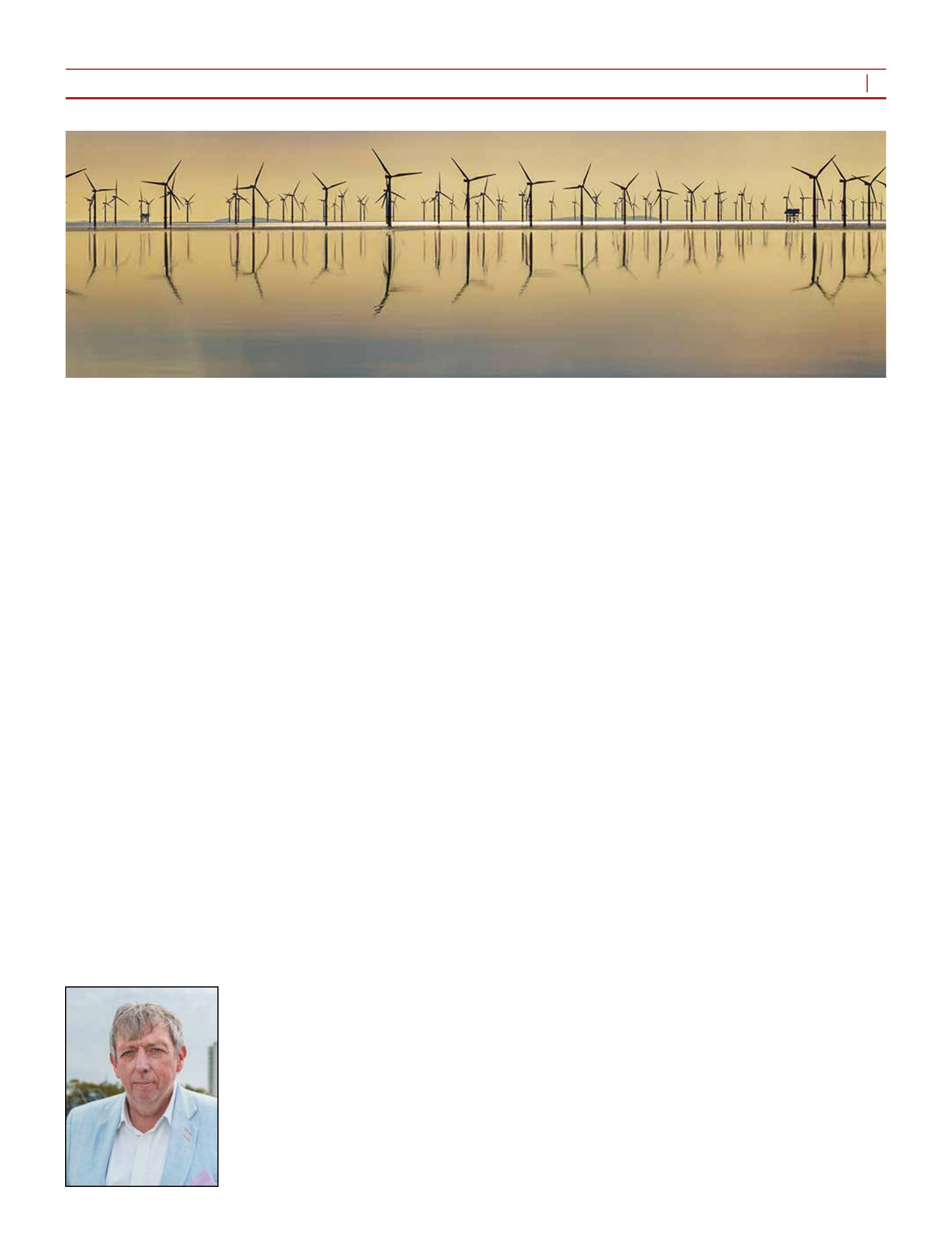
T
he global energy transition has
reached a point where success
can no longer be measured by
how much renewable energy we can
build, but instead by how effectively
we can use it. The strong momentum
behind offshore wind this year has
been telling, with recent auction
rounds delivering record capacity,
competitive pricing, and renewed
condence in the role of renewables
in powering future economies.
On paper, this looks like a major
step forward, but there is a critical
gap that still needs to be addressed.
Generating clean electricity is only
half the equation; what matters just
as much is whether that energy can
be stored and used when people ac-
tually need it.
Without effective storage, a large
portion of the wind power that will
be generated by new projects risks
being wasted, just as existing gener-
ation is too often wasted. As power
systems become more reliant on re-
newables, long duration energy stor-
age (LDES) is fast emerging as the
key solution to reduce wind curtail-
ment, stabilise grids, and ensure that
clean energy delivers its full value.
In many markets today, wind farms
can produce large volumes of clean
electricity. But if this happens when
demand is low and the grid cannot
absorb the excess power, turbines are
slowed down or switched off, often
due to transmission constraints or
oversupply. This curtailment process
means that clean, low-cost energy is
simply not used. In some cases, op-
erators are even compensated for the
electricity they could have generated
but did not.
A 2025 report by Beyond Fossil
Fuels and Ember found that €7.2 bil-
lion in renewable generation was lost
across just seven European countries
in 2024 due to grid constraints. Cur-
tailment in Spain rose from 0.8 per
cent in 2024 to 11 per cent by mid-
2025 while more than 1100 GWh of
clean energy was discarded in July
2025 alone.
Germany saw a 97 per cent surge
in solar curtailment in 2024, with
compensation costs for curtailed re-
newables reaching €554 million for
the year. In March 2025, Greece re-
corded 200 GWh of curtailment in a
single month, equivalent to a quarter
of its total 2024 volume.
In the UK, where over 40 per cent
of power comes from renewables,
about 7 TWh of electricity, just over
2.5 per cent of national consump-
tion, are currently curtailed each
year. As renewable capacity ex-
pands ve to eight times by 2030,
this gure could increase sharply
without intervention.
The economic consequences are
not limited to wasted energy. Curtail-
ment creates a situation where con-
sumers pay twice: once to build and
operate renewable assets, and again
to compensate them for not produc-
ing. It also perpetuates reliance on
fossil fuel generation, which must
remain on standby to provide power
when renewables cannot deliver.
LDES offers a way to resolve cur-
tailment by storing excess wind gen-
eration during periods of oversupply
and allowing that energy to be used
later, rather than wasted. These tech-
nologies can store electricity for ex-
tended periods, typically beyond six
to eight hours, and in some cases for
days or even weeks. LDES will
work alongside short duration ener-
gy storage – batteries – as part of a
tailored, multi-technology solution
to enhance system eibility. The
difference is that LDES is built to
store large volumes of power across
time. It captures excess electricity
when supply exceeds demand and
releases it later, when the grid needs
it most.
This directly reduces curtailment
and improves the utilisation of exist-
ing renewable assets. Instead of re-
newables being intermittent contrib-
utors, they become part of a more
stable and dispatchable energy mix.
That is why policy frameworks
are now beginning to prioritise stor-
age technologies that provide both
storage and eibility. The UK gov-
ernment has introduced a cap and
oor mechanism specically to sup-
port investment in LDES. The mod-
el provides a guaranteed minimum
revenue level to developers, reduc-
ing nancial risk, while also cap-
ping excessive returns to protect
consumers.
According to the National Energy
System Operator (NESO), achieving
a balanced and resilient power sys-
tem will require a diverse mix of
storage technologies, ranging from
batteries to pumped hydro and hy-
drogen, supported by wider infra-
structure improvements. As part of
this approach, up to 8 GW of LDES,
capable of operating beyond eight
hours, is targeted for deployment by
2030.
Analysis suggests that for every
gigawatt of LDES deployed, cur-
tailment costs can be reduced by
approximately €140 million per
year in markets such as Germany.
Tens of billions in system savings
are possible through reduced fuel
consumption, lower infrastructure
requirements, and improved asset
utilisation.
In Scotland, government analysis
demonstrates that 20 GW of LDES
capacity by 2050 could save £24 bil-
lion between 2030 and 200 by re-
ducing gas reliance. To achieve this,
LDES capacity must increase from
just 1.8 GW today to 4-6 GW by
2030.
owever, to deliver grid eibility,
we need technology solutions that
are fully locatable and adaptable,
able to operate in areas of high con-
gestion and close to where demand
is strongest. They must also be mod-
ular, so they can be designed to meet
the specic needs of each location
rather than relying on a one-size-ts-
all approach. As power systems
evolve, this level of eibility is no
longer optional; it is essential.
These solutions must also support
low-carbon systems. It is not enough
to generate renewable energy – we
must also store and manage it in a
way that supports a cleaner system
overall. LDES is becoming an im-
portant part of this shift, helping to
balance supply and demand over
longer periods.
Liquid air energy storage (LAES)
is one example of how these require-
ments can be met. As a form of
LDES, it can store electricity for
hours, days or longer, allowing ex-
cess energy to be captured when
supply is high and used later when
demand increases. This is particular-
ly important in systems with a grow-
ing share of wind and solar power,
where generation does not always
match consumption.
The technology works using pro-
cesses that are already well estab-
lished in industry. It draws in ambi-
ent air, compresses it, and then cools
it to a very low temperature, typical-
ly between -160°C and -196°C, until
it becomes a liquid. This liquid air is
stored in an insulated tank.
When electricity is required, the
liquid air is heated. As it warms, it
expands rapidly, by up to 700 times
its original volume, and this expan-
sion is used to drive a turbine and
generate power. The system captures
and reuses both heat and cold within
the process, improving efciency
and reducing energy losses.
A key advantage of this approach
is its eibility. LE systems do
not depend on specic geographical
features and can be deployed in a
wide range of locations, including
near cities, industrial areas or renew-
able energy sites. Their modular de-
sign allows them to be scaled ac-
cording to system requirements,
making them suitable for both large
and smaller applications.
In addition to storing energy, these
systems can also support grid stabili-
ty. Power networks require services
such as frequency control, voltage
support and inertia to operate reli-
ably. Traditionally, these have been
provided through large synchronous
generators in fossil fuel power
plants, but as they phase out, renew-
able generation does not contribute
the physical inertia needed. This is
where LAES comes in.
A leading example is Highview’s
LAES facility at Carrington near
Manchester, currently being built. As
well as delivering 300 h of stor-
age and an output of 50 MW for six
hours, the plant will also feature an
integrated “stability island”.
This asset can operate inde-
pendently of the storage elements
and provides critical services such
as inertia, short circuit level and dy-
namic voltage control without need-
ing to use any of its energy re-
serves. This allows it to compete
across multiple National Energy
System Operator (NESO) products
without reducing performance
across other functions – and can
even deliver active power. The
same principle will be applied at its
Hunterston project in Scotland, but
on a larger scale.
The market for LDES, including
LAES, represents a $4 trillion in-
vestment opportunity globally, ac-
cording to the Long Duration Ener-
gy Storage Council, which says it
requires a 50-fold scale-up by 2040.
LDES, working alongside short-
duration batteries that provide
fast-response eibility, is no lon-
ger a future option but a critical re-
quirement for modern power sys-
tems. Without it, the full value of
renewables like offshore wind will
remain constrained by curtailment,
grid instability and continued de-
pendence on fossil fuels to deliver
backup power to the grid.
The countries that move fastest to
deploy scalable LDES technologies
will not only deliver energy security
and lower system costs but also gain
a decisive competitive advantage in
the global clean energy race.
With the right policy support and
sustained investment, technologies
such as LAES can transform renew-
able power from an intermittent re-
source into a dependable foundation
for industrial growth, economic re-
silience and net-zero energy systems.
Gary Preece is Chief Market Devel-
opment Ofcer at Highview.
Without effective storage, a large portion of the wind power that will be generated risks being wasted. Long duration
energy storage is fast emerging as the key solution to reduce wind curtailment, stabilise grids, and ensure that clean
energy delivers its full value. Highview’s Gary Preece explains.
Offshore wind’s big breakthrough
Offshore wind’s big breakthrough
depends on long-duration storage
depends on long-duration storage
THE ENERGY INDUSTRY TIMES - JUNE 2026
15
Technology Review
Preece: generating clean energy
is only half the equation
photo:pexels.com
THE ENERGY INDUSTRY TIMES - JUNE 2026
16
Final Word
A
merican educator and author
Stephen Covey once said
“trust is the glue of life…”. It
is a quote not wasted on Fatih Birol,
Executive Director of the Internation-
al Energy Agency (IEA). At the end of
May the IEA launched its 11th ‘World
Energy Investment’ report, one which
Birol called “perhaps the most import-
ant up to now” due to the Middle East
crisis.
According to Birol, the crisis, which
has resulted in the effective closure of
the Strait of Hormuz, is “the largest
energy security threat in history –
bigger than the oil crises of 1973 and
1979, and the 2022 natural gas crisis
in Europe and beyond, put together”.
While ‘what if the Strait of Hormuz
is closed?’ has long been a theoretical
question, the issue is now real. The
closure of this critical transit route –
where as much as 20 per cent of the
world’s oil and gas shipments pass
through – has had, and will continue
to have, wide-ranging impacts for the
energy sector.
Energy security is now priority
number one, two and three for many
countries and industry players, driving
governments to reshape their invest-
ment decisions. The WEI report pro-
vides numbers on expected spend for
the sector this year at this critical time,
as well as knowledge and information
on how budgets compare with the last
ten years.
According to the IEA, global energy
investment will reach $3.4 trillion in
2026, a slight increase year-on-year.
While this top line number is import-
ant, the breakdown is of more signi-
cance. Around $2.2 trillion is expected
to go to grids, storage, low-emissions
fuels, nuclear, renewables, efciency
and electrication in 2026, while
around $1.2 trillion is set to be invest-
ed in oil, natural gas and coal.
“The breakdown provides vital in-
formation for governments and indus-
try players who have to re-shape their
energy investment decisions and
strategies based on the right data and
information,” said Birol.
The IEA chief shared four key areas
that will frame the debate triggered by
the US-Israeli war against Iran.
The rst is energy diversication.
Birol called it his “number one golden
rule”. Avoiding over-reliance on a
single country, trade route or technol-
ogy makes perfect sense and many
countries – both consumers and ex-
porters – have logically taken steps in
this direction.
“The UAE for example, is fast-track-
ing a pipeline to bring energy, not
through Hormuz, but through Fujairah
on the other side of the country,” said
Birol. “For the consuming countries,
a recent example is an agreement
signed by India to store UAE stocks.”
He said the second trend will see
countries shifting to domestic energy
sources where possible. This is partic-
ularly important in Asia, which imports
80-90 per cent of its Middle East oil
and gas through the Strait of Hormuz.
This, says Birol, will strengthen mo-
mentum for renewables, not only in
Asia but globally. Notably, the report
also shows that solar deployments
continues at pace, with global solar
investments hitting $1 billion/day.
The Strait’s closure will also increase
the call for nuclear and in some
countries, coal. Birol noted that it is
too early to say what the net effect will
be on emissions because of the Middle
East crisis.
The IE report nds reduced spend-
ing on coal across all scenarios but
warns this conclusion may also require
careful review in light of today’s crisis.
As coal is the most carbon-intensive
of all the fuels, there are pressing en-
vironmental reasons to reduce its use.
But as it is also relatively abundant in
many Asian countries that are being
hit hard by the current disruption, it
might also be considered an energy
security asset. According to the IEA,
coal investments this year may be the
highest for the last 15 years, driven by
Asia.
While energy resources vary from
country, Birol noted that the “one re-
source that all countries have, is ener-
gy efciency” and urged countries to
make the most of this potential. “We
believe energy efciency measures
will be deployed in many countries in
order to make energy more secure and
affordable,” he said.
urther electrication is the third
strategy the IEA predicts governments
will adopt going forward. “Electricity
will make even stronger inroads into
the energy mix in response to this
crisis. The IEA has already highlight-
ed that the ‘Age of Electricity’ is
coming,” said Birol.
This was evidenced by the an-
nouncement of a major electrication
strategy for France. French President
Emmanuel Macron said last month
that thousands of companies would be
involved in the country’s effort to
double the share of domestically
produced electricity in its energy mix
to 60 per cent by 2030.
ust 0 years ago, in the rst EI
report, the share of electricity in
global energy investment was less than
40 per cent. According to the IEA, that
share is now more than 60 per cent.
This has been driven by electric mo-
bility and more recently by data centre
growth, especially in countries like the
U, where gas and coal red plant
investment is set to overtake China for
the rst time in decades as the country
reacts to data centre demand.
IEA Chief Energy Economist, Tim
Gould, who led the report, added:
“Electricity has always been a big part
of the energy investment picture… but
since 2015, spending on electricity has
been growing faster than other parts
of the global economy… fast forward
to our expectations for 2026, the share
of electricity investment [in the energy
mix] rises to around 70 per cent. In
China, it’s 75 per cent.
In terms of spend on coal and gas
red plant, he said: “hile China has
traditionally been out in front, largely
because of investments in coal, there
has been a sharp increase in the US,
primarily for gas red plants.”
He also noted that global spending
on grids is expected to reach $500
billion in 2026 – up nearly 20 per cent
year-on-year. Spending on battery
storage projects for the power sector
is forecast to be “well above” $100
billion/year.
The fourth trend the IEA predicts is
that in terms of investment, there will
be greater focus on energy security. In
some cases, it says, this will mean
substantial additional investment and
additional cost. With high energy
prices driving ination and conse-
uently interest rates, nancing proj-
ects will become more challenging it
says.
But perhaps in some ways the most
important area of all, is trust. As the
price of commodities continue to rise,
we are seeing scarcity of some com-
modities in certain parts of the world.
But as Birol stresses, there is one
commodity that is the most scarce in
today’s energy world. That is trust.
“In the coming months and years we
will hear [about] trusted partners in
energy trade – imports or even exports.
When countries make long term ener-
gy contracts and trade agreements –
these could be LNG agreements or
building a nuclear power plant – they
will not only look at how much this
energy will cost, what is the technol-
ogy or the quality of the fuel. They will
also ask: ‘Can I trust this partner in the
long term? Can this energy I buy or
technology I develop, be a risk to my
energy security or national security?’”
Trust will certainly be an important
element in the energy world in the
near-term and likely years to come.
Governments will be all too aware
that if the Strait is closed once, it can
be closed again. As Birol puts it, the
closure of Hormuz means the “vase is
broken”. Things will never be as they
were before, at least not for the fore-
seeable future – sometimes memories
can be surprisingly short.
The US-Israel war on Iran has
demonstrated that the world of energy
not only depends on trust, but is much
like trust itself. Infrastructure built up
over years has been damaged in a
heartbeat and will not return any time
soon. As American entrepreneur and
lm producer once said: “Trust takes
years to build, seconds to break, and
forever to repair.”
Events in the Middle East will cer-
tainly leave a lasting impact on the
energy sector.
When trust is broken
Junior Isles
Cartoon by Jem Soar
