THE ENERGY INDUSTRY TIMES - MAY 2026
16
Final Word
A
s the Strait of Hormuz remains
closed, and the war against
Ukraine rumbles on, European
households and businesses continue to
creak under the pressure of astronom-
ical energy prices. In response to the
ongoing energy crisis, the European
Commission recently issued its Accel-
erateEU Communication – one part of
“a toolbox of targeted temporary mea-
sures” to address the recent spikes in
the prices of imported fossil fuels aris-
ing from the war on Iran. Yet striking
the right balance between bringing
short-term relief to its consumers,
while maintaining long term objec-
tives for the bloc, is a tricky one.
According to the Commission, the
Middle East situation has already cost
the EU more than €24 billion, about
€500 million per day, due to continued
dependence on imported fossil fuels.
It is no wonder AccelerateEU stresses
the need to replace fossil fuel imports
with homegrown energy.
But its approach must be careful not
to undermine Europe’s long-term
green transition goals. Pointing to
investments in electrication, energy
efciency and interconnections as
key priorities, EU competition and
climate chief Teresa Ribera, who
previously served as Spain’s Ecolog-
ical Transition Minister, said: “There
are things that we know we need to
do. The earlier we do them, the more
opportunities we build and the lower
costs we may be facing.”
To protect consumers from fossil
fuelled price peaks, AccelerateEU al-
lows member states to introduce
support schemes, energy vouchers and
social leasing schemes and lower ex-
cise duties on electricity for vulnerable
households. For industrial consumers,
the Commission will separately adopt
updated State aid rules, allowing
member states to support the most
exposed economic sectors.
Crucially, the Commission will
present legislative proposals on net-
work charges and taxation this month
(May), so electricity is taxed less than
gas. In addition, the Commission will
present an Electrication Action Plan
by the summer which will include an
electrication target.
AccelerateEU also urges EU mem-
ber states to implement the European
Grids Package, including addressing
grid connection queues – there are 400
GW of wind energy capacity current-
ly waiting for grid connections.
Solving this is possible: the UK has
halved its queues, from 144.5 GW in
2024 to 73.6 GW now.
Finally, AccelerateEU will help
member states make the most of their
EU funding to decarbonise and
electrify. This includes the €219 bil-
lion Recovery and Resilience Facili-
ty, EU cohesion funds as well as a
new €100 billion Industrial Decar-
bonisation Bank auction.
Ribera stressed that support should
focus on structurally lowering energy
bills, for example by expanding solar
panels, heat pumps and better insula-
tion, rather than relying on emergency
measures that risk distorting market
signals needed for the green transition.
She also warned against market
fragmentation. “We can build on a
common menu of solutions that help
the long-term transformation that we
need so that member states can
choose.”
Eurelectric, the organisation repre-
senting Europe’s electricity sector,
also warned that striking a balance
between short-term xes and long-
term goals will be crucial. In a state-
ment, it said Europe needs to provide
immediate relief to consumers and
industry but at the same time, it needs
to attract investment in clean energy,
grids and exibility if it wants to avoid
future crises.
It said “pushing electrication is the
only way out of the fossil fuel depen-
dency” but stressed that not all of the
Commission’s proposed measures
achieve the objectives of reducing
energy costs and short-term price
volatility, while preserving long-term
investment signals.
It noted that past interventions such
as gas price caps or broad subsidies,
including those implemented in Iberia
in 2022, have shown they can be dis-
tortive to the internal market and de-
liver limited benets to consumers.
Looking across the different compo-
nents of electricity bills, Eurelectric
identies several targeted measures
that can lower costs quickly without
undermining market functioning.
Taxes and levies is the rst area. It
says member states can lower VAT in
electricity, shift scal burdens onto
fossil fuels to incentivise electrica-
tion or exempt vulnerable consumers.
Removing non-energy-related levies
and cross-subsidies would also have a
direct impact.
Network tariffs, it says, should also
be targeted. Here, regulators can in-
centivise consumers to optimise ca-
pacity use and shift demand away from
peak periods.
Carbon costs could also offer imme-
diate support. The European Commis-
sion’s proposed €30 billion ETS
(Emissions Trading Scheme) Invest-
ment Booster (funded by 400 million
EU allowances) could support indus-
trial consumers. A targeted adjustment
of the Market Stability Reserve and
related parameters would help indus-
try while preserving the ETS as a
credible investment signal. More ef-
cient use of ETS revenues (over €43
billion raised last year alone) is also
critical to accelerate decarbonisation
and industrial transformation.
Directly targeting energy costs also
offers short-term ease. State aid tools,
such as the industrial price support
proposed in the Clean Industrial State
Aid Framework (CISAF), alongside
unlocking demand-side exibility, can
bring targeted relief, says Eurelectric.
Beyond these immediate xes, the
organisation says structural solutions
include: scaling up electrication, in-
cluding institutionalising the Industri-
al Decarbonisation Bank pilot auction
with a stronger, dedicated budget;
expanding long-term contracts such as
Power Purchase Agreements (PPAs)
and Contracts for Difference (CfDs)
to stabilise retail prices; and acceler-
ating the deployment of clean,
homegrown electricity generation,
exibility and storage to reduce Eu-
rope’s exposure to fossil fuel price
volatility.
The “homegrown” energy” element
is one that continues to chime strong
under current geopolitical tensions.
Renewables and energy storage pro-
ponents voiced strong support for this
element of the AccelerateEU plan,
especially as war again demonstrates
the fragility of a fossil-dependent
system.
WindEurope said that “with Accel-
erateEU, the Commission is crystal
clear”: any energy price relief mea-
sures must be underpinned by a faster
transition to homegrown renewables
and a more electried economy.
“It’s wake-up call for member states
to nally implement EU permitting
rules. And it specically highlights the
role repowering old wind farms can
play in boosting renewable power
supply,” said the organisation.
“Electrication is a strategic imper-
ative for Europe’s independence, se-
curity, and prosperity. It needs to
happen immediately and at scale. We
must make homegrown electricity the
cheapest option,” said Tinne van der
Straeten, WindEurope CEO. “This
means cutting VAT and taxes on heat
pumps, electric vehicles and other
electrication technologies. It means
addressing the low hanging fruit in
low- and medium temperature heat
processes. AccelerateEU is bold polit-
ical leadership in a time of crisis.”
Philippe Dumas, Secretary General
of EGEC, stated: “The Commission’s
focus on homegrown energy correctly
shines a spotlight on geothermal. It
provides the right attention to massive-
ly deploy geothermal in Europe. Now
it must quickly publish the Geother-
mal Action Plan to fast-track invest-
ments and reduce uncertainty, and save
families, businesses, industries and
farmers from the energy crisis.”
Meanwhile, Energy Storage Europe,
said it is key that energy storage is
being recognised not only as a decar-
bonisation enabler but as a strategic
competitiveness asset in the EU policy
framework.
“The recognition that energy storage
is no longer a side topic to renewables,
but a strategic infrastructure is a far
more powerful investment signal than
a narrow renewables policy,” it said in
a statement.
While the EU has a careful path to
tread in the coming months, that
pathway is clear – and there is no
going back. The drive for homegrown
energy is likely here to stay and it must
be clean.
Fatih Birol, Executive Director of
the International Energy Agency
(IEA), best summed it up in an inter-
view with the Guardian newspaper.
He said a key effect of the US-Israel
war on Iran was that countries would
lose trust in fossil fuels and demand
for them would reduce.
“Their perception of risk and reli-
ability will change. Governments will
review their energy strategies. There
will be a signicant boost to renew-
ables and nuclear power and a further
shift towards a more electried fu-
ture,” he said. “And this will cut into
the main markets for oil.”
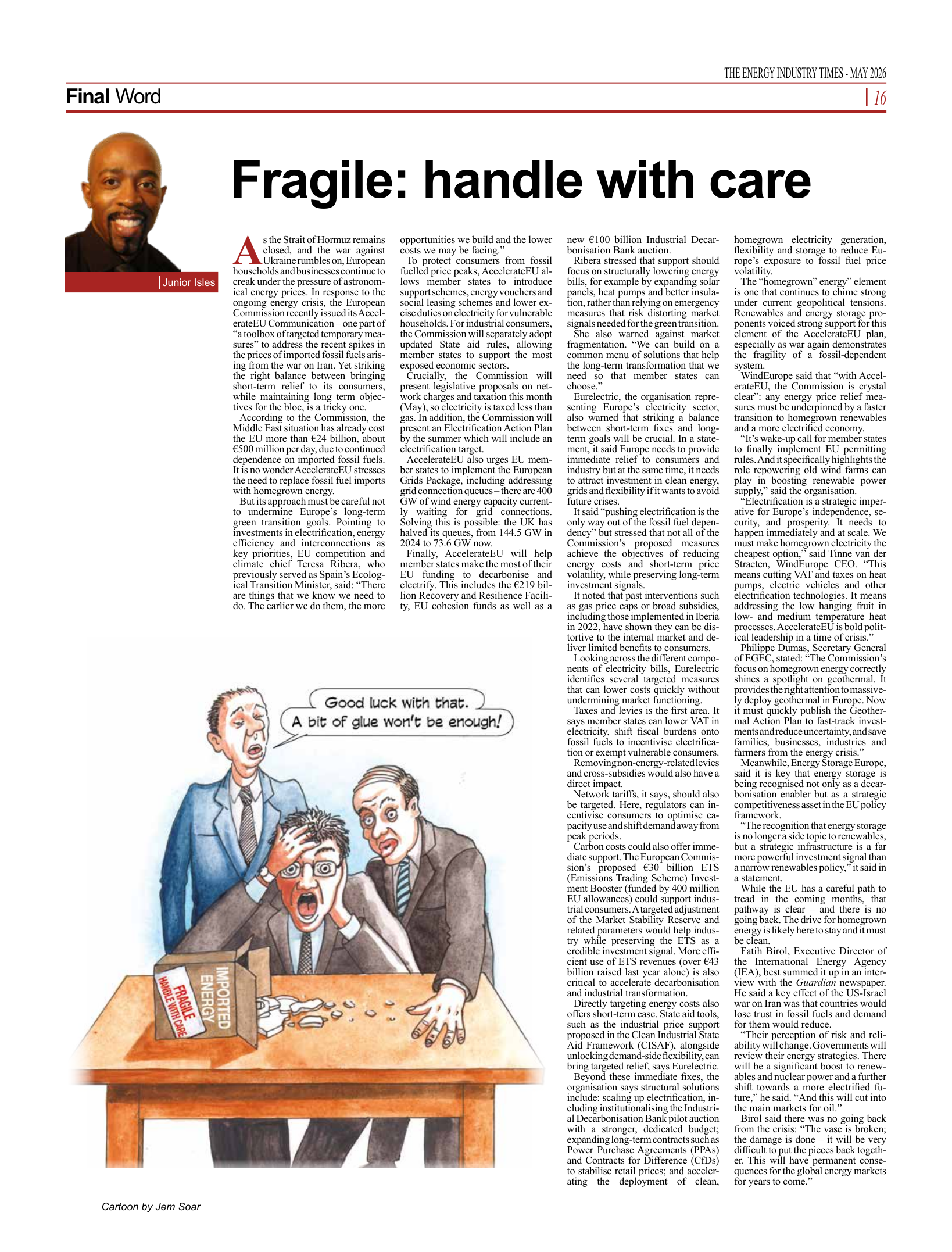
Birol said there was no going back
from the crisis: “The vase is broken;
the damage is done – it will be very
difcult to put the pieces back togeth-
er. This will have permanent conse-
quences for the global energy markets
for years to come.”
Fragile: handle with care
Junior Isles
Cartoon by Jem Soar
