their needs and tailor a solution to
them,” he said.
Such tailored solutions essentially
mean developing plant control sys-
tems capable of handling the tasks
needed to run an asset that must be
reliable and available. These tasks
can be divided into two areas – the
operational tasks and maintenance
tasks. To run the plant, the operator
has to ensure that all the maintenance
tasks have been carried out – this
covers both preventative maintenance
and monitoring.
“There are a lot of things involved
in the operations aspect,” said Abbasi.
“They include maintaining all the
EHS [environment, health and safety]
requirements, and all the ISO stan-
dards that need to be met in the vari-
ous locations – and each location has
its own regulatory requirements.
Emissions have to be monitored and
reported proactively.”
On top of this, he noted that as per-
sonnel change, staff need continuous
development. “The plant operation is
really the backbone of the plant.
Without this central role, things will
not run. It’s a very unique role and it’s
not easy to nd ualied people. f-
ten, they work beyond retirement be-
cause there is such a demand for
them. And we often seek advice from
them because of the need for their
experience.”
These are the challenges that Sie-
mens Energy is trying to help its cus-
tomers with by developing systems
that are automated and ultimately
autonomous.
Typically, in the past a gas red
combined cycle gas turbine (CCGT)
would be run by around 35-40 people,
varying slightly according to whether
it is owned by an independent power
producer or government utility. But
plant in this way are one element, the
demand for people with the right
skills to work in these plants is “caus-
ing all sorts of challenges”.
Abbasi explained: “For example,
our capacity is limited and we are in-
creasing that capacity. So, we will
look for people and resources to work
in our factories. But we are competing
with the power plants, since they need
similar skilled people. So, there’s a
skills gap in terms of capability.”
At plant manager level the chal-
lenge is even greater, where special-
ist knowledge and experience are
needed.
“The plant manager is like the cap-
tain of the ship – they need to know
all the regulatory requirements, how
to operate the plant, not only for the
year but over the next few years. So,
they need to have integral knowledge
of the plant but also need to know
what is happening in the energy
landscape so the plant can be readied
for the type of operation that is re-
quired in the future.”
Balancing the need for skilled staff,
and whether those staff are even
needed, against the cost pressures that
come with operating a plant initially
designed to run 24/7 but now operates
only when required, is a tricky task.
Although striking the right balance
depends on the plant owner’s operat-
ing model, Abbasi notes that Siemens
Energy is “in the game to help cus-
tomers nd solutions that meet their
needs”.
“In the past the requirement was for
baseload, efcient plant, so we tai-
lored our solution to that. Now we see
a change in many markets, due to the
energy transition, so our customers’
models are changing. So instead of
being a product provider we are in a
co-creation mode where we discuss
T
he drive towards decarbonisa-
tion has changed the power gen-
eration landscape over the last
decade or so and, with the falling cost
of renewables, will continue to do so
for years to come. Many countries
have set net zero targets and European
countries are among the frontrunners
in the drive to achieve net zero carbon
emissions by 2050.
The shift to clean renewables –
mostly intermittent wind and solar
–has resulted in conventional plant,
originally designed to operate at
baseload, changing their operating
regimes to run for fewer hours. This
in itself has brought signicant
challenges to power plant operators.
Waheed Abbasi, SVP Gas Services
EU & Africa at Siemens Energy, com-
mented: “The traditional generation
business – whether it’s coal or gas –
still has a role to play in supporting
the transition to renewables. And with
gas being cleaner than coal, there has
been a demand for faster [starting and
ramping] power plants. Not necessar-
ily for baseload, but for maintaining
grid stability and providing peaking
capacity when there is no solar or
wind.”
This new type of operating regime
can shorten equipment lifespan and
therefore increase operation and
maintenance (O&M) costs. But in the
changing energy system, there is
greater competitive pressure, which
in turn creates a need to optimise.
“You have to optimise your opera-
tions and how you do things,” said
Abbasi. “This puts pressure on costs
as well as how you respond to market
requirements.” Using a peaking plant
as an example, he said: “You may not
need to run the plant for one or two
weeks. But that doesn’t mean the
plant does not need to be maintained.
The dispatcher will call for power,
and you may have around 30 minutes
to have the plant up and running. So,
it has to be always ready.
“But the question is: if you have a
fully staffed plant, how do you pay
for all the people and things you
need to do for a normal [baseload]
plant when you are rarely running
the plant? This is the dilemma a plant
owner or operator has to think about.
It is about how to maximise your
asset utilisation while ensuring reli-
able, safe compliance and immediate
availability.”
Although the resulting increased
costs of running a gas red
Special Interview
THE ENERGY INDUSTRY TIMES - APRIL 2026
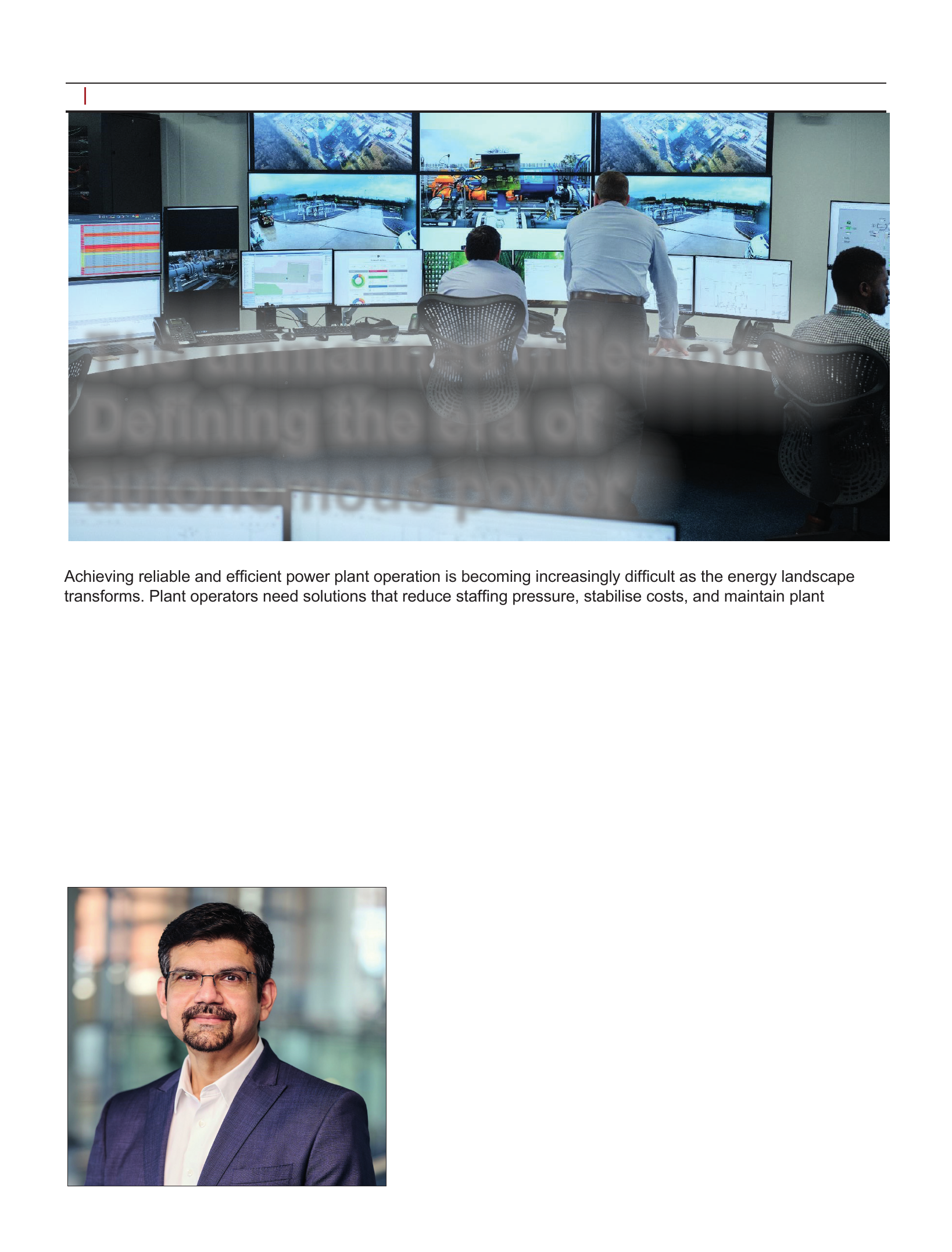
chievin reliale and ecient ower lant oeration is ecomin increasinl diclt as the ener landscae
transorms lant oerators need soltions that redce stan ressre stailise costs and maintain lant
readiness nder all oeratin models r aheed asi enior ice resident o as ervices roe rica
at iemens ner elains how the coman is sortin the shit rom conventional onsite oeration and
maintenance towards remotel manaed and ltimatel atonomos lant oerations Junior Isles
11
The unmanned milestone:
ia
autonomous power
Abbasi: It is about how to
maximise asset utilisation
isiiasa
compliance and immediate
availability
Aisasaiisacssisa
icisi-ai
far more informed and comprehensive
than a human can make.”
Siemens Energy’s cooperation with
Drax Group over the years is a good
example of how far control systems
have come. Siemens Energy had long
term service agreements (LTSAs)
with Drax, covering turbines at three
UK open-cycle power plants –
Hirwaun, Progress and Millbrook.
When Drax decided the units would
be used for peaking operation, it is-
sued an open tender for each plant’s
operation and maintenance.
Building on the existing service
agreement and drawing on its broad
power plant equipment and plant
control expertise, Siemens Energy
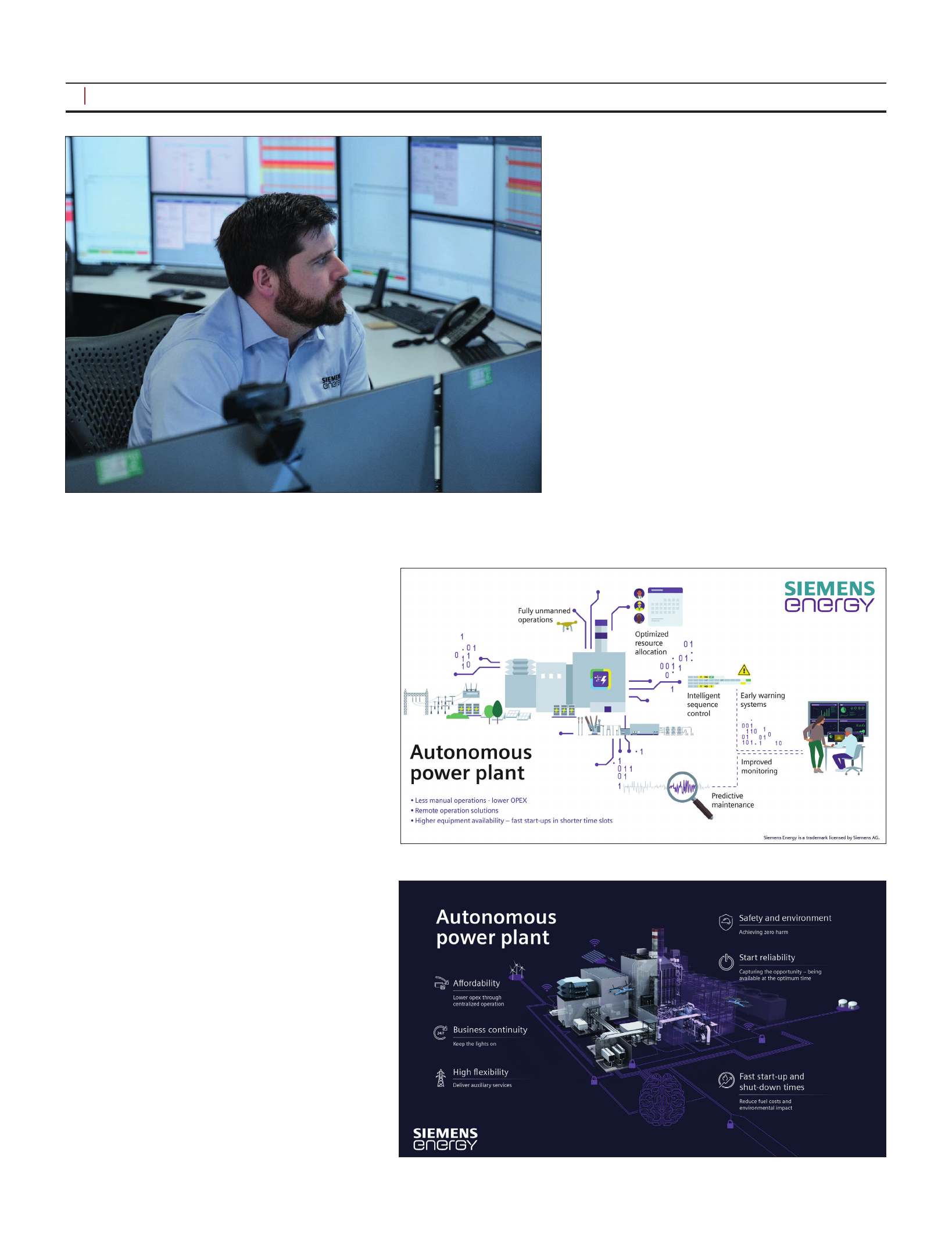
came up with the concept of remotely
operating the three plants from its
Remote Operational and Control
Center in Newcastle.
“I believe it was this concept that
helped us win the tender,” said Ab-
basi. “We then developed the solution
with them, with the goal of making
the plants reliable and available so
they can dispatch when needed.”
The remote operating centre will
control three SGT4000F gas turbines
and grid technology equipment,
managing large amounts of data from
disparate systems to enable compli-
cated decision-making in both opera-
tions and market participation.
This type of remote operation is es-
pecially welcomed by independent
power producers (IPPs) looking for
new models that allow them to opti-
mise their operations.
Abbasi explained: “The historical
baseload models no longer work, so
they come to us to help create a solu-
tion that meets their requirements for
the grid. The tender could be for a
peaker that has to make a specied
number of starts at short notice for a
certain period of time, and they get
paid for doing this. But those pay-
ments are not the same for being
baseloaded, so they have to optimise.”
With the need to be commercially
successful, one clear goal is to reduce
the number of operating staff – with
the ‘holy grail’ being a plant that can
operate autonomously. According to
Abbasi, there are a few critical chal-
lenges on the road to this goal.
“Safety is super-critical,” he said.
“Everything starts with securing the
safety of people, and secondly the
safety of equipment. This is funda-
mental. You can also argue that safety
includes cybersecurity because people
will try to hack the system to destroy
it. Then it’s about what you deliver,
i.e. availability and reliability.
“Another aspect might be opera-
tional excellence – how you run it.
You d on’t wa nt t o e xcee d e missio ns
or operate the machine in a way that
results in extraordinary maintenance,
because that adds to the cost. And you
want to look into the future to see the
preventative things you can do to fend
off potential problems. The control
system of the future has to do all of
this.”
uch a system is the rst level of
autonomy, whereby it can look at all
the data coming from sensors to
make the decisions that would nor-
mally be made by maintenance staff
and operators.
“The system would tell you that you
generally, the move is towards greater
optimisation of resources.
Giving an example, Abbasi said: “A
traditional control system of the past
was not like it is today. Now you have
articial intelligence (I tools and
all the incoming information that al-
lows you to react faster and plan a lot
of things in advance. Today you have
more knowhow and knowledge of
your machine. So, less people are re-
quired to monitor it, and this is what
we are driving towards – where the
system can autonomously take care of
things for you.”
Such systems are evolving but full
autonomy is not yet a reality. Abbasi
compared it to self-driving cars: “We
need the technology and we see it in
the future but we’re not there yet. We
are developing it phase-by-phase.
You sta rt s mall – a t e quipme nt l evel
you have automation, then you bring
it to plant level automation.”
A plant, however, is only one of the
pieces connected to the grid, which is
an ecosystem. “It’s like an autono-
mous car on a street that connects all
the cars around it in an ecosystem,”
said Abbasi. “So, it’s about how we
integrate into an ecosystem. That’s
why it’s a journey of automation and
digitalisation. We have solutions at
the equipment level and plant level,
which brings opportunities to opti-
mise, automate and do unmanned
tasks. ut the nal result depends on
how the whole system integrates.”
Control system capabilities have
advanced tremendously over the last
years, as processing power has in-
creased, to allow real-time data analy-
sis and automation. “Today there is
tremendous computing power with
processors that work in nanosec-
onds,” said Abbasi. “So, the evolution
of computing technology has given us
much greater ability to automate.”
Certainly, real-time automation has
changed how systems can be con-
trolled. Combining real-time data
analysis with machine learning and
AI allows control systems to make
adjustments in real-time.
“The technology has given us the
tools to develop AI systems that can
monitor all the data coming from the
sensors – not only from the turbine
but from the plant. For example, you
can look at emissions such as NOx,
vibration data and decide to either
keep a unit running or shut it down in
a controlled manner,” said Abbasi.
He added: “Because an AI system
can handle as many inputs as you can
give it, it can make decisions that are
Special Interview
THE ENERGY INDUSTRY TIMES - APRIL 2026
12
isisisssaaaaaiaas
The Remote Operational and
icas
ica
Group’s power plants
of managing complex load changes in
real-time
n Built-in safety functions that trigger
controlled, protective shutdowns, not
abrupt trips
n Flexible driving modes and reliabil-
ity-enhancing upgrades
n Integrated digital tools, training, and
consulting to help plant teams master
new operating models
According to the company, this is
where its Omnivise T3000 sets the
benchmark. The system was rst in-
troduced decades ago but has evolved
signicantly.
Commenting on the T3000’s capa-
bilities and its development over the
years, Abbasi said: “From my per-
spective, the evolution has been quite
drastic because the backbone is very
reliable. It has multiple layers of cy-
bersecurity built into it; all of the fea-
tures in the control system have been
tested, and they work.
“Now we are looking at how it’s
evolving in terms of its capability
to operate and automate. We are
doing this through test cases with
customers.”
He cited one case where Siemens
Energy was asked to explore how its
control system could improve a
plants efciency, i.e. burn less gas to
deliver the same power output. The
company developed a tailored plant
control system that allowed Dubai
Electricity and Water Authority
(E to signicantly improve ef-
ciency at the Jebel li ower and
Desalination Complex.
Together, Siemens Energy and
DEWA implemented what is claimed
to be the worlds rst I lant Intel-
ligent Controller. The system deliv-
ered signicant results, including a
2.2 per cent improvement in ef-
ciency and fuel savings, in addition
to a reduction of 35 000 tonnes of
carbon emissions per year for each
power block.
Following these exceptional re-
sults, in October last year the two
companies signed a new agreement
to implement the second phase of the
project in M-Station Power Blocks
20 & 30 at the complex.
In another project that moves the
industry even further forward in
terms of what control systems can
ultimately enable, Siemens Energy
undertook a pioneering project in
Germany.
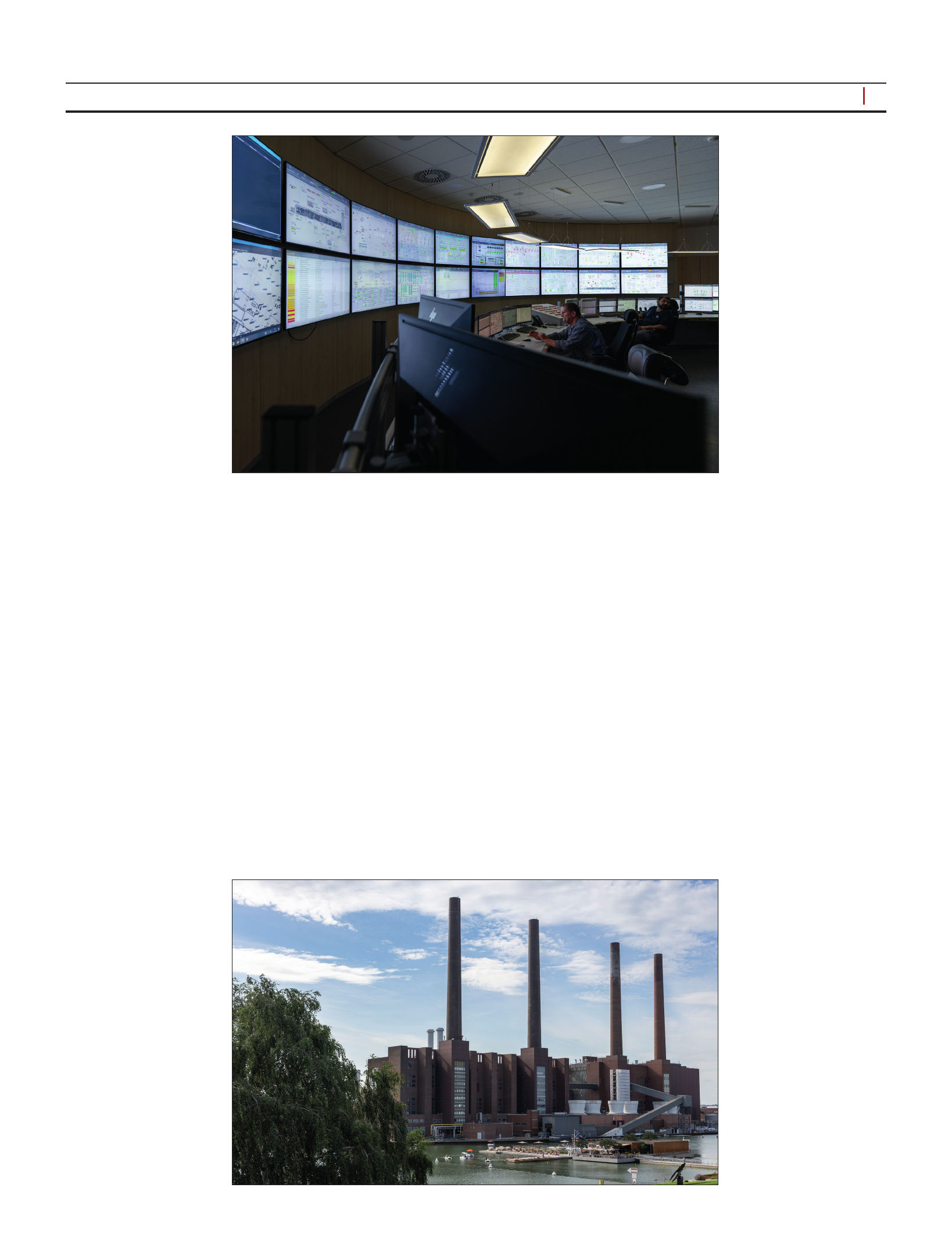
The transformation of Volkswa-
gen’s historic Wolfsburg cogenera-
tion plant, modernised from a coal
red landmark into an advanced gas
red facility, represented another
important milestone in the journey to
autonomous operation. In modernis-
ing the plant, which provides elec-
tricity to VW’s manufacturing facili-
ties as well as to the city of Wolfsburg,
VW wanted to have a plant that
could run unattended for three days.
The challenge saw Siemens Energy
and VW agree on a groundbreaking
initiative known as the 72 hour op-
eration without constant supervision
(BosB72), with the goal of designing
a control system that could run unat-
tended for 72 hours, responding to
remote commands and managing
safe, controlled power plant shut-
downs autonomously.
The modernisation saw Siemens
Energy implement a comprehensive
and innovative solution based on two
SGT-800 gas turbines and the state-
of-the-art control system Omnivise
T3000. This digital control system
was the key to enabling BosB72
functionality.
“Here, we had to deliver a solution
based on certain customer require-
ments dened as os2. This was
all audited by a third party to ensure
that we complied with the require-
ments,” said Abbasi. “Our objective
was to work with the customer to
develop a control mechanism and
system that could run with no human
intervention. It had to have the capa-
bility to see any issues, react to them
and adjust the operation; or shut it
down safely if necessary.
“What made this project exceptional
is not simply that the plant can run
unattended for three days, rather that
it operates on a system able to think,
adapt and respond autonomously.”
To achieve this, the journey began
with an assessment between Volk-
swagen, Siemens Energy and an inde-
pendent inspection authority. Togeth-
er, they conducted indepth analyses
and evaluated logistical site con-
straints to ensure compliance with
every safety regulation.
This validation phase demonstrated
Siemens Energy’s “partner-educator”
approach. “We don’t just deliver a
solution, we help shape it, test it, and
tailor it to real world conditions,” said
the company.
The Omnivise T3000 enabled the
plant to:
n Autonomously respond to remote
load commands for electricity and heat
n Execute controlled shutdowns in
emergencies to prevent damage and
maintain availability
n Free-up staff to focus on critical
maintenance or manage personnel
shortages more effectively.
While the control system has the
Omnivise T3000 at its core, it has
custom-built modules designed for
the plant. These modules, says Sie-
mens Energy, are developed and
“trained” using a mix of data from the
turbines at Wolfsburg, as well as ex-
perience from Siemens Energy’s
wider eet.
“AI is not only leveraging data from
this particular plant; we also have the
know-how from hundreds of opera-
tional units,” said Abbasi.
With the concept proved at Wolfs-
burg, Siemens Energy plans to con-
tinue to develop systems that will
enable its customers to meet the
changing operational demands of the
new energy landscape.
“The integration of renewables into
the grid will require a lot of adjust-
ment in the control systems and how
you operate and manage them. Our
systems will help customers integrate
all their assets, and manage and dis-
patch them. We will be leveraging AI
to help integrate wind, solar and their
other assets and optimise their dis-
patch. This is where the future is go-
ing,” said Abbasi.
He concluded: “I’m super-excited
about the energy transition. Just two
years ago we were projecting energy
demand growth of 65-70 GW per an-
num for our gas business but today we
easily see it hitting triple digits. As a
major OEM, we have a role to play in
this transition, and we want to ensure
we have the solutions our customers
are looking for.”
need to maintain or inspect a piece of
equipment in, say, 1000 hours, to
prevent an event. So when you are
ofine, you can do it anytime when
you have time,” said Abbasi.
He noted that the operational part of
system autonomy is much more
achievable in the near term. Achiev-
ing autonomous maintenance is,
however, further in the future. Much
depends on what the plant owner is
trying to achieve.
“At the end of the day, what is the
vision? It could be that you design
systems that self-maintain. But some
systems cannot be self-maintained,
which means intervention from a hu-
man or a robot. We are already doing
exterior visual inspections using
drones, with a system detecting if
something’s wrong based on visual
feedback. The next decade will be
about how you integrate automation,
which can be robotic.”
As the industry evolves, remote
O&M naturally transitions into un-
manned operations, where digital in-
telligence handles routine decisions
and safeguards the plant. However,
autonomy requires more than soft-
ware, it requires a control system
engineered for safe, independent de-
cision-making.
Siemens Energy’s approach to au-
tonomy has so far seen the develop-
ment of:
n Intelligent control systems capable
THE ENERGY INDUSTRY TIMES - APRIL 2026
Special Interview
13
sa
control system enables the
aa
72 hours
asai
sass
caiaa
caaaiaas
aciiisaia
milestone in the journey to
autonomous operation
