THE ENERGY INDUSTRY TIMES - APRIL 2026
16
Final Word
T
he war launched by the US and
Israel against Iran brings a
sense of déjà vu. One country,
or countries, attacks another, and an
energy crisis ensues – but this time the
ramications are geographically far
more widespread than those that fol-
lowed Russia’s attack on Ukraine.
Energy crises have repeatedly ex-
posed the vulnerability of fossil fuel
dependent energy systems from the
oil shocks of the 1970s to the gas
crisis following Russia’s invasion of
Ukraine and the current conict in the
Middle East.
The war in Iran began pretty much
four years to the day after the still
ongoing Ukraine invasion, but the
world’s energy sector seems no more
prepared. oth renewables and fossil
fuel lobby groups have seied on the
current conicts as pivotal moments
in terms of what should be the imme-
diate response or focus.
The Global Wind Energy Council
(GWEC) last month launched a Wind
Action Plan setting out emergency
policy measures for governments to
accelerate wind energy deployment
and strengthen their energy resilience.
“We need to break the cycle of ener-
gy crises. The unfolding tragedy in the
iddle East and its impact on surging
oil and gas prices is just the latest re-
minder of our vulnerability to volatile
fossil fuels. e simply cant go on like
this, said en ackwell, E of
GWEC. “Economies built around
limitless, homegrown wind and re-
newable energy benet from long-
term, low-cost price certainty.
eanwhile, a new report by ublic
irst, produced in collaboration with
the Royal United Services Institute
(RUSI) and commissioned by Renew-
ableUK, warned that ongoing reliance
on internationally traded gas has left
the U over-exposed to global price
shocks, scal risk and hostile state
activity. The report nds that although
the UK’s energy system is resilient,
this comes with a heavy price tag for
consumers due to unpredictable spikes
in the costs of fossil fuels.
ome politicians, and not only in the
US, also believe the way to energy
independence is to increase domestic
oil and gas extraction. In the U,
where energy prices have been among
the most affected by the conicts in
Ukraine and Iran, the opposition party
has renewed calls for increased drilling
in the North Sea.
ut is this really the most sensible
response, especially when looking for
lasting energy independence
learly fossil fuel independence
cannot come overnight, and there will
be a need for continued investment for
a period. The International as Union
argues that continued investments in
energy infrastructure – including LNG
and a diverse energy supply are
“critically needed to mitigate market
shocks such as the one we are current-
ly experiencing.
The ublic irst report recognises the
ongoing role of the UK’s North Sea
gas production and the role of gas
storage. However, it concludes that
domestic gas alone cannot protect the
U from international price volatility,
because gas prices are set on global
markets regardless of where the gas is
produced.
New analysis from Aurora Energy
Research also shows that as gas mar-
kets have become more international,
prices have become more volatile
month-to-month, even in the absence
of major shocks.
erhaps those looking to orth ea
elds for the answer should take note
of U public sentiment. fter all, the
proof of the pudding is always in the
eating.
In late March, UK-based energy
supplier ctopus said solar and heat
pump sales surged by more than half
as the Iran conict not only hit prices
at the pump but household energy
prices too.
Rebecca Dibb-Simkin, Chief Prod-
uct fcer at ctopus Energy, com-
mented: “We are seeing a massive shift
as people stop just asking and start
acting. ritish families are tired of
being held hostage by global fossil fuel
prices.
For the last several years, Eurelectric,
the organisation representing the
common interests of the European
electricity industry, has advocated
direct electrication using renewables
as the primary, cost-effective pathway
to EU climate neutrality. Although the
main thrust for the need for renewables
might have shifted from climate to
energy security, the electrication
messaging has remained steadfast.
In arch 202, it published its own
Electrication ction lan, identify-
ing the main bottlenecks and laying
out concrete proposals to reignite
progress. This was followed by the
Electrication lliances joint recom-
mendations, putting forward pro-
posed actions across nine categories,
backed by three overarching priorities.
The EU is expected to ofcially
adopt an electrication action plan
this year; the target is to increase
electricitys share of nal energy
consumption to 2 per cent by 200,
up from 2 per cent in 202.
ith the growing global conicts,
the case for electrication is becoming
increasingly clear-cut, and this was
again brought home at last month’s
Eurelectric EVision conference,
which started just days after the rst
strikes on Iran.
Electric vehicles not only play an
important role in global decarbonisa-
tion through the electrication of
transport, but would also protect
government budgets and drivers from
the high fuel prices triggered by the
war. ut in Europe the clean energy
drive has begun to stutter.
uring a high-level political debate
at EVision, Thomas Pellerin-Carlin,
ember of the European arliament,
strongly criticised recent moves by the
EU, pointing out that there has been
a lack of policy coherence in the
bloc.
There has been a lack of policy
coherence in everything the Commis-
sion has been doing – or rather, undo-
ing – over the last 18 months,” he said,
noting that “for decades” non-coherent
energy policies led to sub-optimal
outcomes for the energy sector as a
whole. Realising that it needed to take
a more system-wide approach ad-
dressing sectors such as transport,
heat, industry and electricity – on July
14, 2021, it unveiled the ‘Fit for 55’
Package.
Pellerin-Carlin commented: “On
one single day, you had 20 pieces of
legislation that go from the Energy
Efciency irective to
2
standards
for cars, to carbon pricing, to energy
taxation directive, renewables, and so
on. That’s the way you need to do
policy. ut thats the way the om-
mission has stopped doing policy.
Over the last 18 months, what we’ve
been witnessing is the great unravel-
ling of the Green Deal, with a salami
approach just one slice after another.
He added: “On December 16th the
Automotive Package came in, and the
package is about slowing down elec-
trication. ou can wrap it how you
want but the CO
2
for cars regulation,
as proposed by the ommission, is
worse than the existing law that should
have been implemented under the
202 package.
“A lot of my colleagues think
electrication is happening. Its not.
We are consuming less electricity
now than we did in 2019. And the
new proposal by the ommission
will make electrication worse. o
we are in a situation where we have
two parallel debates: there is the
Eurelectric debate on electricity
grids, and there is the debate on
slowing down electrication and at
the end of the day, if we don’t connect
these, we will be building an electric-
ity grid to nowhere.”
As the world becomes more divided
on the direction of travel, indeed we
seem to be going nowhere. pening
the EVision conference, Eurelectric
Secretary General, Kristian Ruby
summed up the situation best: ow
many wars is it going to take us to
understand that our way to indepen-
dence, to strength, goes by our energy
electric energy
Edwin Starr once sang “War… What
is it good for? Absolutely nothing”.
erhaps there is one thing it may well
prove good for: accelerating electri-
cation and the clean energy transition.
War… What is it good for?
Junior Isles
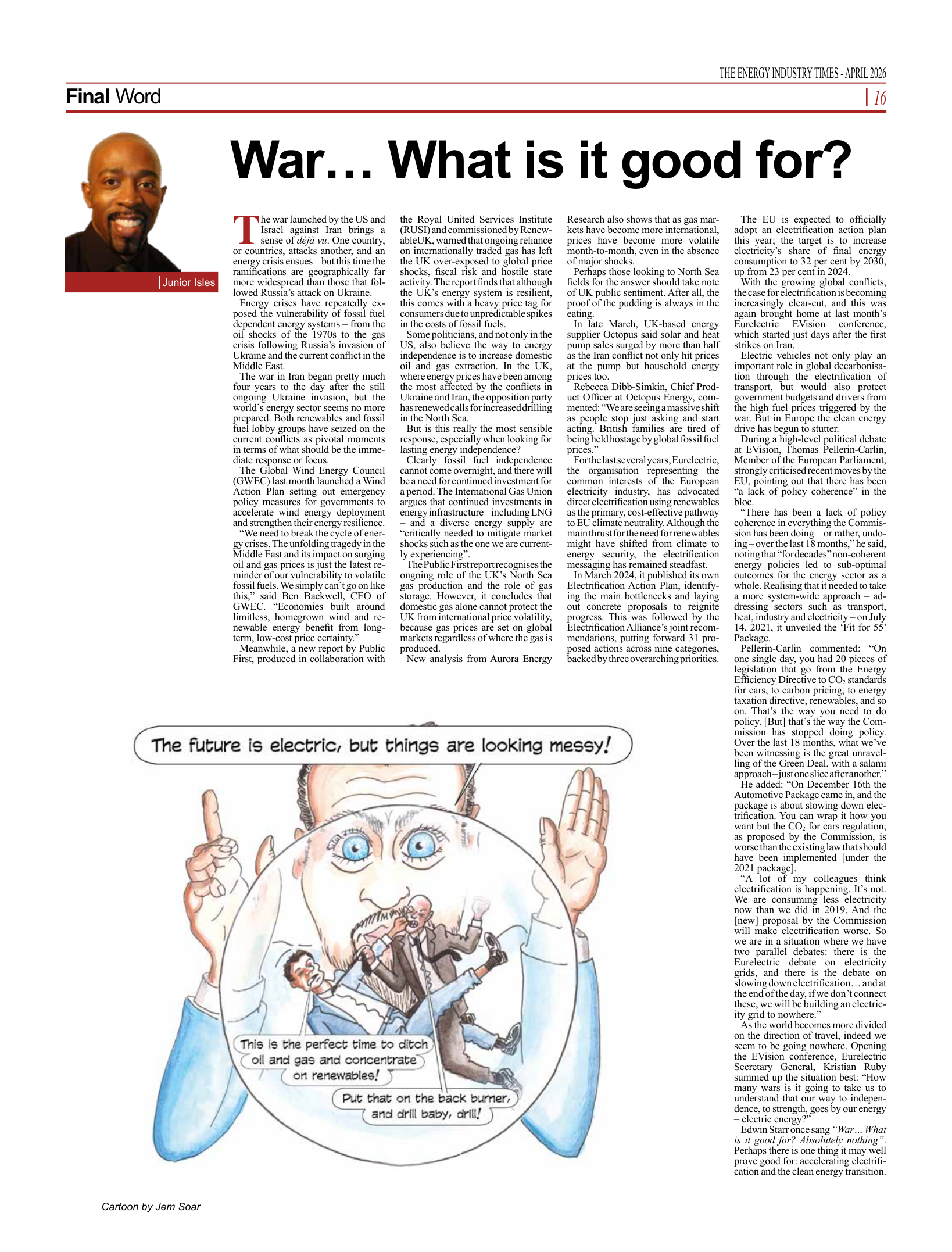
Cartoon by Jem Soar
